
Robotic Rabbits Help Researchers Catch Invasive Pythons in the Florida Everglades
Burmese pythons are a secretive bunch, making them difficult to spot and difficult to coax out into the open — that is, unless you’re a robotic rabbit.
According to the South Florida Water Management District (SFWMD), robotic rabbits are a part of an innovative initiative to remove the Burmese python from the Florida Everglades. Set up in areas across South Florida, the robots mimic the python’s prey, convincing the stealthy snakes to come out of the shadows and allowing snake removal agents to spot them, trap them, and take them away.
“Invasive pythons are one of the most destructive and harmful species in America’s Everglades. Their aggressive predation on native wildlife robs panthers, raptors, bobcats, and other native predators of their primary food sources,” the SFWMD said in a statement in July 2025. “Every python that is removed and eliminated is making a difference to protect the Everglades and South Florida’s diverse and native wildlife.”
Read More: On the Front Lines of Florida’s Fight Against Pythons
The Burmese Python Problem
Though Burmese pythons (Python bivittatus) are a native species in South Asia, they’re invasive in South Florida, where they’ve slithered through the Everglades since the 1970s. Introduced to the ecosystem through the pet trade, the snakes entered the Everglades through accidental or intentional pet releases. Ever since then, the snakes have hunted the native species and threatened the native ecosystems of South Florida, disrupting the natural balance between predators and prey.

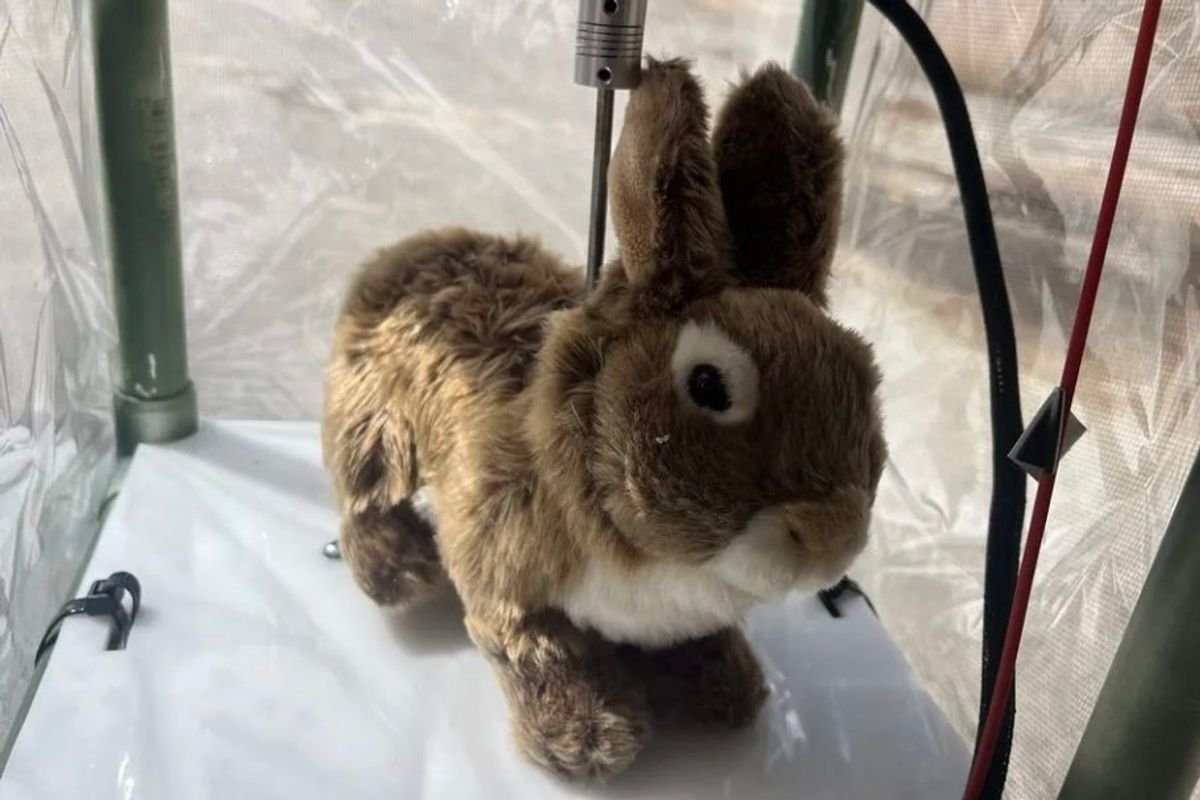
The robotic rabbits were positioned in South Florida to attract pythons for trapping and removal.
(Image Credit: Maggie Jones)
Hunting mammals, reptiles, and birds, the pythons leave little prey behind for native panthers, bobcats, and alligators. And in addition to limiting the available food for these natural predators, the pythons also carry parasites and pathogens, spreading them throughout South Florida’s environments.
Based on these negative impacts, the SFWMD has implemented several programs to control python populations in the Everglades. But the new initiative is particularly pioneering, implementing the robotic rabbits as a means to attract the ambush predators from afar.
Created in collaboration with the University of Florida, the robots themselves are constructed out of stuffed rabbit toys, whose stuffing is removed and replaced with a tangle of motors, wires, heaters, and solar panels. Once put into position, the robots’ movements are compelling enough to convince hungry pythons. They even emit a heat and a smell that mimic those of pythons’ prey.
The robots also contain cameras that capture footage of the pythons as they approach. Whenever a snake is spotted, the robots alert the SFWMD and a python removal agent is sent to the scene, allowing for the successful collection of the snake.
Read More: Stopping the Spread of Invasive Species
Providing Protection for the Everglades
Burmese pythons are a serious threat to the Florida Everglades, though they aren’t the only issue facing the environment there. In fact, the Everglades spanned around 11,000 square miles about a century ago, though they only cover around half of that area today.
Classified as a mishmash of marshes, freshwater and saltwater ponds, prairies, and tree islands, the Everglades have been drained over the years, for agriculture, construction, and flood control. The drainage has harmed the countless species that call its ecosystems home, including several threatened and endangered species, like the Key Largo woodrat (Neotoma floridana smalli), the Florida panther (Puma concolor coryi),and the American crocodile (Crocodylus acutus). While some of these species are eaten by the Burmese python, others eat less thanks to the snake’s activities, meaning that an Everglades without pythons is a healthier Everglades as a whole.
“The State of Florida has taken unprecedented action to protect the Everglades and eliminate invasive pythons from across the landscape,” added the SFWMD in their statement. “The District continues to expedite Everglades restoration efforts, and we will continue working to protect South Florida’s natural resources and combat invasive species like Burmese pythons.”
Read More: 10 Invasive Species You Can (and Should) Eat
Article Sources
Our writers at Discovermagazine.com use peer-reviewed studies and high-quality sources for our articles, and our editors review for scientific accuracy and editorial standards. Review the sources used below for this article: