
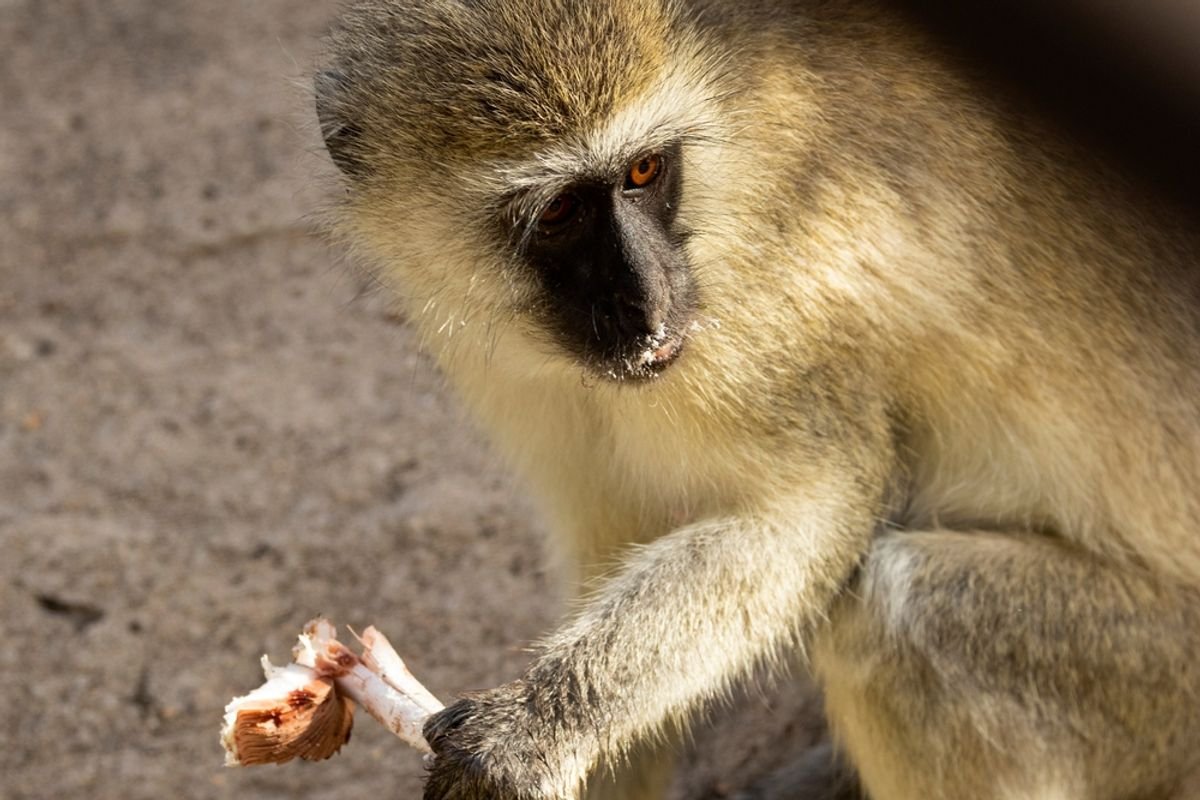
Our Prehistoric Ancestors May Have Snacked on Mushrooms Just Like Some Primates Do Today

Mushrooms can be a divisive food for some people, but our distant primate relatives would have a different opinion on the matter. Non-human primates are known for their love of fruit, leaves, and insects as snacks, but surprisingly, some of them are fungi fans as well.
A new study published in Ecology and Evolution has picked out the mushroom-eating tendencies of three primate species in East Africa: chimpanzees, red-tailed monkeys, and yellow baboons. These primates have been foraging for mushrooms long before it became trendy, which may even indicate that our earliest ancestors also included them in their diets.
How Primates Prefer Their Fungi
Mycophagy, or the consumption of mushrooms, has been described in 105 primate species. In some instances, a species may consume mushrooms as a fallback food, choosing it when preferred foods like fruits aren’t available. Other times, a species’ consumption of mushrooms has nothing to do with the availability of other foods and is just a way to supplement their diets with more nutrients.
The new study aimed to see just how mushrooms are prioritized by chimpanzees, red-tailed monkeys, and yellow baboons living in Tanzania’s Issa Valley.
After observing the primates’ feeding habits, researchers found multiple factors at play that influenced how each species used mushrooms. For red-tailed monkeys and chimpanzees, mushrooms weren’t a top priority; they would generally consume mushrooms when ripe fruit started to become scarce and mushroom density increased.
Baboons, though, appeared to be much more fond of fungi, since they were observed seeking them out even when mushroom availability was low. One potential reason for this, researchers suggest, is that baboons may adapt their diets to avoid competition with chimpanzees when there isn’t enough fruit to go around for everyone.
Read More: After Thousands of Years, Humans Are Still Finding New Uses For Mushrooms
Coming into Season
Mushrooms are about 90 percent water, so their abundance largely rests on the amount of rainfall in a season. The study found that the peak of mushroom consumption for the three primate species came during the wet season at Issa Valley, from roughly October to April, a period when mushrooms are most abundant.
However, while chimpanzees and red-tailed monkeys mostly used mushrooms as key dietary components in the middle of the wet season (around December to January), baboons continued to eat them for much longer, even when they started to get scarce again around May.
Overall, 11 percent of the baboon feeding observations were on mushrooms, compared to 2 percent for both chimpanzees and red-tailed monkeys.
A Long Legacy of Mushroom Hunting
Since mushrooms provide protein and other micronutrients, they may have been enjoyed by prehistoric hominins similar to the primate species in the study. The researchers say that the Issa Valley, which is a mosaic woodland habitat of forests interspersed with grassland areas, may be like a modern-day version of the environment where our primate ancestors (like Australopithecus and Homo habilis) would’ve spent their days.
However, whether or not these hominins hunted for mushrooms is only speculation. This is because, according to the researchers, mushrooms don’t fossilize well and leave few traces behind. It’s therefore doubtful that scientists will find concrete evidence of hominins eating mushrooms upwards of 2 or more million years ago.
Even though mushroom fossils are rare, some studies have linked them to hominin consumption in more recent times. For example, a 2017 Nature study found that the diet of Neanderthals living in Spain’s El Sidrón cave around 48,000 years ago included edible gray shag mushrooms.
Fast-forwarding a few millennia, ancient humans who lived during the Magdalenian culture of the Upper Paleolithic (around 18,000 to 12,000 years ago) may have consumed bolete mushrooms based on analysis of hardened dental plaque.
Nevertheless, mushrooms can still be found in kitchens worldwide thousands of years later, carrying on a legacy that may have started with primates.
Read More: What Makes Death Cap Mushrooms the Deadliest in the World?
Article Sources
Our writers at Discovermagazine.com use peer-reviewed studies and high-quality sources for our articles, and our editors review for scientific accuracy and editorial standards. Review the sources used below for this article: