
One of the Oldest Organisms on Earth Thrives in Yellowstone’s Scalding Hydrothermal Features

The most dangerous thing in Yellowstone National Park isn’t bears, bison, wolves, or cougars — it’s thousands of hydrothermal features. These beautiful yet deadly features are scattered around the park and are responsible for multiple human injuries and even deaths every year.
One would imagine that nothing could survive these seemingly uninhabitable locations. But there is one organism that calls these hydrothermal features home. Recent coverage from the Yellowstone Volcano Observatory offers a look at these unique beings, known as thermophiles, and discusses how they may hold the key to the future of agriculture and beyond.
“These heat-loving cyanobacteria are far more than Yellowstone curiosities — they are living blueprints of resilience,” said Tanvi Govil, assistant professor in the Department of Chemical and Biological Engineering at South Dakota Mines, in the news release. “By learning from organisms that thrive in extremes, we are opening pathways to technologies that could help build a more sustainable and adaptable future.”
Read More: Yellowstone Hot Springs Create Perfect Environment for Ancient Microbes
Organisms Surviving Extreme Heat
Thermophiles, literally meaning “heat lovers,” are organisms that prefer high-temperature environments and can include archaea, bacteria, or fungi. These organisms can live in temperatures as high as 122 degrees Celsius (about 250 degrees Fahrenheit) thanks to the unique structure of their proteins and lipids. They are also billions of years old, with thermophiles being one of the earliest organisms to evolve on Earth and create the conditions necessary for other life to exist.
Over the years, Yellowstone’s thermophiles have been the focus of study for many researchers. Their unique structures can be used to learn more about how organisms survive in extreme environments and how we might be able to replicate these processes for humans.
In 1966, the discovery of a particular Yellowstone thermophile — Thermus aquaticus — led to the development of the Polymerase Chain Reaction (PCR) technique. PCR testing was a revolutionary discovery that led to a Nobel Prize in chemistry and is still used today in medicine, genome mapping, and forensic science. It also may sound familiar to you, as PCR tests became a household product after the rise of viruses like COVID-19.
Recent Research on Thermophiles
Today, thermophiles are being studied in the context of sustainability. Cyanobacteria, a type of thermophile, use photosynthesis to convert atmospheric carbon dioxide and nitrogen gases. Once converted, these elements can be harnessed and used as a sustainable alternative to fossil fuels.
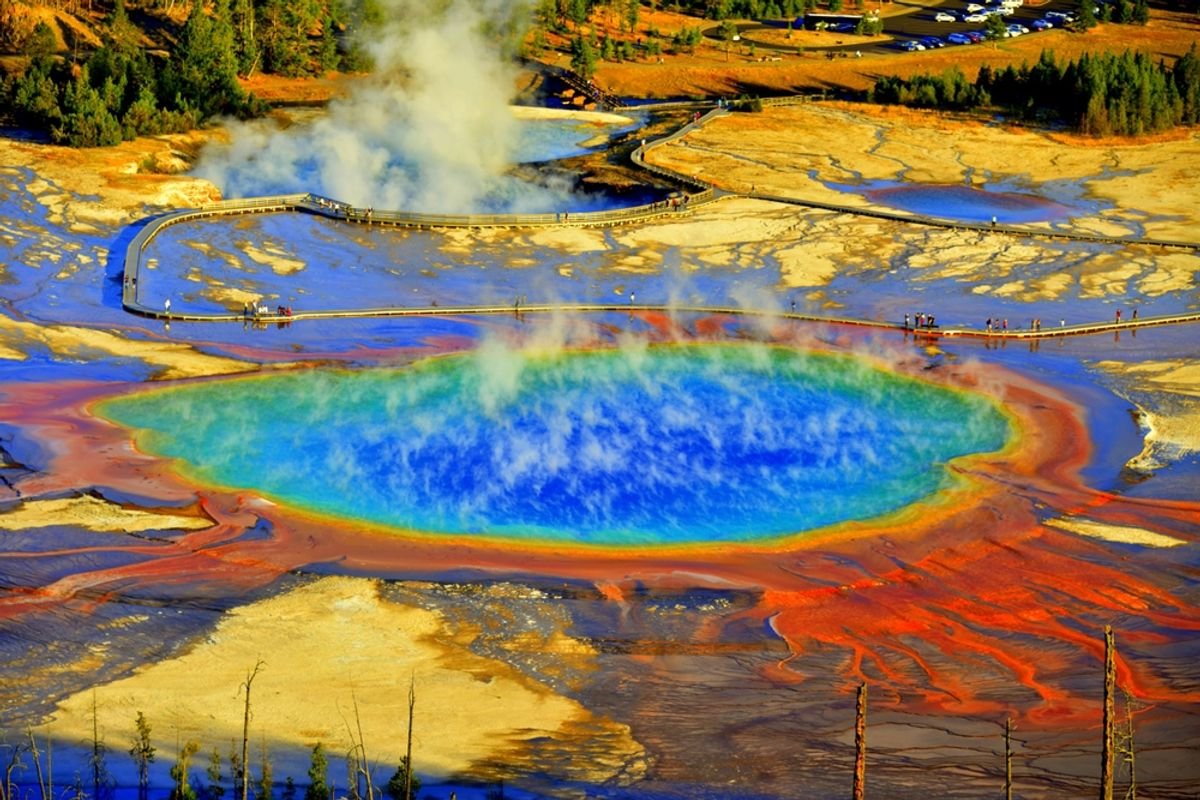
Even though your everyday plant may be capable of the same process of photosynthesis, the special quality of cyanobacteria is that they can effectively perform this process in areas of extreme heat. It is this process that gives many of Yellowstone’s hydrothermal features their mesmerizing green color that lures innocent passersby into receiving second- or third-degree burns.
Beyond sustainable agriculture, projects are currently underway to use a better understanding of thermophiles to create advancements in biofuels, bioplastics, pharmaceuticals, and genetics.
In fact, it is estimated that a quarter of all research being done in Yellowstone is related to its thermophiles.
Although we may use them to marvel at the beauty of our surroundings and escape the chaos of city life, national parks continue to be at the forefront of scientific inquiry and groundbreaking discoveries that actively improve the world around us.
Read More: Yellowstone Bison Meets Tragic End at Hot Spring, Showing the Danger of Hydrothermal Features
Article Sources
Our writers at Discovermagazine.com use peer-reviewed studies and high-quality sources for our articles, and our editors review for scientific accuracy and editorial standards. Review the sources used below for this article: