
New JWST Data Shows Rogue Planet With a Colorful Combo of Wavelengths, Strong Storms, and Beautiful Auroras

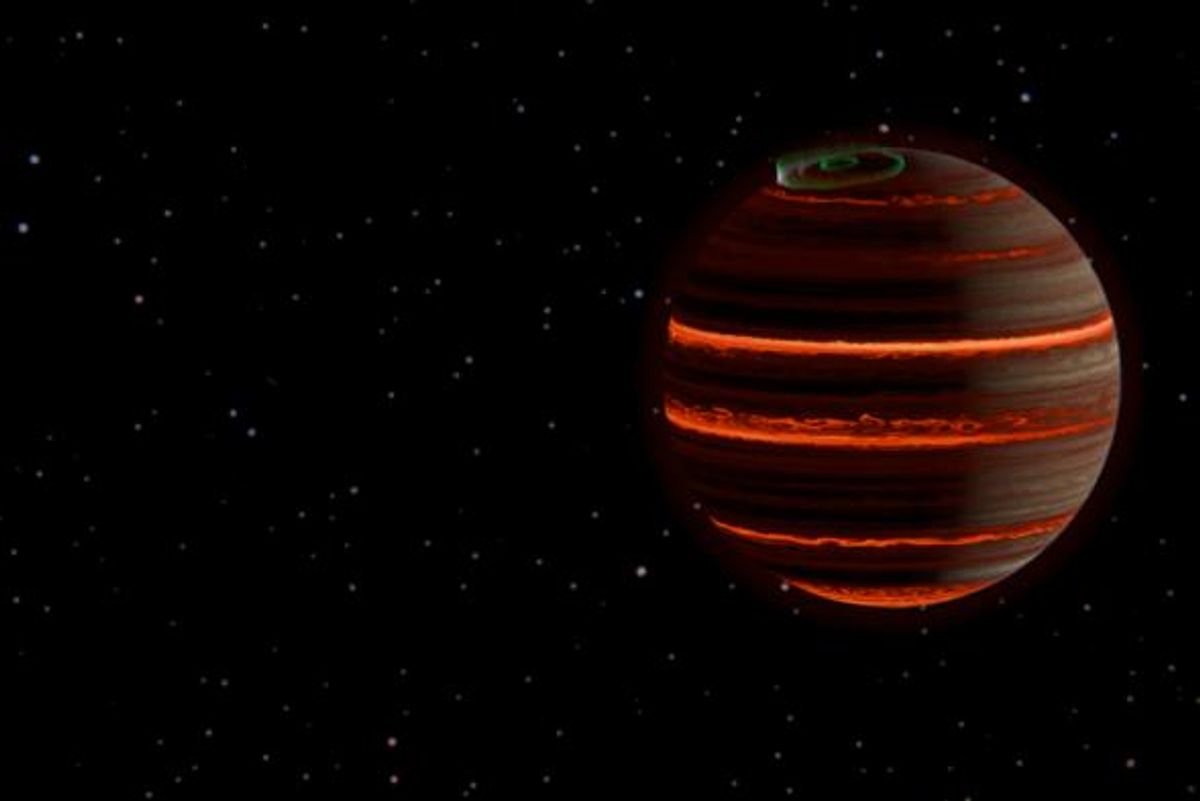
For the faraway rogue planet SIMP-0136, the weather calls for clouds, sweltering heat, and a spectacular aurora reminiscent of the Northern Lights on Earth. This otherworldly weather report comes courtesy of the James Webb Space Telescope (JWST), with instruments so precise that they’re able to detect the most minute changes in the planet’s atmosphere.
In a new study published in Astronomy & Astrophysics, the latest observations of SIMP-0136 reveal auroral activity that researchers believe is heating up its stratosphere. The planet’s aurora, along with other distinct features like layers of patchy clouds, has come into view thanks to its fast rotation.
The Colorful Features of SIMP-0136
SIMP-0136, located 20 light-years from Earth in the Milky Way, is considered a rogue planet (or a free-floating planet), meaning it is not bound to any star. Sitting at around 13 times the mass of Jupiter, the planet has all the right conditions to make it a perfect study subject. It’s exceptionally bright and not obscured by light contamination since it is so isolated.
SIMP-0136 also has a quick rotation period of only 2.4 hours, a helpful factor for researchers looking to survey the planet. Observing its full rotation, researchers have found hundreds of light curves that represent changes in brightness, viewed as a vast array of infrared wavelengths (or colors).
These patterns delineate the planet’s features, similar to how the color blue would indicate Earth’s oceans, while green and brown would indicate soil or vegetation.
“Different wavelengths of light are related to different atmospheric features. Similar to observing the changes in color over the surface of the Earth, the changes in the color of SIMP-0136 are driven by changes in the atmospheric properties,” said the new study’s lead author, Evert Nasedkin, a postdoctoral fellow at Trinity College Dublin, in a statement. “So by using cutting-edge models, we could infer the temperature of the atmosphere, the chemical composition, and the position of the clouds.”
Read More: Exoplanet Winds Expose a World Out of Science Fiction
Rotating Storms and Heating Auroras
The researchers involved in the new study were able to pinpoint temperature changes of less than 5 degrees Celsius on SIMP-0136. Variations in the planet’s chemical composition that cause these temperature changes, they say, are connected to storms rotating into view.
“These are some of the most precise measurements of the atmosphere of any extra-solar object to date, and the first time that changes in the atmospheric properties have been directly measured,” said Nasedkin.
SIMP-0136 also shows auroral activity produced by electrons that interact with its atmosphere. The researchers hypothesize that the auroras are causing hotspots to appear in the planet’s stratosphere, something that is already seen with Jupiter. The auroras on Jupiter are known to heat its upper atmosphere, although the mechanisms behind this phenomenon are not fully understood.
A Patchwork of Peculiar Clouds
Observations of SIMP-0136 have also revealed how its clouds work; rather than having varied cloud coverage as experienced on Earth, SIMP-0136 has constant cloud coverage. Its clouds are vastly different from the ones on Earth as well, due to the planet’s high temperatures of over 825 °C (1517 °F).
The assorted wavelengths that researchers have observed from SIMP-0136 have helped them track where the clouds are located and what they’re made of. One group of wavelengths that originates deep in the atmosphere represents patchy clouds composed of iron particles. Other wavelengths are linked to higher clouds that are made of tiny silicate grains, similar to sand on a beach.
Along with patchy clouds and temperature fluctuations, the wavelengths also reflect carbon chemistry in the planet’s atmosphere, pointing to varying levels of methane and carbon monoxide.
The researchers say that examining the weather and chemical processes that occur on exoplanets like SIMP-0136 will be a critical undertaking moving forward, especially as new projects like the Extremely Large Telescope are set in motion.
Read More: Can Life Exist on a Rogue Planet?