
Mushrooms May Replace Metal in Future Computers — And You Could Build One At Home

Mushrooms are an incredibly versatile product used for many purposes all over the world. We may use them on our steaks and in our stir fry, but they hold promising potential for the future of sustainable technology.
Published in PLOS One, a new study has identified an exciting new role for mushrooms: helping power the computers of the future through data storage. Thanks to the well-developed neural networks of fungi, mushrooms are a viable replacement for the costly metal devices typically used in computers.
“Being able to develop microchips that mimic actual neural activity means you don’t need a lot of power for standby or when the machine isn’t being used,” said John LaRocco, lead author of the study, in a press release. “That’s something that can be a huge potential computational and economic advantage.”
Read More: Our Prehistoric Ancestors May Have Snacked on Mushrooms Just Like Some Primates Do Today
Mushrooms and Bioelectronics
Scientists have long known that mushrooms, and fungi in general, are incredibly resilient and have many properties that make them unique. Their ability to create neural networks makes them particularly suited to bioelectronics, an emerging interdisciplinary field of research that combines electronics and biological materials.
In this study, researchers focused on two mushrooms commonly found in our kitchens: shiitake and button mushrooms. They found that these two types of mushrooms can be specifically grown to act as organic memristors. Memristors are a type of data processor that can remember past electrical states even when they are turned off.
Due to mushrooms’ neural abilities, they were able to reproduce these electric memories as effectively as semiconductor-based chips.
Turning Mushrooms into Computer Chips
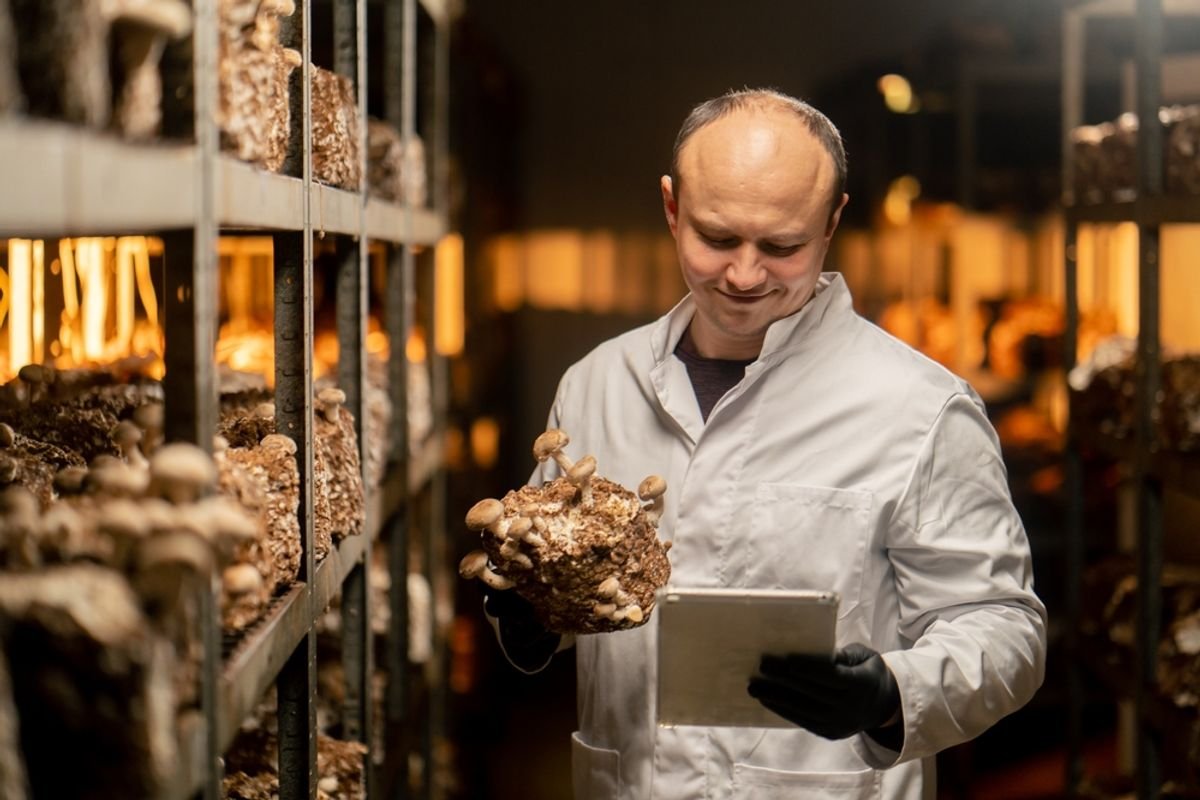
Researchers grew shiitake and button mushrooms in their lab to use in their biotech experiments. Once matured and dehydrated, the mushrooms were connected to an electronic circuit and electrocuted. The tests were extensive, involving different placements, voltages, and frequencies to explore all of the mushrooms’ potential.
“We would connect electrical wires and probes at different points on the mushrooms because distinct parts of it have different electrical properties. Depending on the voltage and connectivity, we were seeing different performances,” explained LaRocco.
The experiments went on for months, and the mushrooms continued to perform, switching between remembered electrical states with 90 percent accuracy. The mushrooms did show one weak spot — the higher the frequency of electrical voltages, the worse the performance.
This behavior actually lines up with how the neural network in the brain works, and it was fixed in the same way by increasing the number of mushrooms hooked up to the network to help share the neural load.
The Future of Biotechnology
The success of this research shows how easy it will be for future technology to make exciting advancements while still protecting the environment. Societies’ concern with protecting the environment for future generations “could be one of the driving factors behind new bio-friendly ideas like these,” added Qudsia Tahmina, co-author of the study.
Although still early in development, mushroom memristors could be used in everything from aerospace exploration to wearable tech. According to LaRocco, it could also be a type of biotechnology accessible to us at home: “Everything you’d need to start exploring fungi and computing could be as small as a compost heap and some homemade electronics.”
Read More: What Makes Death Cap Mushrooms the Deadliest in the World?
Article Sources
Our writers at Discovermagazine.com use peer-reviewed studies and high-quality sources for our articles, and our editors review for scientific accuracy and editorial standards. Review the sources used below for this article: