
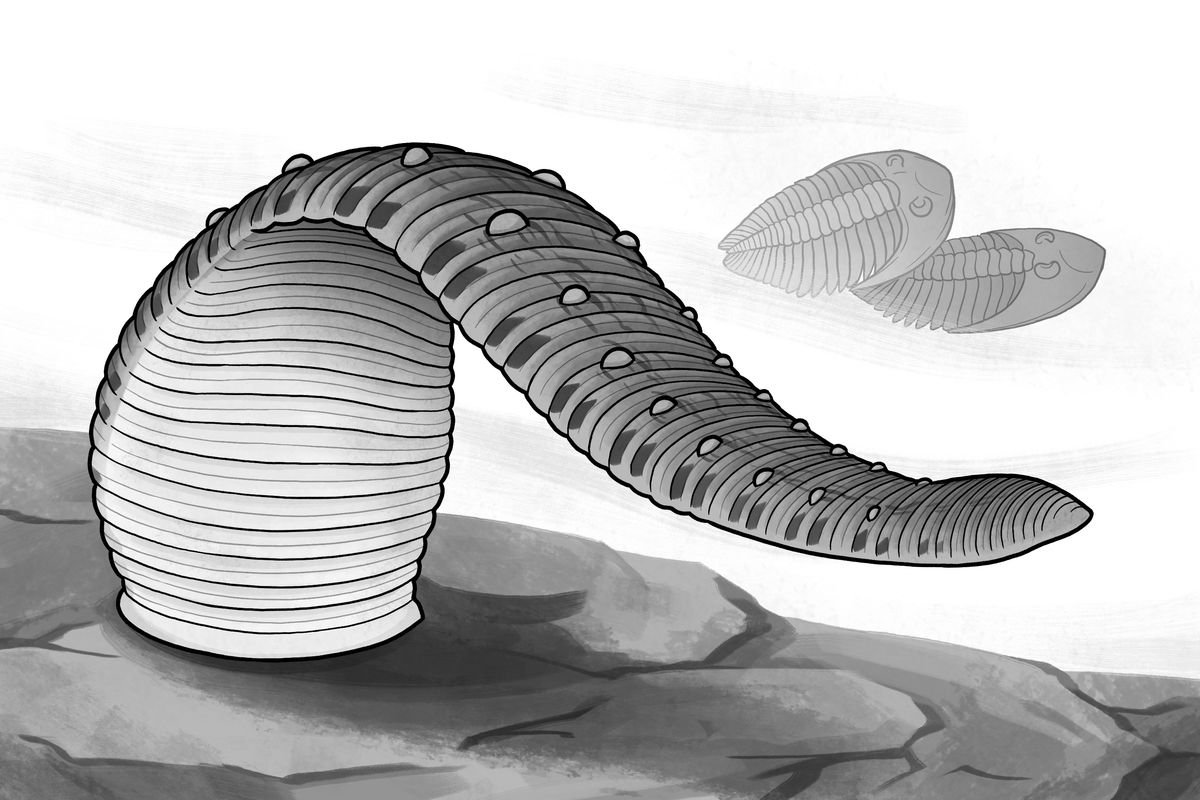
Leeches Didn’t Always Suck Blood — Ancient Fossils Reveal They Swallowed Prey Whole
It’s the beginning of the spooky season, which means ghouls, ghosts, and bloodsuckers abound. One of the most famous bloodsuckers in nature is, of course, the leech. These parasites feed on blood and have been used throughout history to treat a whole host of medical problems in humans.
Now, for the first time, researchers have found a complete fossil of an ancient leech. Published in PeerJ, the study of this rare fossil has pushed back the presence of leeches on Earth to about 480 million years ago. The fossil also revealed something shocking: ancient leeches did not feed on blood. Instead, they likely swallowed soft-bodied organisms whole or feasted on their internal fluids.
“We don’t know nearly as much as we think we do,” said Karma Nanglu, a paleontologist at the University of California – Riverside, in a press release. “This paper is a reminder that the tree of life has deep roots, and we’re just beginning to map them. It’s a beautiful specimen. And it’s telling us something we didn’t expect.”
Read More: Leeches and Maggots Are FDA-Approved and Still Used in Modern Medicine
Leeches Weren’t Always Bloodsuckers

The fossil leech compared with a modern leech. Double arrows indicate the large caudal sucker used for attachment, single arrows indicate body annulations.
(Image Credit: Andrew J Wendruff/Otterbein University and Takafumi Nakano/Kyoto University)
Until now, scientists had no reason to believe that ancient leeches weren’t bloodsuckers like their modern counterparts. Although modern leeches feed in multiple ways, they are most well known for their parasitic blood-sucking habits. Leeches use a forward sucker at the front of their body to draw blood and secrete anticoagulants to ensure a consistent blood flow.
The new leech fossil is missing the forward sucker necessary for this process, leading researchers to believe it must have subsisted on something other than blood.
“Blood feeding takes a lot of specialized machinery. Anticoagulants, mouthparts, and digestive enzymes are complex adaptations. It makes more sense that early leeches were swallowing prey whole or maybe drinking the internal fluids of small, soft-bodied marine animals,” said Nanglu in the press release.
Instead of feeding on blood, this leech ancestor likely ate other marine animals whole or consumed their internal fluids. This feeding strategy is backed up by the fact that the leech ancestor was more aquatic than modern leeches and likely roamed the ocean looking for prey.
Why Are Leech Fossils So Rare?
Leeches belong to a group known as Hirudinida, and this is the only body fossil ever found from a member of this group. A research team discovered in the Waukesha biota in Wisconsin, which is a geological formation famous in the scientific world for its preservation of soft tissue.
The history of leeches on Earth has been nearly impossible to study as their fossils rarely survive. Leeches have no bones, exoskeleton, or shells that can be easily preserved in the fossil record over millions of years, so most of the knowledge about leeches has come from more modern versions.
In order for a leech fossil to survive, it needed the perfect combination of the low-oxygen environment and unique geochemical conditions present in the Waukesha biota. Additionally, it was likely buried almost immediately after its death, which helped perfectly preserve the fossil before any degradation and allowed for this fantastic find.
“A rare animal and just the right environment to fossilize it — it’s like hitting the lottery twice,” said Nanglu in the press release.
Read More: Biologists Use Blood-Sucking Leeches to Log Biodiversity
Article Sources
Our writers at Discovermagazine.com use peer-reviewed studies and high-quality sources for our articles, and our editors review for scientific accuracy and editorial standards. Review the sources used below for this article: