
Laser Beams to the Brain Help Us Understand How We Perceive Illusions
Optical illusions mess with our eyes — and brains — in the weirdest ways. Looking at one usually makes us perceive something that isn’t really there. Take the Kanizsa square, a visual featuring four black circles with slices cut out of them to make each one look like Pac-Man. Immediately, we see something else as well: a white square, the illusion in question.
A new study published in Nature Neuroscience has revealed what causes brains to fill in the gaps of illusions like the Kanizsa square. Testing brain activity in mice, researchers discovered that a specific group of cells known as IC-encoders (“IC” standing for “illusory contours”) receive instructions to make the brain recognize the outer edges, or “contours,” of many illusions.
How the Brain Perceives Illusions
Brains have been capable of deciphering illusory contours for ages. And humans aren’t the only ones who can perceive these illusions; Nonhuman primates, mice, fish, and even insects can as well.

Kanizsa square used in optical illusion experiments
(Image Credit: Creative Commons Attribution 4.0 International / ResearchGate and https://www.illusionsindex.org/)
This ability most likely emerged from the need to infer objects based on incomplete information, helping us comprehend the space around us. It comes in handy when objects are occluded, meaning they are partially hidden from view. When faced with something that is occluded, the brain springs into action to fill in the missing details.
Similar to the Kanizsa square, the Kanizsa triangle puts this ability to the test. In this visual, there are three discs with Pac-Man mouths and three pairs of lines. Based on the configuration of these elements, we see not one, but two secret shapes: an inverted triangle pointing downwards and a solid white triangle pointing upwards, appearing almost like a top layer of the visual.
Neither triangle, though, exists. It’s simply the edges of the discs and lines that make it appear as if there are two triangles. Processing an illusory contour like this one becomes a trial for the brain, which must factor in all sorts of details, such as color, lightness, and texture.
Read More: Optical Illusions Are Weirder Than You Think
Instructions for Illusions
In order to perceive illusory contours, our brains require help from IC-encoder neurons, which facilitate the process of recurrent pattern completion (in other words, seeing the things that aren’t really there in many illusions).
But the IC-encoders themselves need a little push from visual areas in the brain that are higher up in the chain of command. An illusion’s appearance first arises in these visual areas, and then information is passed on to IC-encoders in the primary visual cortex.
According to a press release on the new study, this process is like a manager telling entry-level staff to complete a task. And in this case, the instructions received by IC-encoders are to see something in an illusion that isn’t really present — like imaginary triangles.
The Brain’s Active Visual System
The researchers behind the study saw IC-encoders at work as they monitored the electrical brain activity patterns of mice that were shown illusory images like the Kanizsa triangle.
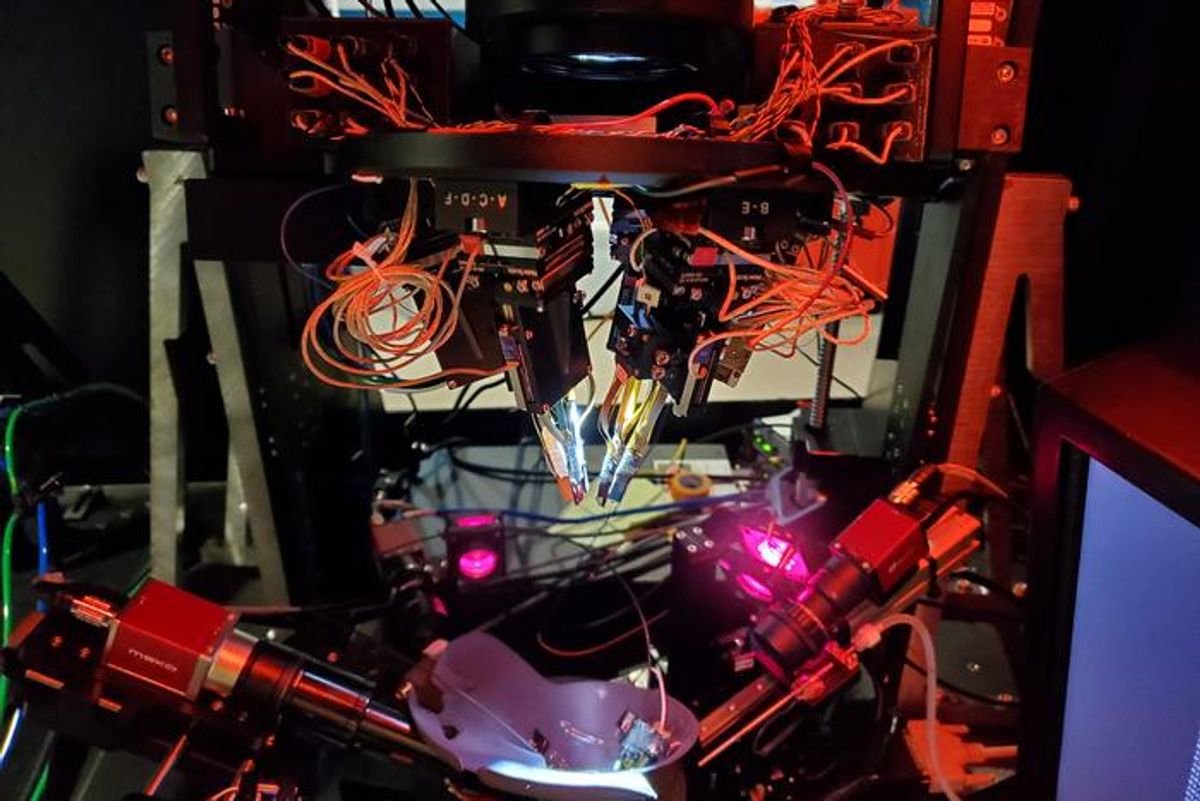
To better understand how the neurons work, they shot beams of light at them, in a process called two-photon holographic optogenetics, when there was no illusory image present. When hit with the beams, IC-encoder neurons replicated the same brain activity patterns that occur when an illusory image was present.
Now that the researchers know how active the brain is when processing an illusion, they’re interested in seeing how this work may influence treatments for diseases that impact the brain’s ability to perceive visual stimuli.
“In certain diseases you have patterns of activity that emerge in your brain that are abnormal, and in schizophrenia these are related to object representations that pop up randomly,” said author Jerome Lecoq, associate investigator at the Allen Institute. “If you don’t understand how those objects are formed and a collective set of cells work together to make those representations emerge, you’re not going to be able to treat it; so understanding which cells and in which layer this activity occurs is helpful.”
Read More: Why Mirages Are Like Nature’s Magic Trick
Article Sources
Our writers at Discovermagazine.com use peer-reviewed studies and high-quality sources for our articles, and our editors review for scientific accuracy and editorial standards. Review the sources used below for this article: