
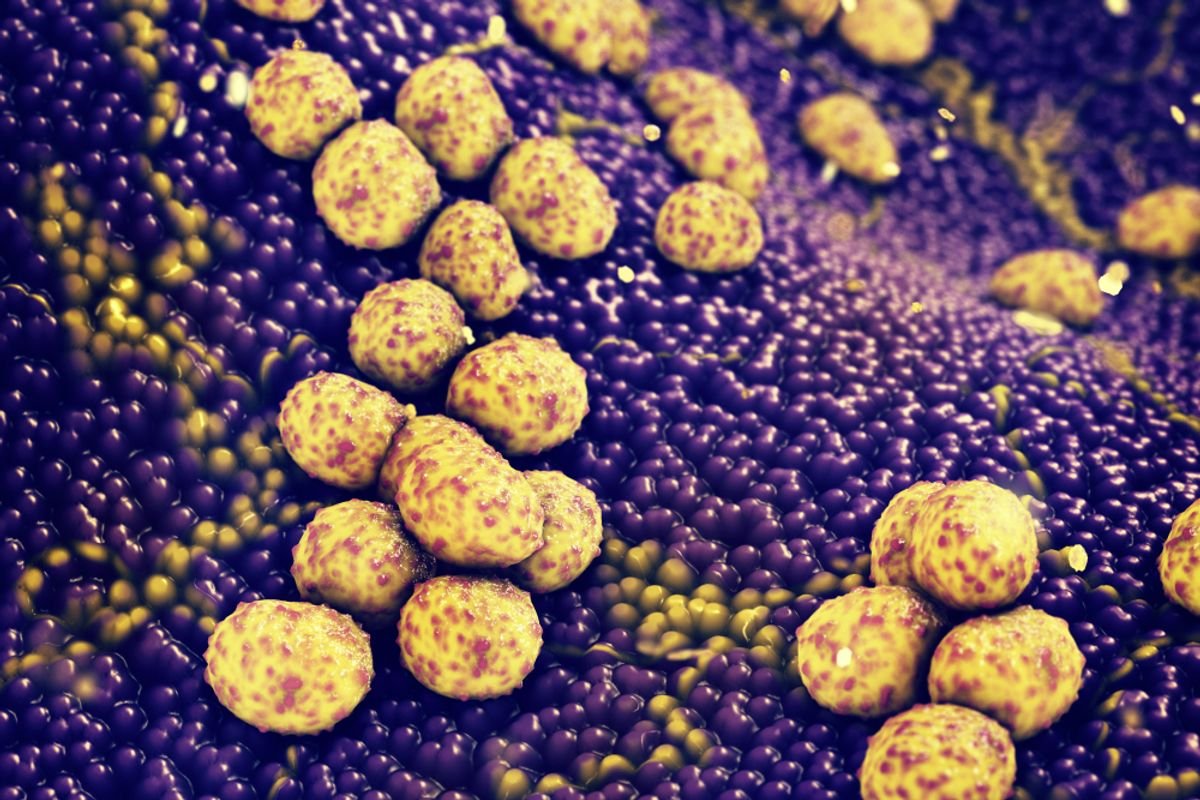
Infectious Staph Bacteria Stick to Human Skin With the Strongest Grip in Nature

When staph bacteria meet skin, they hang on for dear life and won’t let go. The ties that bind staph and human skin, as it turns out, shape one of the strongest bonds in biology. Unfortunately for us, the microbe’s clinginess can lead to infections that, in some cases, can be fatal if left untreated.
A new study published in Science Advances has found out why the common bacterium Staphylococcus aureus is so difficult to remove once it attaches to vulnerable human skin. Researchers attribute staph’s stubborn hold to a protein that it uses to latch onto a human protein, resulting in the strongest biological grip ever measured.
“It is the strongest non-covalent protein-protein bond ever reported,” said senior author Rafael Bernardi, professor of physics at Auburn University, in a statement. “This is what makes staph so persistent, and it helps us understand why these infections are so difficult to get rid of.”
The Dangers of Staph Infections
Surprisingly, many people already have Staphylococcus aureus dwelling on their faces; roughly 1 in 3 people carry the bacterium on their skin or in their nose, and it is usually spread through skin-to-skin contact. However, staph is harmless in most cases.
On occasion, staph will infect the skin through an open wound such as a cut or scrape. These infections cause noticeable symptoms, including sores or pus-filled boils. Minor cases can often be treated with a topical antibiotic.
An infection gets more serious, though, when it digs deeper and enters the bloodstream. Staph bacteria in blood can eventually progress to life-threatening septic shock, in which an overactive immune response prompts organs to start shutting down.
Even more grave is infection with MRSA, a group of staph bacteria that are resistant to several antibiotics normally used to treat staph infections. The Centers for Disease Control and Prevention (CDC) estimates that “MRSA is responsible for more than 70,000 severe infections and 9,000 deaths per year.”
Read More: The Fungus on Your Skin Can Stave Off An Antibiotic-Resistant Bacteria
The Strongest Protein Bond
In the past, scientists were never quite sure why staph held on so tightly to human skin. The new study has finally found an answer: staph bacteria use a protein called SdrD as a grappling hook to adhere to a protein on humans called desmoglein-1. The researchers behind the discovery say that this bond’s potency rivals even the strongest chemical bonds. This is why staph sticks on skin despite scratching, washing, or sweating.
To detect this bond, the research team used atomic force microscopy to measure the force of a single staph bacterium attaching to human skin proteins. This interaction was then modeled atom by atom on powerful supercomputers to confirm that SdrD’s grip on desmoglein-1 is stronger than any other protein bond known in biology.
Parting Ways with Staph
The researchers were surprised to see that calcium levels on skin played a major role in the strength of the staph-skin bond. During their experiments, reducing calcium levels weakened the protein bond. When the calcium was added back, the bond grew even stronger.
This would explain why people with eczema, a condition that disrupts calcium balance in the skin, particularly struggle with skin infections from staph.
According to the researchers, these experiments have shown that the best course of action in combating staph in the future may involve therapies that block or weaken bacterial adhesion to skin. While attempting to kill staph directly often drives the evolution of antibiotic resistance, stopping it from clinging onto skin would give the immune system an opportunity to clear it before an infection sets in.
“By targeting adhesion, we are looking at a completely different way to fight bacterial infections,” said Bernardi. “We are not trying to destroy the bacteria, but to stop them from latching on in the first place.”
This article is not offering medical advice and should be used for informational purposes only.
Read More: How Light-Controlled Bacteria Could Tackle the Problem of Antibiotic Resistance
Article Sources
Our writers at Discovermagazine.com use peer-reviewed studies and high-quality sources for our articles, and our editors review for scientific accuracy and editorial standards. Review the sources used below for this article: