
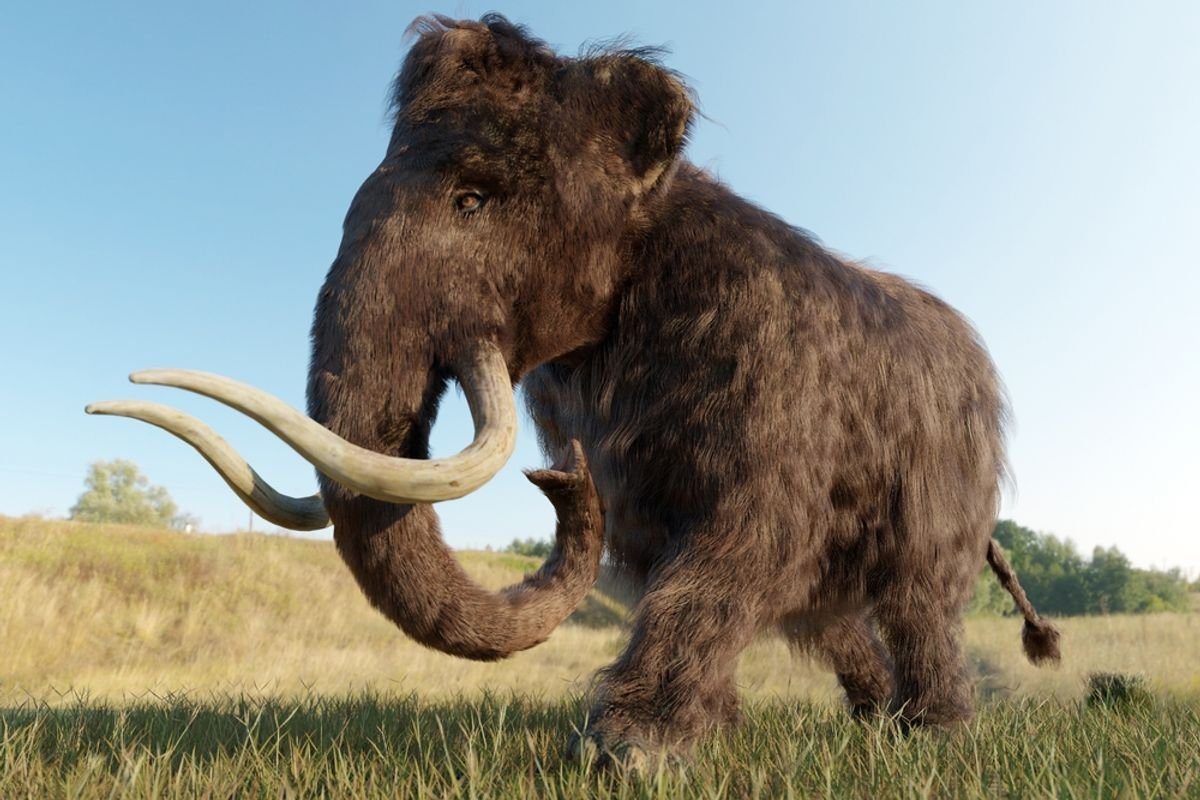
Hippos Lived Alongside Mammoths 47,000 Years Ago During the Last Ice Age
Although there is a popular song requesting a hippopotamus for Christmas, the heat-loving giants aren’t animals we’d expect to enjoy a snowy Christmas climate. But a surprising new discovery has changed what scientists thought they knew about Europe’s prehistoric wildlife, including the extinction date of hippos.
According to new research published in Current Biology, hippos — today confined to sub-Saharan Africa — actually survived in central Europe far longer than anyone had previously assumed.
Analyses of fossilized bones revealed that these semi-aquatic animals lived in Germany’s Upper Rhine Graben between 47,000 years and 31,000 years ago, smack dab in the middle of the last Ice Age.
Read More: Large and In Charge, Hippos Are Stirring Up Trouble In Colombia
How Did Scientists Find Ice Age Hippos?

Left mandible fragment of a female hippopotamus from Reiss-Engelhorn-Museen Mannheim, Slg. Reis Hippopotamus sp. Age dating: Between 46,000 and 48,300 years ago. Location: Bobenheim-Roxheim, Rhine-Palatinate district.
(Image Credit: Rebecca Kind)
Until now, it was believed that hippos vanished from central Europe around 115,000 years ago at the end of the last interglacial period. The idea of hippos wading through icy European rivers alongside mammoths and woolly rhinos may sound impossible, but the new evidence suggests it happened.
Researchers from the “Eiszeitfenster Oberrheingraben” project, an interdisciplinary initiative studying climate and environmental change in southwestern Germany, examined a series of hippo bones found in the Upper Rhine Graben region. The gravel and sand deposits located in the Upper Rhine Graben helped make the area an invaluable resource for ancient animal fossils.
“It’s amazing how well the bones have been preserved. At many skeletal remains, it was possible to take samples suitable for analysis — that is not a given after such a long time,” said Ronny Friedrich in a press release.
The survival of hippos well into the last ice age suggests that parts of Europe experienced brief, warmer intervals that would’ve been enough to sustain these tropical animals alongside the expected ice age megafauna.
Exploring the Ancient DNA of Ice Age Hippos
The research team used a combination of radiocarbon dating and ancient DNA sequencing to reveal the unexpected details about hippos during the European ice age. Radiocarbon dating placed the hippos in a relatively mild phase of the Weichselian glaciation, when local climates allowed temperate ecosystems to flourish amid the wider ice age.
Ancient DNA sequencing showed that the ice age hippos were almost genetically identical to the African species that still lives today. Additionally, the study also found that these hippos had low genetic diversity, which indicates that they lived in small, isolated populations. It’s possible that these surviving hippos were the remnants of a larger population devastated by climate change.
“The results demonstrate that hippos did not vanish from middle Europe at the end of the last interglacial, as previously assumed,” said Patrick Arnold, the study’s first author, in the press release. “Therefore, we should re-analyze other continental European hippo fossils traditionally attributed to the last interglacial period.”
A New Picture of Europe’s Last Ice Age
These findings are inspiring scientists to reconsider how variable the Ice Age climate really was. “The current study provides important new insights which impressively prove that ice age was not the same everywhere, but local peculiarities taken together form a complex picture — similar to a puzzle,” said Wilfried Rosendahl in the press release.
The discovery of ice age hippos in Germany paints a more complex picture of Europe’s ancient ecosystems, one where cold-adapted and heat-loving species coexisted. Future studies of other warm-loving species could shed even more light on the climate shifts that defined the last 400,000 years of European prehistory.
Read More: How Ice Age Humans Mastered Fire During the Coldest Era in History
Article Sources
Our writers at Discovermagazine.com use peer-reviewed studies and high-quality sources for our articles, and our editors review for scientific accuracy and editorial standards. Review the sources used below for this article: