
Fossils of Extinct Coelacanths Faced a Case of Mistaken Identity for Over a Century

Fossil hunting has led to countless cases of mistaken identity throughout the ages. Most recently, archaeologists have resolved a mystery involving extinct coelacanth specimens housed at several museums across the U.K. These fish, which lived during the end of the Triassic around 200 million years ago, have been mistaken for a different reptile species ever since the late 1800s.
A new study published in The Journal of Vertebrate Paleontology sorted through collections of ancient bones to prove that specimens once thought to be small marine reptiles have actually been coelacanths this whole time.
The mix-up has gone unnoticed for years because of similarities between the two animals’ bones, but with everything now settled, archaeologists are looking to understand how the coelacanths of the British Triassic lived.
The Slow Evolution of Coelacanths
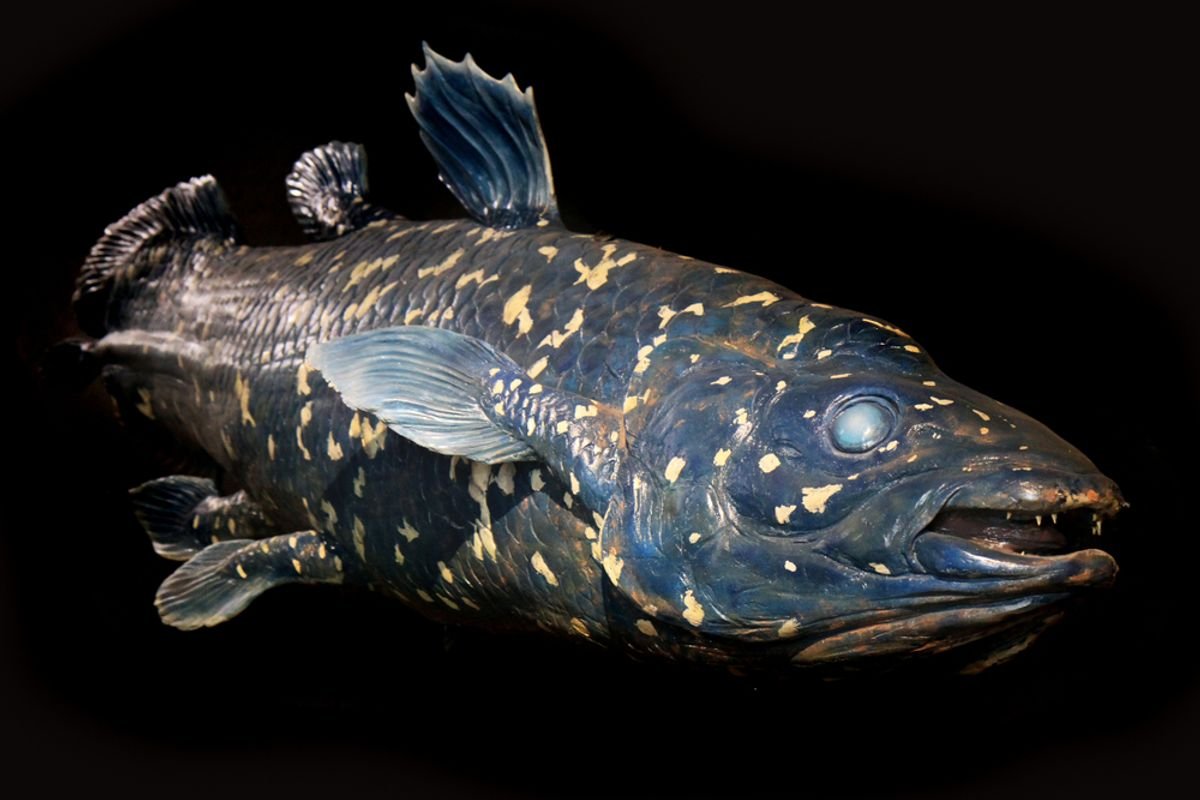
Coelacanths are still around today, although they’re exceedingly rare in nature. Only two living species of the coelacanth genus Latimeria exist today: the West Indian Ocean coelacanth, first discovered off the coast of South Africa in 1938, and the Indonesian coelacanth, first discovered north of Indonesia’s Sulawesi island in 1998.
These deep-sea fish tend to dwell in caves off the slopes of volcanic islands, living anywhere from 300 to 2,300 feet below the sea.
The coelacanth is perhaps known best by its nickname, the “living fossil”. The name comes from modern coelacanths’ striking similarity to its fossilized ancestors that lived hundreds of million of years ago.
It would almost seem as if the coelacanth hasn’t evolved at all since the prehistoric era — hence the “living fossil” name — but that’s far from the case. It has evolved over time, albeit at a very slow rate. This may be due to the stable environment they inhabit, along with low predation.
Read More: Living Fossils Like the Coelacanth Have Remained Unchanged for 400 Million Years
An Ancient Case of Mistaken Identity
Extinct coelacanths that lived near the modern-day U.K. are well-represented from the Paleozoic Era (around 542 to 251 million years ago) and the later Cretaceous Period (145 to 66 million years ago). In between these periods, the coelacanth fossil record from the last stage of the Triassic (also called the Rhaetian, from around 209-201 million years ago) is spotty due to a lack of fossilized material.
The new study, however, has added several specimens to the ranks of the British Rhaetian coelacanths. Certain groups of fossils hailing from sediments deposited within formations in southwest England were originally identified as Pachystropheus rhaeticus, a small marine reptile known as a thalattosaur.
Revisiting these bones with X-ray scans, researchers began to piece together their true identity: They belonged not to Pachystropheus rhaeticus, but to mawsoniids, a category of extinct coelacanths. And this isn’t the first time British Rhaetian coelacanths have been misidentified, with previous cranial bones mistaken for other reptiles and even mammals at first.
“It is remarkable that some of these specimens had been sat in museum storage facilities, and even on public display, since the late 1800s, and have seemingly been disregarded or identified as bones of lizards, mammals, and everything in-between,” said author Jacob Quinn, a paleontologist from the University of Bristol, in a statement. “From just four previous reports of coelacanths from the British Triassic, we now have over fifty.”
Living on the Seafloor
Most mawsoniids from the British Rhaetian likely preferred brackish or freshwater environments near shores, unlike modern-day coelacanths that live in deep marine waters. A few mawsoniids, though, did live in marine environments, leading some archaeologists to suggest that the group was euryhaline, meaning the fish may have been able to tolerate a wide range of salinity and explore different kinds of ancient aquatic environments.
According to the researchers, these ancient coelacanths lurked near the seafloor and consumed just about anything they would encounter. In an ironic twist, their diet likely included the smaller Pachystropheus reptiles that caused this whole identity mess in the first place.
Read More: Pivotal Ancient Fish Fossils Mark a Key Turning Point in a Slow Evolution
Article Sources
Our writers at Discovermagazine.com use peer-reviewed studies and high-quality sources for our articles, and our editors review for scientific accuracy and editorial standards. Review the sources used below for this article: