
Fossilized Resin Reveals a Wet Forest Full of Insects and Spiders 112 Million Years Ago
For the longest time, South America’s amber deposits lacked one thing, and one thing in particular, and that’s bugs.
But a September 2025 study in Communications Earth & Environment describes the first amber deposits from South America that include insects from the Cretaceous period (around 143 million to 66 million years ago).
The deposits, which were found in Ecuador, include a medley of material from insects, springtails, spiders, and plants, painting a picture of the resin-rich forests of South America around 112 million years ago, when the supercontinent of Gondwana was starting to split apart.
Amber From the Cretaceous Period

d-h) Small or medium-sized amber pieces, formed from resin exuded from trunks or branches in aerial conditions, are scarce, but some of them contain bio-inclusions.
(Image Courtesy of Delclòs, X., Peñalver, E., Jaramillo, C. et al.)
Amber traps a lot of things — from insects and spiders to spores and plant pollens — that aren’t always preserved in the fossil record.
These trapped items have been found in amber from as many as 230 years ago, but almost all of the “bio-inclusions” from the Cretaceous period have appeared in amber from the Northern Hemisphere up until this point, obscuring the environments and ecosystems from the south.
“From the Cretaceous period, such ‘bio-inclusions’ are almost exclusively known from sites in the Northern Hemisphere,” Mónica Solórzano-Kraemer, a study author and a scientist at the Senckenberg Research Institute and Natural History Museum in Frankfurt, said in a press release. “Our understanding of the biodiversity and ecosystems of the Southern Hemisphere during the period,” the arthropod specialist added in the release, is therefore “very limited.”
Read More: What Are Fossils, And Where Are They Found the Most?
Studying South American Amber
To address this gap in the fossil record, Solórzano-Kraemer and a team of researchers turned to the amber from the Hollín Formation in eastern Ecuador. This sedimentary rock formation features two types of approximately 112-million-year-old amber, or fossilized resin, that solidified among the roots of trees underground or among the trunks and branches of trees aboveground, through the stiffening of the resin in the air.
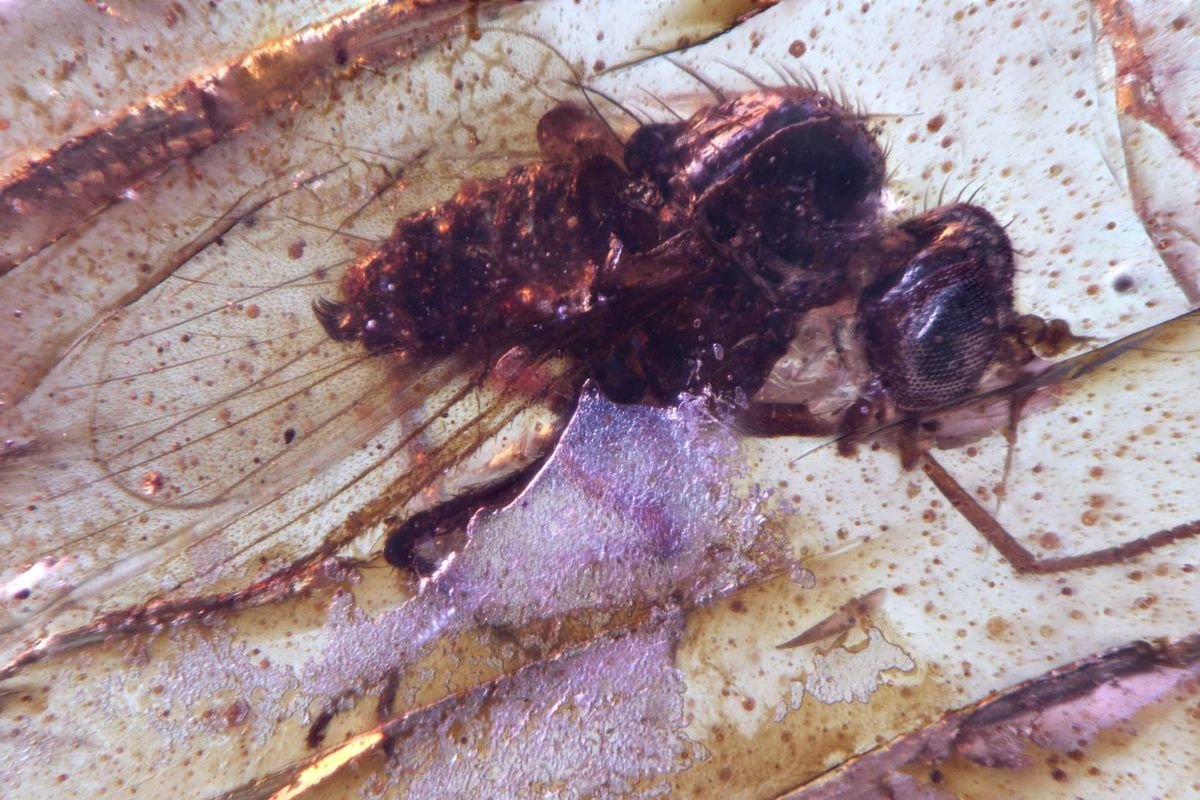
Isolating 21 bio-inclusions amid 60 or so samples of air-stiffened amber, the team identified a series of insect bodies and body parts, a single springtail, a single spider web, and a selection of spores and plant pollens, almost all of which were well-preserved. While the insect fossils came from five orders of insects, among them the Diptera (the flies), the Coleoptera (the beetles), and the Hymenoptera (the ants and wasps), the fossilized spider web came from an orb-weaving species, which spun its web in an orbicular, or spiral shape.
A Cretaceous ‘Time Capsule’

a) Diptera; b) Diptera; c) Diptera; d) Trichoptera; f) Coleoptera; g) Coleoptera; h) Hymenoptera; i) Hymenoptera.
(Image Courtesy of Delclòs, X., Peñalver, E., Jaramillo, C. et al.)
Taken together, the fossils suggest that the forests of South America were warm and wet in the Cretaceous period, when South America was starting to separate from Gondwana.
“Our findings suggest humid conditions,” Solórzano-Kraemer said in the release. “We assume that 112 million years ago, a humid, densely forested habitat existed in Equatorial Gondwana, which was already characterized by flowering plants.”
In fact, the team also analyzed the amber itself, in addition to its inclusions, pinpointing its source as something similar to an araucaria tree. This type of tree would thrive in the same sort of environment that would suit the insects, springtails, and spiders seen in the amber, still stuck there after 112 million years.
“The newly discovered amber deposit is of crucial importance for paleontology,” Solórzano-Kraemer added in the release, stressing the importance of the team’s research. “It not only provides direct evidence of a forest ecosystem rich in resin, but also of its diverse arthropods in the early Cretaceous period. The ambers and their inclusions allow us to open a ‘time capsule’ to explore the biodiversity and ecosystems of the Southern Hemisphere.”
Read More: Deep-Sea Deposits of Amber May Document Massive 116-Million-Year-Old Tsunamis
Article Sources
Our writers at Discovermagazine.com use peer-reviewed studies and high-quality sources for our articles, and our editors review for scientific accuracy and editorial standards. Review the sources used below for this article: