
First Evidence From Proto Earth May Be a Chemical Imbalance Hidden Inside Ancient Rocks

Earth’s earliest days were so chaotic that it’s hard to believe life ever got its start here. What’s now the beautiful blue marble we inhabit was once an apocalyptic wasteland with a molten surface and an atmosphere severely lacking in oxygen. Virtually all evidence from this fiery first era of the planet, referred to as “proto Earth,” has long since vanished. There’s one chemical remainder, though, that has just come to light.
A new study published in Nature Geoscience has revealed the only known piece of proto Earth left: a chemical signature hidden in some of the oldest preserved rocks on the planet.
Researchers believe that an imbalance in potassium isotopes within these rocks is a vestige of Earth’s earliest environment that was never wiped away.
The Giant Impact That Hit Proto Earth
The Solar System materialized around 4.6 billion years ago as gas and dust formed into a swirling disc that would become the solar nebula. Most of this primordial material was drawn to the center, giving rise to the Sun. The remaining gas and dust coalesced at various points to create each planet, including Earth.
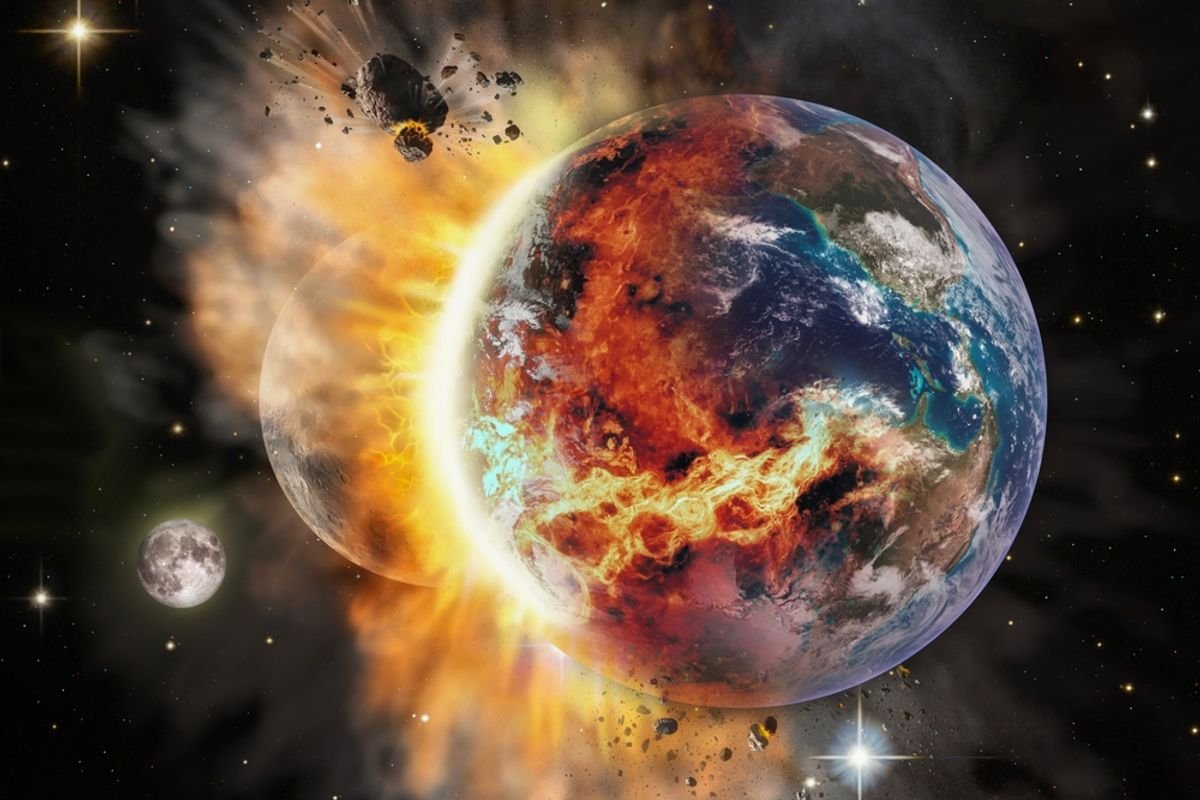
Proto Earth was in no shape to support life. In addition to its hot and hostile conditions, the young planet was under constant duress from asteroid collisions. At one climactic point, it was struck by a Mars-sized meteorite (sometimes called “Theia”). This giant impact would change the trajectory of our planet.
After being thrashed by Theia, Earth’s interior was melted and thrown into disarray. The environment that was once Proto Earth had been changed completely, with nearly all material being vaporized. There is a silver lining to this violent chapter in Earth’s history — we have the giant impact to thank for releasing the debris that would become the Moon.
Read More: Origins of Water on Earth May Not Have Started with an Asteroid Impact
Chemical Leftovers from Proto Earth
Earth had it rough after the giant impact, but its surface eventually cooled down and solidified. It seemed that material from Proto Earth was gone forever.
The new study, however, appears to prove that this isn’t true. As researchers examined samples from rocks in Greenland and Canada, as well as lava deposits in Hawaii that originated from the mantle, they discovered an unusual imbalance of the potassium-40 isotope.
The researchers had previously found a similar imbalance in meteorites that didn’t share Earth’s present composition. The same imbalance in ancient rocks and lava deposits, then, would suggest that they contain material that originates from Proto Earth before Theia struck.
“This is maybe the first direct evidence that we’ve preserved the proto Earth materials,” said author Nicole Nie, a professor of earth and planetary sciences at MIT, in a statement. “We see a piece of the very ancient Earth, even before the giant impact. This is amazing because we would expect this very early signature to be slowly erased through Earth’s evolution.”
Simulating Meteorites
Upon testing the rock and lava samples, the researchers noticed a specific deficit in the potassium-40 isotope, a feature that made these materials stand out compared to everything else found on Earth.
If Proto Earth was truly made out of potassium-40 deficient materials, these materials would’ve experienced chemical changes from meteorite impacts (including the giant impact). Referencing this assumption, the researchers used data from every known meteorite and tested simulations of meteorite impacts on an early Earth. The simulations came up with compositions that aligned with most of Earth’s modern materials,
This reinforces the fact that the ancient rock and lava samples somehow held onto a remnant of Proto Earth while everything around them changed after the giant impact.
No meteorites, however, have been shown to share the exact same potassium isotope deficient as these Proto Earth samples. More clues pointing to Proto Earth, therefore, may still be out there.
“Scientists have been trying to understand Earth’s original chemical composition by combining the compositions of different groups of meteorites,” said Nie. “But our study shows that the current meteorite inventory is not complete, and there is much more to learn about where our planet came from.”
Read More: Earth Formed 4.54 Billion Years Ago – How Do Scientists Know?
Article Sources
Our writers at Discovermagazine.com use peer-reviewed studies and high-quality sources for our articles, and our editors review for scientific accuracy and editorial standards. Review the sources used below for this article: