
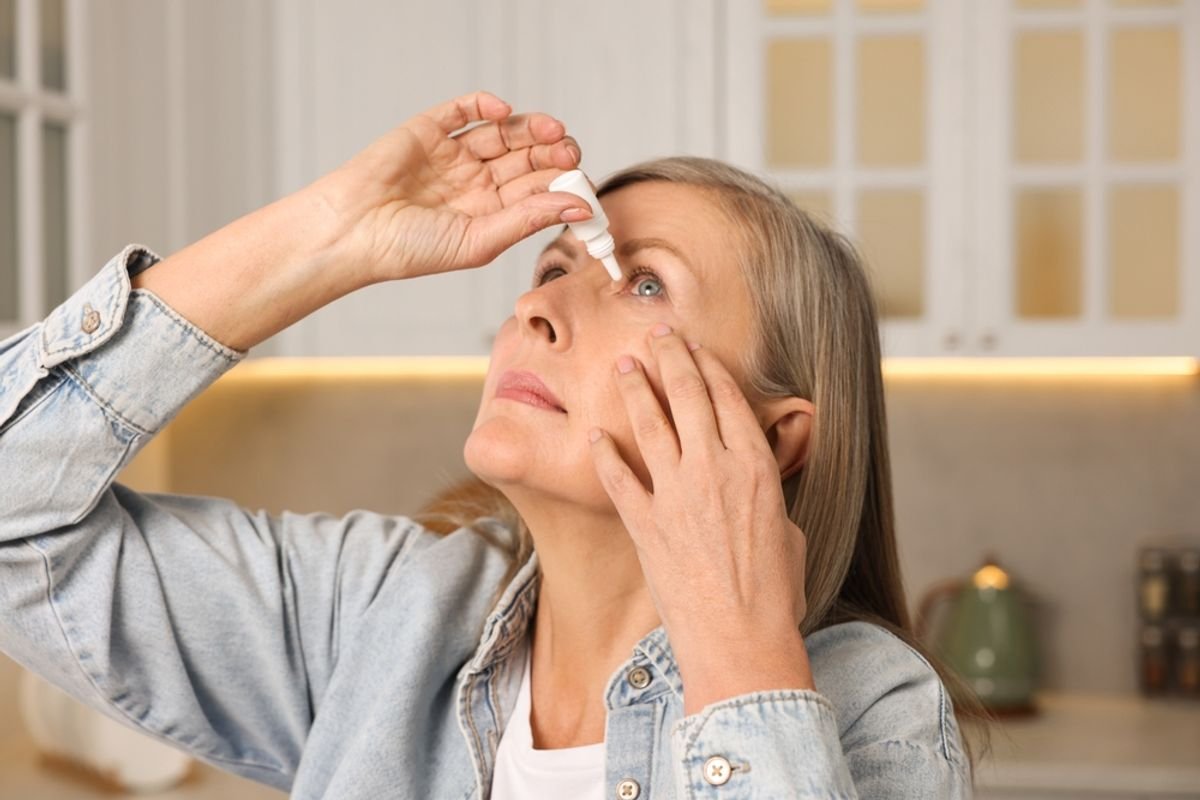
Eye Drops May One Day Replace Reading Glasses, and Could Help Our Vision as we Age

As we age, we’ll all experience a decline in our vision and will likely need reading glasses. Instead of reaching for those glasses though, imagine taking 2 to 3 eyedrops a day to see something up close.
New research that experts will present at the 43rd Congress of the European Society of Cataract and Refractive Surgeons (ESCRS) explores presbyopia, the condition that makes it hard for the eye to focus on close objects and text, and how eye drops could one day replace eyeglasses.
Alternative to Glasses and Eye Surgery
For this study, lead researcher Giovanna Benozzi, who is also the director of the Center for Advanced Research for Presbyopia in Buenos Aires, Argentina, and her team followed a group of 766 presbyopia patients with an average age of 55 years. The team’s hope was to help find an alternative solution to glasses and eye surgery.
“We conducted this research due to the significant unmet medical need in presbyopia management. Current solutions, such as reading glasses or surgical interventions, have limitations, including inconvenience, social discomfort, and potential risks or complications,” Benozzi said in a press release.
“There is a group of presbyopia patients who have limited options besides spectacles, and who are not candidates for surgery; these are our primary focus of interest,” Bennozi added in the press release.
Read More: Here’s How To Avoid These 3 Types of Age-Related Vision Loss
Eye Drops for Clearer Vision
The eye drops are made up of two active ingredients: pilocarpine and diclofenac. Pilocarpine helps constrict the pupils while contracting the ciliary muscle — the muscle that controls the eye’s ability to focus on objects at varying distances. Diclofenac is an NSAID (non-steroidal anti-inflammatory drug) that helps relieve the inflammation that pilocarpine can cause.
For their research, the team put the patients — 373 women and 393 men — into three separate groups and administered the eye drop mixture. The first group had drops with 1 percent pilocarpine. Group two had drops with 2 percent pilocarpine, and group three had drops with 3 percent pilocarpine.
One hour after administering the drops, the team recorded how well the patients could read the Jaeger chart — the basic eye test used for near visual acuity — without glasses.
“Our most significant result showed rapid and sustained improvements in near vision for all three concentrations. One hour after having the first drops, patients had an average improvement of 3.45 Jaeger lines. The treatment also improved focus at all distances,” Bennozi said in the press release. “Impressively, 99 percent of 148 patients in the 1 percent pilocarpine group reached optimal near vision and were able to read two or more extra lines. Approximately 83 percent of all patients maintained good functional near vision at 12 months. Importantly, no significant adverse events like increased intraocular pressure or retinal detachment were observed.”
In the 2 percent group, about 69 percent of patients were able to read three or more lines on the Jaeger chart, while in the 3 percent group, 84 percent of patients could read three or more lines on the chart.
Treatment for Presbyopia
During the study, the research team noted that there were a few side effects, including dimmed vision in about 32 percent of patients, watery eyes, redness, and light sensitivity. However, the effects were rather mild, and no patient stopped treatment.
“Nearly all patients experienced positive improvements in near visual acuity, although the magnitude of the improvement depended on the status of their vision before treatment at baseline,” Bennozi said in the press release. “Our study revealed that optimal pilocarpine concentrations could be [individualized] depending on the baseline severity of presbyopia as assessed by the initial Jaeger scores.”
The results show that this is a safe and effective way to help treat presbyopia, but the authors also note that this treatment isn’t a replacement for surgeries if they are needed.
This article is not offering medical advice and should be used for informational purposes only.
Read More: What Science Says About Blue-Light-Blocking Glasses
Article Sources
Our writers at Discovermagazine.com use peer-reviewed studies and high-quality sources for our articles, and our editors review for scientific accuracy and editorial standards. Review the sources used below for this article: