
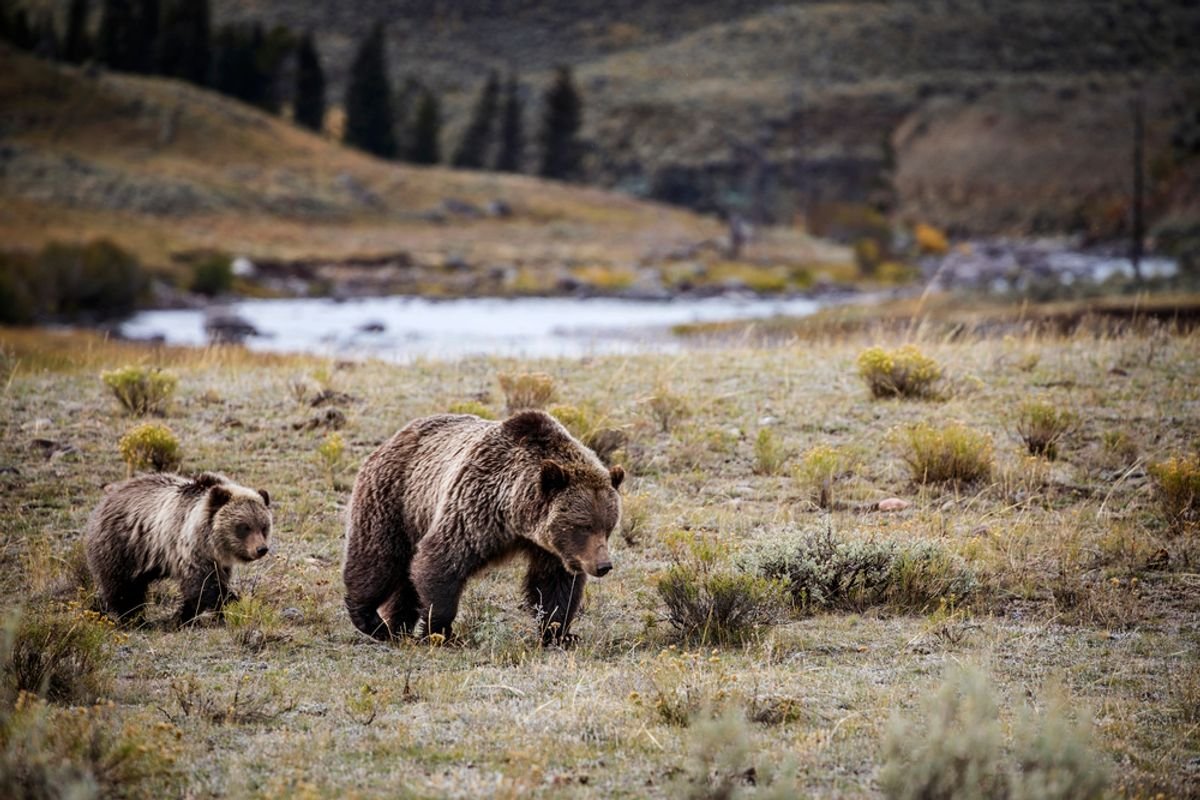
Are Animals Like Mountain Lions and Bears Leaving Yellowstone National Park?

Have you heard that hordes of animals are fleeing Yellowstone National Park? If so, did you wonder if it’s true? Well, there’s no need to worry. It’s not true, and the claim is easily debunked.
An article about the rumor posted on the Yellowstone Volcano Observatory website points out that the July 2025 social media post that seems to have set off the rumor claimed that hundreds of mountain lions had been seen leaving the park, headed south.
But, as the website points out, there are only about 40 mountain lions in the park. A few days later, another social media post showed a video of bears walking down a road and claimed the bears were clearing out of the park.
It took only a little investigation to determine that the video had been taken at a wildlife park in South Dakota. Similar posts were just as easily debunked.
Animal Rumors at Yellowstone National Park
These days crazy rumors and fake videos aren’t surprising. But the rumor about animals leaving Yellowstone is strangely persistent. It crops up every few years, says Michael Poland, a research geophysicist and Scientist-in-Charge of the Yellowstone Volcano Observatory. And occasionally it really takes off.
What makes people fall, again and again, for this crazy rumor? It may have something to do with earthquakes, and with another persistent myth.
Read More: Yellowstone Bison Meets Tragic End at Hot Spring, Showing the Danger of Hydrothermal Features
Seismic Activity at Yellowstone
There’s a lot of seismic activity in Yellowstone. In fact, it’s one of the more seismically active places in the United States. Huge faults run through Yellowstone, Poland explains.
The Yellowstone Plateau has the highest elevation of any area in the Rockies. It gets a lot of snow and rain. All that water moving around in the subsurface can promote tiny fault slips, which cause frequent small earthquakes.
There are typically between 1,000 and 3,000 earthquakes in Yellowstone every year, and 99 percent of them are magnitude 2 or less — that’s too small to feel. But bigger ones do occasionally rock the park (at least a little bit). In fact, the day before Discover interviewed Poland, there had been a magnitude 3.7 quake which was felt by several people in the park, he says. In 1975, there was a magnitude 6, and in 1959, there was a magnitude 7.3 just west of the park. That one, says Poland, is still the largest earthquake ever recorded in the Intermountain West.
So, what does this have to do with an animal exodus? According to Poland there’s a “low-level myth” that animals can sense this seismic activity and act weirdly if there’s about to be an earthquake. So when some prankster posts a fake video purporting to show animals leaving Yellowstone, one myth feeds the other.
Wildlife and Earthquakes
However, there’s no scientific evidence that wildlife can sense impending earthquakes or volcanic eruptions, says Linda Veress, spokesperson for Yellowstone.
And in any case, at the moment there’s nothing to suggest that a big earthquake is imminent. Poland and colleagues at the Yellowstone Volcano Observatory are keeping an eye on this.
Yellowstone is home to 40-odd seismic stations, says Poland, with multiple sensors at each site, totaling about 120 different types of sensors throughout the region.
“We can detect very, very small earthquakes,” says Poland. So, even if animals were inclined to scarper at the first hint of a quake, there’s nothing going on right now that doesn’t always go on.
Read More: New Hydrothermal Feature Emerges at Yellowstone National Park
Yellowstone Doesn’t Need Myths to Make It Special
Still, it might make sense that Yellowstone inspires myths. It’s a special place. Established in 1872, it’s the nation’s oldest national park, and is arguably the most beloved.
It’s home to grey wolves, black bears, grizzly bears, elk, deer, bison, moose, bighorn sheep, and much more. And that’s just the big mammals. There are badgers and bobcats and foxes and river otters. There are snakes and fish and frogs and over 300 species of birds. Over 1,000 species of native flowering plants bloom in the park.
Yellowstone has 290 waterfalls and more than 500 active geysers. That’s the densest concentration of geysers anywhere in the world.
“Boiling water shooting out of the ground. That doesn’t happen many places on Earth,” says Poland.
It’s easy to see why the park inspires myths. But Yellowstone doesn’t need myths to be inspirational.
“You don’t have to make stuff up to make Yellowstone spectacular,” says Poland.
Read More: A Yellowstone Sasquatch Event Blew Sediment 30 Feet in the Air
Article Sources
Our writers at Discovermagazine.com use peer-reviewed studies and high-quality sources for our articles, and our editors review for scientific accuracy and editorial standards. Review the sources used below for this article: