
Ancient People Brought Animals From Far and Wide for Elaborate Feasts in Bronze Age Britain
According to a new study in iScience, feasts were well worth the travel, even at the turbulent end of the British Bronze Age.
Analyzing the material from six middens, or massive rubbish mounds, that are still present in the terrain of England today, the study authors found that people travelled from all over Late Bronze Age Britain to take part in large food festivals, bringing animals like pigs and cattle along with them.
“Our findings show each midden had a distinct makeup of animal remains,” said Carmen Esposito, a study author and an archaeologist at the University of Bologna, according to a press release. “With some full of locally raised sheep and others with pigs or cattle from far and wide.”
Read More: Stonehenge Poses a New Mystery: The Altar Stone Came From Faraway Scotland
Feasting Leftovers in the Late Bronze Age

Landscape location of All Cannings Cross midden.
(Image Credit: Credit Cardiff University)
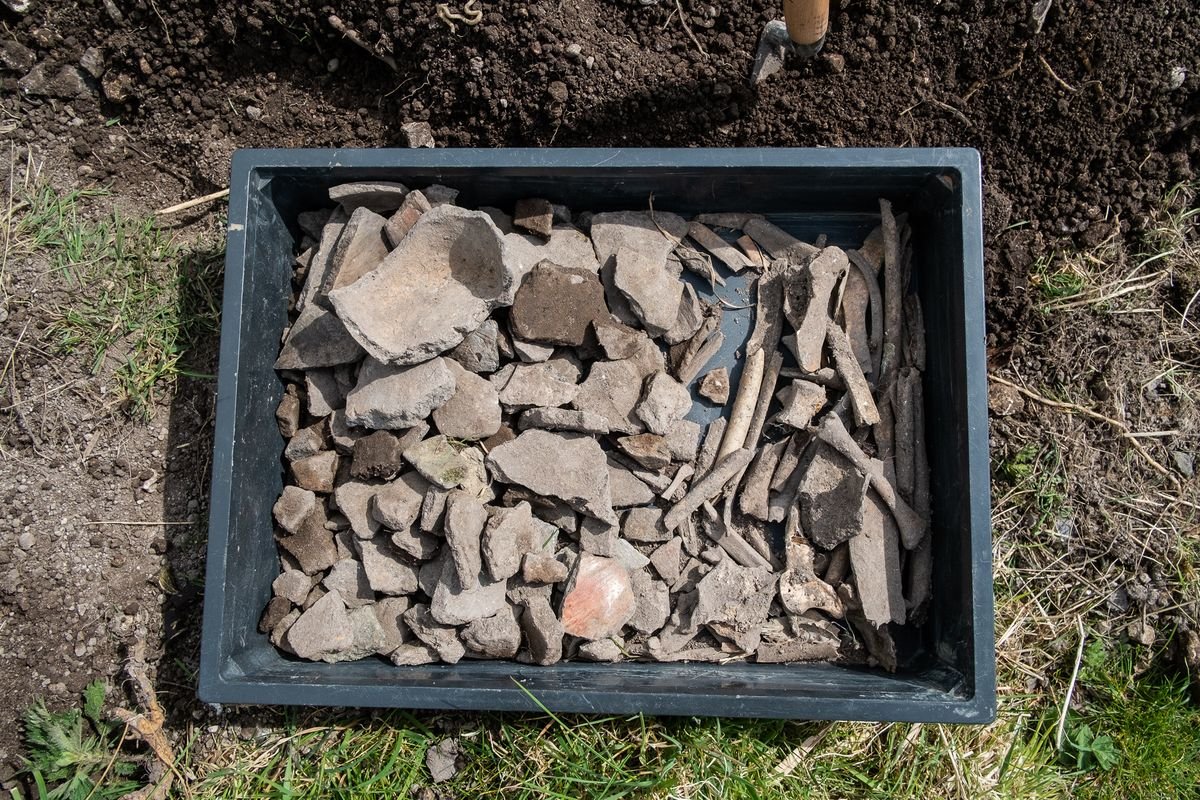
Left behind by ancient people, middens are mounds of debris, including discarded animal bones and broken pottery, many of which have turned into grassy hills over the years. In fact, in England, there are a handful of such hills in the southern areas of Wiltshire and the Thames Valley, the largest of which — Potterne in Wiltshire — contains around 15 million fragments of animal bones, left over from Late Bronze Age food festivals.
Hoping to learn more about these feasts, the authors of the new study analyzed the isotopes of the animal bone fragments found in six of England’s middens, all dating back to the Bronze Age-Iron Age transition between around 900 B.C.E. and 500 B.C.E. Showing where the animals were originally raised, the analysis underscores the size and scope of these gatherings, which were “key to sustaining specific regional economies, expressing identities, and sustaining relations between communities,” Esposito added in the release.
Indeed, the study authors found that the feasts were likely some of the largest to take place in British prehistory, with animals being brought from throughout the English terrain, creating new networks of social and economic connections centered on the festivities.
“At a time of climatic and economic instability, people in southern Britain turned to feasting — there was perhaps a feasting age between the Bronze and Iron Age,” said Richard Madgwick, another study author and an archaeologist at Cardiff University, according to the release. “These events [were] powerful for building and consolidating relationships both within and between communities.”
Read More: Archaeologists Propose Stonehenge May Have Unified People in Ancient Britain
Food From Near and Far
Of course, it was the isotopes from the animal bone fragments that allowed the study authors to size up these food festivals. Accumulated from the environment as an animal eats and drinks, isotopes appear in bones in different concentrations in different areas, allowing archaeologists to identify where an animal was raised, based only on its bones or bone fragments. Applying multi-isotope analysis, the study authors were thus able to isolate these markers, tracing the remains in the middens to animals brought up across England.
While the midden at East Chisenbury contained remains from local sheep, the majority featured rubbish from pigs or cows sourced from a range of British regions. At the Potterne midden, for instance, most of the feasting leftovers came from pigs, while at the Runnymede midden, more came from cattle. Still, the animals consumed at both sites were brought in from an assortment of locales, some as far away as northern England.
“The scale of these accumulations of debris […] is astonishing and points to communal consumption and social [mobilization] on a scale that is arguably unparalleled in British prehistory,” Madgwick concluded in the release. “Overall, the research points to the dynamic networks that were anchored on feasting events during this period and the different, perhaps complementary, roles that each midden had at the Bronze Age-Iron Age transition.”
Read More: How Hunter-Gatherers Used The Land Around Stonehenge
Article Sources
Our writers at Discovermagazine.com use peer-reviewed studies and high-quality sources for our articles, and our editors review for scientific accuracy and editorial standards. Review the sources used below for this article: