
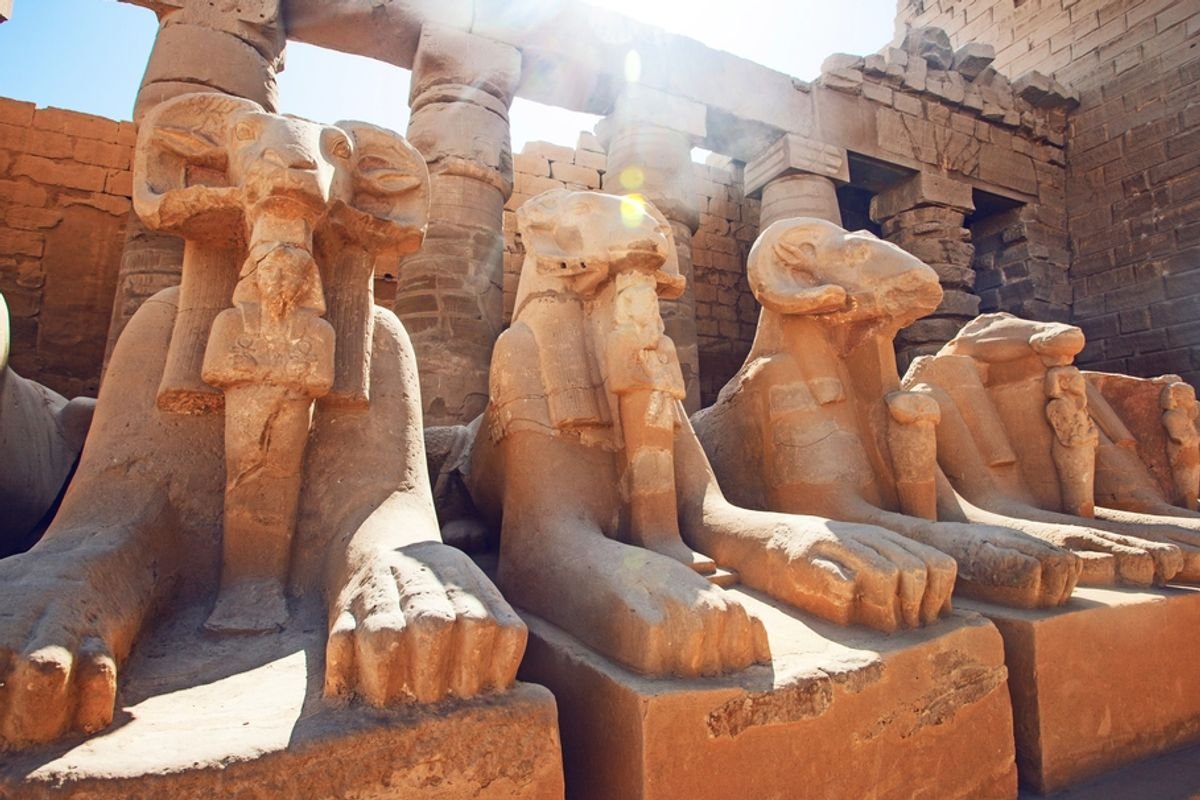
Ancient Egypt’s Karnak Temple Once Rose from the Nile River, Serving as a Tribute to Deities

With centuries of construction to its name, Ancient Egypt’s illustrious Karnak Temple wasn’t built in a day. The site — complete with colonnades, courtyards, and even a sacred lake — was constantly being upgraded over the course of 3,000 years. Karnak was the crown jewel of Thebes, Ancient Egypt’s religious capital, where people would worship multiple deities.
A new study published in Antiquity has dug through the storied past of Karnak, completing the most comprehensive geoarchaeological survey of the temple complex to date. Investigating 61 sediment cores excavated near the site, researchers uncovered a wealth of details on this religious hub, including when it was first occupied and the symbolism behind its position on the Nile River.
Ancient Egypt’s Karnak Temple
Before it grew to be a must-see destination by Egypt’s Eighteenth Dynasty (starting in 1550 B.C.E.), Karnak wasn’t exactly a hot spot of deity worship. About a century prior, it was just starting to take shape.
With the 61 sediment cores, researchers were able to determine when Karnak was established. They found that prior to 2520 B.C.E., regular flooding from the fast-moving Nile would’ve made the site unsuitable for permanent occupation.
It likely wasn’t until later in the Old Kingdom period (2591 to 2152 B.C.E) that people would’ve first settled on Karnak, with ceramic fragments suggesting that the earliest date of occupation could be sometime between 2305 to 1980 B.C.E.
Read More: First-Ever Whole Genome of an Ancient Egyptian Reveals What Life Was Like 4,800 Years Ago
Building an Island Temple
Though the Nile River prevented people from creating Karnak at first, it would later lay the foundation for the temple complex. The researchers say that the land Karnak was founded on was formed when river channels cut through beds to the east and west, creating an island in the middle of the Nile.
The researchers say that as the river channels on either side diverged further, more space became available for the temple complex to spread.
“The river channels surrounding the site shaped how the temple could develop and where, with new construction taking place on top of old rivers as they silted up,” said co-author Dominic Barker, an archaeology technician from the University of Southampton, in a statement. “We also see how Ancient Egyptians shaped the river itself, through the dumping of sands from the desert into channels, possibly to provide new land for building, for example.”
Over the centuries, pharaohs added to the site by building more grand structures. This would set the stage for celebrations like the annual Opet Festival, during which statues of deities would travel from Karnak to the nearby Luxor Temple. The procession took place along the Avenue of Sphinxes, a nearly two-mile road that connected the temples.
Parallels to Ancient Mythology
Situated on an area of high ground, the Karnak Temple would’ve looked like it was rising out of the Nile. This unique setting may have had religious meaning for the Ancient Egyptians who built the temple complex on the island, potentially as a way to convey their dedication to Amun-Ra, a major deity seen as a fusion of Amun (the god of air and creation) and Ra (the Sun god, known for his distinct falcon head).
Texts from the Old Kingdom portray the creator god as high ground that emerged from “the lake”. Since the island Karnak was founded on is the only known area of high ground surrounded by water in the region, it may be linked to this creation myth.
“It’s tempting to suggest the Theban elites chose Karnak’s location for the dwelling place of a new form of the creator god, ‘Ra-Amun’, as it fitted the cosmogonical scene of high ground emerging from surrounding water,” said lead author Ben Pennington, a geoarchaeologist at the University of Southampton.
Moving forward, the researchers plan on studying other sites in the region to find additional connections between the setting of the Nile and places of worship in Ancient Egypt.
Read More: 3 of the Most Important Pharaohs of Ancient Egypt
Article Sources
Our writers at Discovermagazine.com use peer-reviewed studies and high-quality sources for our articles, and our editors review for scientific accuracy and editorial standards. Review the sources used below for this article: