
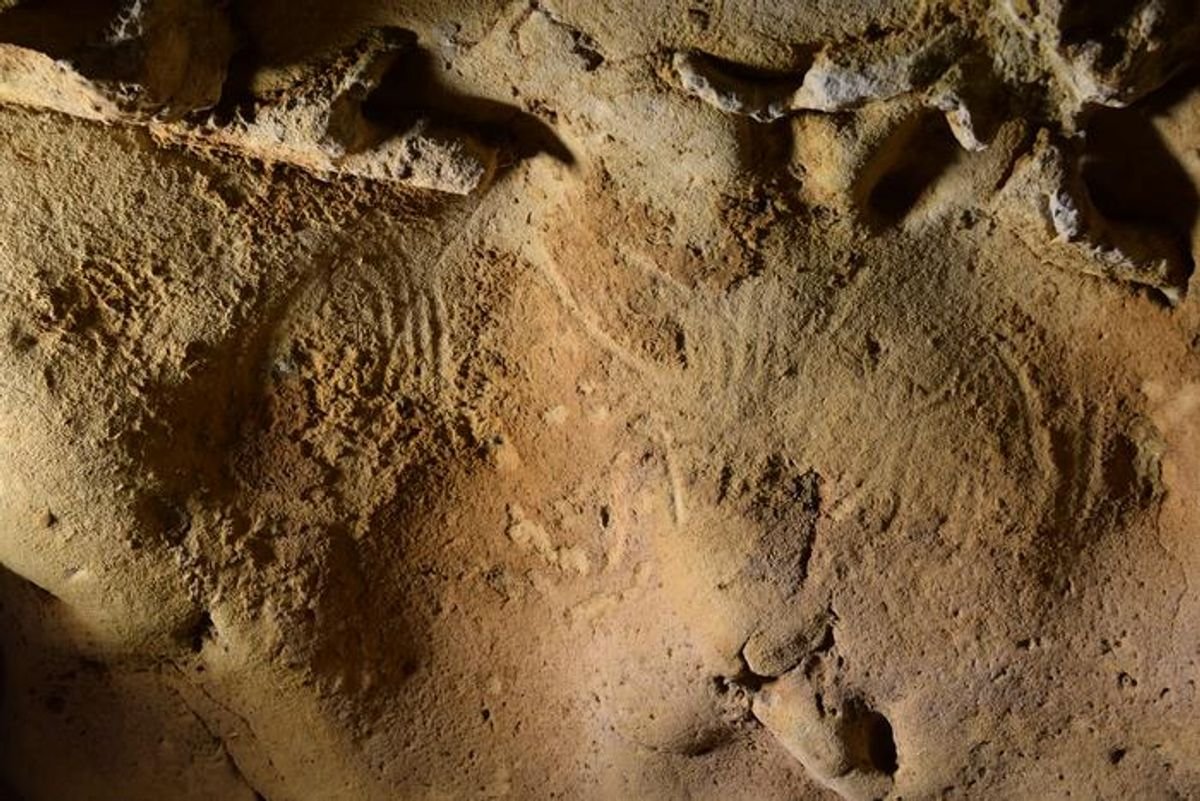
AI Helps Decode Mysterious Prehistoric Cave Markings Known as Finger Flutings

Every mark left on a cave wall is a conversation across time. Thousands of years ago, someone pressed their fingers into soft mineral film and drew looping lines — what archaeologists call finger flutings. These gestures endure, but the people behind them remain unknown.
That anonymity could be starting to fade. In a new paper published in Scientific Reports, researchers unveiled an AI system that analyzes modern finger flutings to test whether the sex of their ancient makers might one day be inferred, offering a rare way to trace identity in the deep past.
“Whether the marks were made by men or women can have real world implications,” said Dr. Andrea Jalandoni, lead researcher, in a recent press release.
What Are Finger Flutings?
Finger flutings are prehistoric markings made by running fingertips through clay or mineral deposits on the walls, ceilings, and floors of limestone caves. They appear at archaeological sites across Western Europe and Australia, dating from roughly 60,000 years to 12,000 years ago during the late Middle to Upper Paleolithic period.
Archaeologists regard them as some of the earliest known examples of symbolic expression, and one of the few art forms created by both Homo sapiens and Neanderthals.
“Finger flutings have the potential to reveal information about age, sex, height, handedness and idiosyncratic mark-making choices,” the authors wrote in the study, describing how their machine-learning framework merges physical replication with digital modeling.
Previous attempts to determine who made finger flutings relied on measuring finger widths — a method recent reviews have criticized as unreliable due to variation in cave surfaces and measurement error. The new AI-based approach offers a more objective way to test those ideas.
Read More: AI Could Translate 5,000-Year-Old-Language, Saving Time and Historical Insights
Using AI and VR to Decode Finger Flutings
Researchers ran two controlled experiments with 96 adult participants. Each person created nine flutings twice, once in a moonmilk clay substitute mimicking cave walls, and once in virtual reality (VR) using a Meta Quest 3. The images were used to train two image-recognition models designed to detect geometric differences in the marks.
The VR flutings didn’t yield reliable sex classifications, but the tactile ones performed much better.
“Under one training condition, models reached about 84 percent accuracy, and one model achieved a relatively strong discrimination score,” said Dr. Gervase Tuxworth of Murdoch University in the press release.
Still, the models picked up artefacts of the setup, not features that would generalize across caves. Even so, the study shows a reproducible pipeline linking archaeological methods and AI — a crucial step toward more rigorous digital archaeology.
Making Ancient Art Analysis Open and Reproducible
The researchers emphasize that their work is a proof of concept, not a final method. While the models performed best on the physical clay samples, they also revealed the limits of current AI approaches, learning patterns tied to the experimental setup rather than traits that could apply to ancient caves.
“We’ve released the code and materials so others can replicate the experiment, critique it, and scale it,” said Dr. Robert Haubt, co-author and information scientist at the Australian Research Centre for Human Evolution. “That’s how a proof of concept becomes a reliable tool.”
The team’s open dataset and code are available on GitHub. They suggest the framework could also be adapted for analyzing other forms of ancient markings, from petroglyphs to tool wear, broadening its use.
Read More: AI Revives 2,000-Year-Old Roman Scroll Burned in Mount Vesuvius Eruption
Article Sources
Our writers at Discovermagazine.com use peer-reviewed studies and high-quality sources for our articles, and our editors review for scientific accuracy and editorial standards. Review the sources used below for this article: