
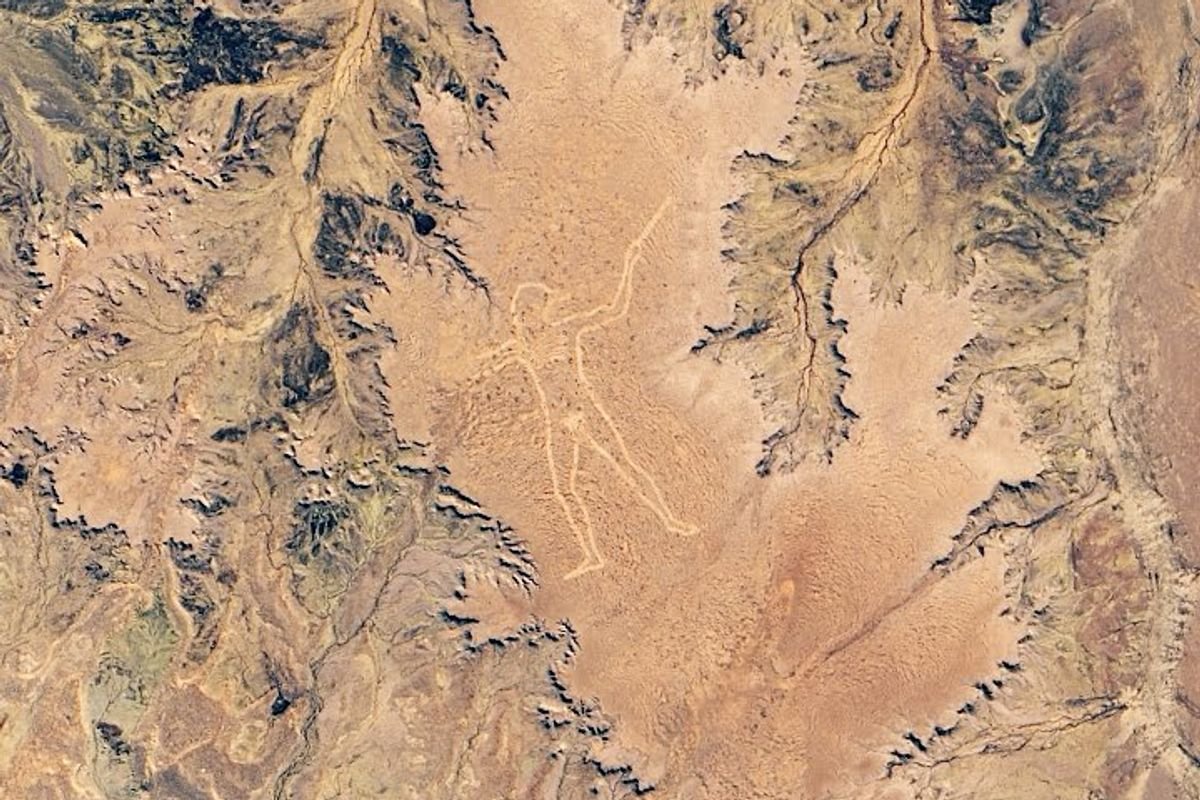
A Two-Mile-Tall Man Is Carved Into the Australian Outback — But No One Saw It Happen

If you ever find yourself flying over the Australian outback, you can look down and see one of its most enduring mysteries — a two-mile-tall naked man carved into the ground.
Known as the “Marree Man” or “Stuart’s Giant,” this enormous geoglyph appeared seemingly overnight on the Finniss Spring plateau, about 37 miles west of the remote township of Marree in South Australia.
The figure depicts what appears to be an Aboriginal hunter holding a throwable weapon. From top to bottom, the Marree Man stretches roughly 2.2 miles, with a perimeter that spans nearly 17 miles — a length that would take you about 30 minutes to drive.
Satellite data from NASA’s Landsat 8 dates the design’s creation to a span of just 16 days: somewhere between May 27 and June 12, 1998. Whoever made it worked fast and left nothing behind but a slowly disappearing puzzle yet to be solved.
Read More: Prehistoric Rock Art Lies Hidden Throughout the Grand Canyon
How the Marree Man Almost Disappeared
Thanks to the help of Mother Nature, the Marree Man geoglyph came close to disappearing forever. Over time, desert winds began to erase the mysterious giant’s shallow lines. By 2016, the Marree Man’s 10-inch-deep grooves had nearly completely faded into the landscape.
Before that could happen, a group of locals decided to bring him back to life. Using a commercial digger and a GPS-guided mapping system, they retraced the entire figure — a process that took 60 hours to complete.
The restored version has a special feature the original lacked: shallow grooves designed to trap water. These grooves will hopefully encourage vegetation to grow around the geoglyph’s outline. This clever addition means that in years to come, the figure’s green border may help better preserve its shape even longer than before.
Curiously, while redrawing the lines, workers uncovered about 250 bamboo stakes along the figure’s perimeter. Experts assume these were markers used by the original builder and suggest that the Marree Man’s creator used some kind of early GPS mapping system, which would have been cutting-edge technology in the late 1990s.
Marree Man: The Baby of the Geoglyph Family
Geoglyphs like the Marree Man are nothing new. For centuries they’ve been considered ancient symbols of human imagination.
The most famous examples are the Nazca Lines in Peru, which are vast ground drawings etched between 500 B.C.E. and 500 A.D. These massive figures of animals, plants, and imaginary beings have long puzzled archaeologists who still debate whether they served cosmic or ritual purposes, according to UNESCO.
The Blythe Intaglios in California depict human and animal forms carved into the desert between 450 and 2,000 years ago. The local Mojave people believe one figure represents Mustamho, their creator. In the Midwest, the Effigy Mounds of Iowa — shaped like birds, bears, turtles, and panthers — date back to 1400 B.C.E and served as both ceremonial and burial sites.
The Marree Man, by contrast, is barely old enough to drive. Yet, despite its youth, it carries the same mystifying power as those ancient counterparts. Who carved it, and why, remains one of modern archaeology’s strangest unsolved mysteries.
For now, the towering hunter continues to stand silent over the Australian outback, like a colossal question mark etched into the earth.
Read More: Petroglyphs in the U.S.: What Native Communities Want You to Know About These Rock Carvings
Article Sources
Our writers at Discovermagazine.com use peer-reviewed studies and high-quality sources for our articles, and our editors review for scientific accuracy and editorial standards. Review the sources used below for this article: