
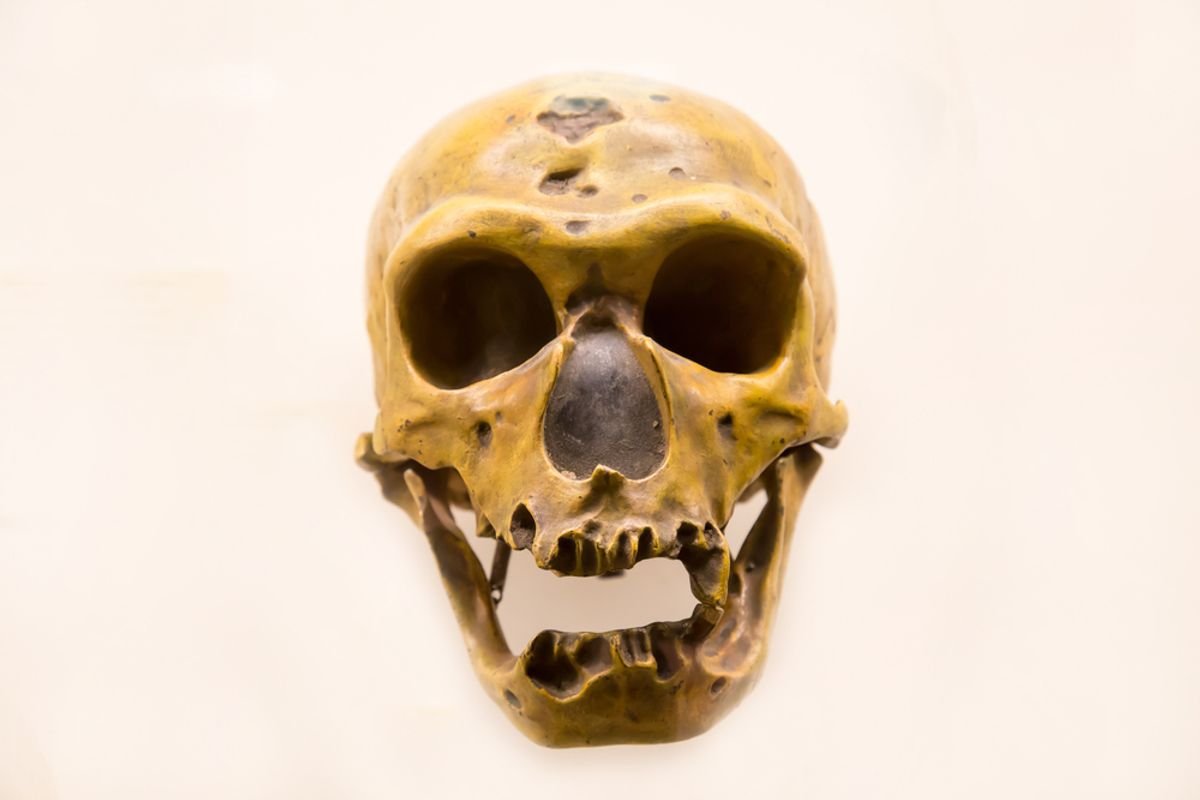
A Math Equation May Help Solve the Neanderthal Extinction Mystery

For decades, Neanderthals have been cast as the supporting characters in our evolutionary story. They thrived across Ice Age Europe and Western Asia for hundreds of thousands of years until modern humans arrived. Not long after, Neanderthals were gone. Did climate chaos doom them? Did our species outcompete them? Or were they simply swallowed by history?
A new mathematical model, published in Scientific Reports, offers a new answer.
“Small-scale Homo sapiens immigrations into Neanderthal populations, providing recurrent gene mixing, could have led to almost complete genetic substitution over 10,000 to 30,000 years,” the study’s authors said.
In other words, Neanderthals may not have died out. Instead, they became us.
Read More: The Fascinating Path of Neanderthal Evolution: Where Did Neanderthals Come From?
When Homo sapiens met Neanderthals
Neanderthals originated in Eurasia around 400,000 years ago, adapting impressively to glacial extremes. They were the region’s predominant hominins, crafting sophisticated tools and hunting animals long before H. sapiens showed up.
Genetic and archaeological evidence suggests that “modern humans are thought to have migrated from Africa to the Levant and then spread throughout Eurasia by the end of the Middle Paleolithic, around 45,000 years ago.”
These migrations didn’t happen in one giant wave, but more like a long series of arrivals over thousands of years. Every wave created new opportunities for interaction, trade, competition, alliances, and reproduction.
Today, most people outside Africa still carry a small percentage of Neanderthal DNA. That genetic legacy hints that the Neanderthal’s story wasn’t one of extinction, but of absorption.
How Does Math Help Tell the Story of Neanderthals?
The new study takes this idea of genetic absorption and puts math behind it. The mathematical model is based on neutral species drift — a term meaning no one population requires a biological advantage to be successful. Instead, all they needed was larger demographics and lots of time.
Neanderthal groups were small, with just a few thousand individuals across a huge geographic area. Meanwhile, H. sapiens populations were much larger.
As described in the study, Neanderthal groups were like “islands,” whereas H. sapiens groups were the “mainland.” Each new wave of H. sapiens immigrants contributed a bit more modern human DNA to the Neanderthal groups. Genetically, the effects compound exponentially over time. A little genetic dilution every generation leads to dramatic change within a couple of thousand years.
“Rather than sudden extinction, our model proposes that repeated cycles of H. sapiens immigration leading to the Neanderthal gene dilution could account for the Neanderthals’ disappearance and the observed patterns of Neanderthal ancestry in modern human populations,” explained the research team.
Changing the Neanderthal Story
Although it may be a less exciting story about what happened to the Neanderthals, this study aligns with genetic evidence of interbreeding between H. sapiens and Neanderthals. It also implies that by the time the Neanderthals vanished, their genetic identity might have already been largely combined into the modern human gene pool.
This mathematical model suggests that you don’t need a Hollywood-inspired dramatic event — like a plague or sudden climate disaster — to explain the genetic disappearance of Neanderthals. Instead, a constant trickle of modern human genes into the smaller Neanderthal pool could have easily done the job.
Read More: Neanderthal vs Homo Sapiens: How Are Neanderthals Different From Humans?
Article Sources
Our writers at Discovermagazine.com use peer-reviewed studies and high-quality sources for our articles, and our editors review for scientific accuracy and editorial standards. Review the sources used below for this article:
This article references information from the recent study published in the journal Scientific Reports: A simple analytical model for Neanderthal disappearance due to genetic dilution by recurrent small-scale immigrations of modern humans