
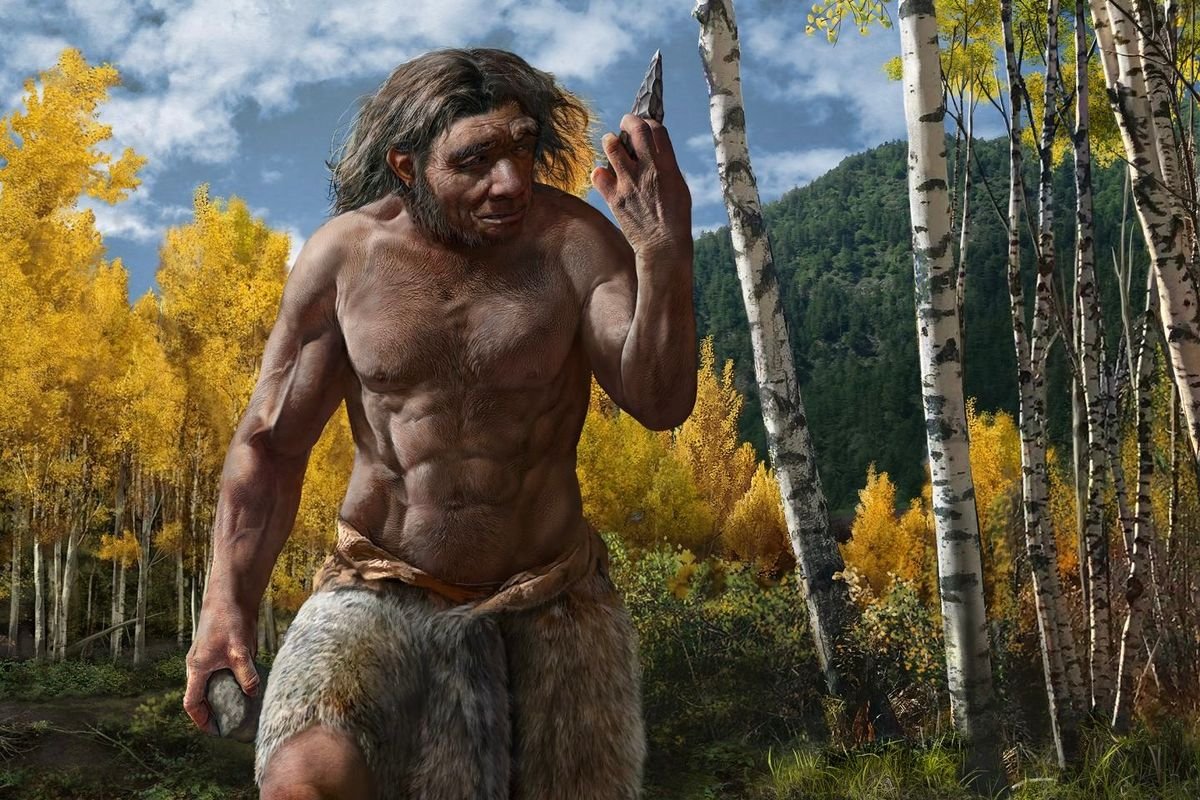
A Crushed Cranium From One Million Years Ago Could Transform Our Timeline of Human Origins

In 1990, researchers pulled a damaged cranium out of the layers of sediment in Central China. The skull was difficult to identify due to the distortion, but was assigned to the early human lineage Homo erectus, based on the age of the surrounding strata.
A new analysis in Science challenges that classification, however, showing that the approximately one-million-year-old specimen belonged to Homo longi, a sister species of Homo sapiens that has been tied to the Denisovans, who once occupied Asia while the Neanderthals inhabited Europe.
The new analysis, which involved the reconstruction of the skull, suggests that the species is much older than traditionally thought. In fact, the results could transform the origins not only of Homo longi, but of Homo sapiens and Homo neanderthalensis, as well, hinting that the three lineages diverged not hundreds of thousands of years ago, but millions.
Read More: Who Were the Denisovans?
Reconstructing a Smashed Skull
The cranium wasn’t the first to be found in Yunxian, an area in the city of Shiyan in Central China. Instead, it was the second, following a skull found in 1989. Both specimens were traced to around a million years ago — about 1.10 million to 0.94 million, to be specific — and showed a mishmash of primitive and modern features, similar to those seen in H. erectus and H. sapiens. But, because these skulls were damaged from their time in the soil, their attribution to H. erectus has remained tentative.
To learn more about their identity, the authors of the new analysis turned to computed tomography to scan, separate, and digitally reconstruct the distorted sections of the less-damaged skull, Yunxian 2. The reconstruction revealed several cranial traits that had been hidden by the destruction, including a large braincase and a low, long frontal bone, indicating that the fossil belonged not to H. erectus or H. sapiens, but to an early branch of H. longi — a lineage identified from a skull from Harbin, China, in 2021, and linked to the Denisovans in 2025.
If the new classification of Yunxian 2 is correct, the age of the fossil could push back the divergence of H. longi, H. sapiens, and H. neanderthalensis by hundreds of thousands of years. Though it is traditionally thought that these species arose approximately 700,000 to 500,000 years ago, the researchers instead assert that H. longi and H. sapiens could have separated from their shared common ancestor around 1.32 million years ago, while H. neanderthalensis could have split off in advance of that, as many as 1.38 million years ago.
Read More: 146,000-Year-Old Dragon Man Skull Confirmed as Denisovan Through Dental DNA
The Human Species Split
In addition to their large braincases and their lower, longer foreheads, H. longi individuals also possessed a prominent brow and a pronounced depression between the brow bones, both of which are apparent in the cranium from Harbin — a later specimen, from approximately 146,000 years ago.
That these traits are also apparent in the reconstructed Yunxian 2 skull suggests that they emerged early on after the separation of H. longi and H. sapiens, pointing to a period of sudden diversification shortly after their split.
Though the results of the study are still shaky, the analysis opens the door for future reconstructions of distorted fossils, whose deformation has historically obscured our picture of the past, hiding essential evidence about the early evolution of humans.
“It is now well known that there were at one time many Homo lineages,” wrote Sacha Vignieri, the editor of the analysis, in its editorial summary. “Understanding of the differences among these lineages is largely dependent upon crania that are rare and often damaged and deformed by age.”
The approach, therefore, means that the damaged may not remain damaged forever, giving us a new glimpse into the faces and history of humans past.
Read More: 146,000-Year-Old Dragon Man Skull Confirmed as Denisovan Through Dental DNA
Article Sources
Our writers at Discovermagazine.com use peer-reviewed studies and high-quality sources for our articles, and our editors review for scientific accuracy and editorial standards. Review the sources used below for this article: