
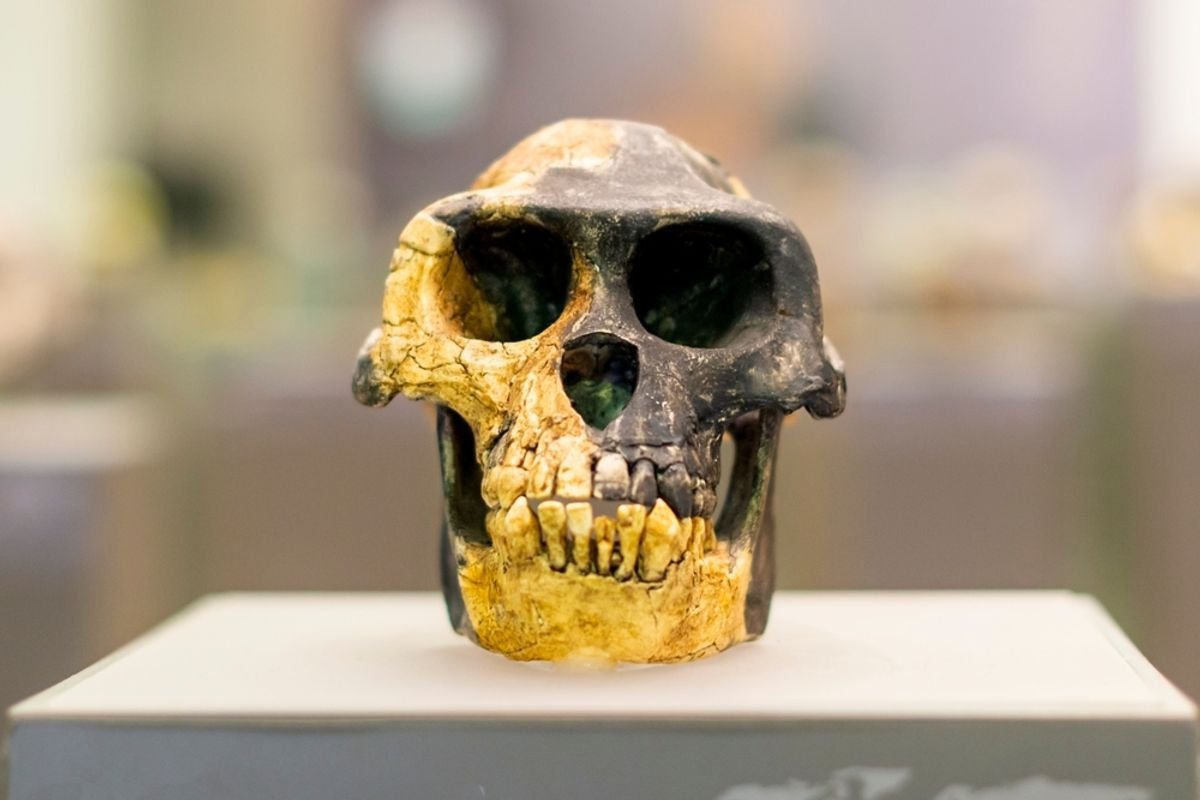
4.4-Million-Year-Old Ankle Holds Clues to How Our Ancient Ancestors Walked

New research gives weight to the idea that humans evolved from a species not dissimilar to an African ape. And it all comes down to the ankles.
Humans stand apart — quite literally — from other primates thanks to our preference for walking on two legs. While bonobos, chimpanzees and other species of ape and monkey do sometimes walk on their hind limbs, it isn’t their predominant mode of movement. As such, the shift from walking on four limbs (quadrupedalism) to walking on two feet (bipedalism) is considered a crucial moment in our evolutionary journey.
Now, a study published in the journal Communications Biology puts forward evidence that suggests an ancient hominin possessed morphological features similar to those seen in gorillas and chimpanzees today, as well as features indicative of an early form of bipedalism. This sheds light on the evolution of bipedalism and “directly narrows the range of explanations for the origin of our lineage,” the researchers wrote in the study.
Read More: Were Hominins in Europe 6 Million Years Ago? Footprint Find Sparks Debate
Ardipithecus ramidus: A True Transitional Species
Between 1992 and 1994, a team of paleoanthropologists digging in the Afar Region of Ethiopia uncovered the first remains of an ancient species called Ardipithecus ramidus — an omnivorous creature that clambered through the trees and strolled through the woodlands of Africa 4.4 million years ago, more than a million years before its more famous relative “Lucy” (Australopithecus afarensis).
The discovery of a new species is a big occasion in itself, but finding Ar. ramidus was particularly momentous because of its place in our family tree. Ar. ramidus is the only hominin (that we currently know of) to have existed at that point in time and some researchers believe it may have been an ancestor of Australopithecus, which itself is thought to be an ancestor of the genus Homo.
Since 1992, the team has found fossils belonging to around 35 individuals. By far the most impressive is a partial skeleton belonging to a female, first described in 2009. The individual (nicknamed “Ardi”) is estimated to weigh around 50 kilograms (about 110 pounds) and stand about 120 centimeters (about 47 inches) tall.
“One of the surprises in this discovery was that Ardi walked upright, yet retained a lot of ape-like characteristics, including a grasping foot,” lead author Thomas Prang, assistant professor of biological anthropology in Arts & Sciences at Washington University in St Louis, said in a statement.
The fact that it combines features common to apes such as chimpanzees and gorillas as well as those seen in human ancestors makes Ar. ramidus “a true transitional species,” said Prang.
Three decades after the initial discovery, Ardi continues to be one of the oldest and most complete skeletons of a hominid discovered to date.
Comparing the Foot Bones of Primates
In this new paper, Prang and his team compared Ardi’s ankle bones to those of apes, monkeys and early humans — specifically the talus (a bone in the ankle that meets the tibia (shin bone) and fibula (calf bone)) and calcaneus (the heel).
Interestingly, Ardi’s ankle presented a unique blend of features that incorporated characteristics seen in African apes and those suggestive of bipedal movement. The positioning of the talus, for example, shows “a more African ape-like ankle posture” that may have supported movement such as vertical climbing.
“Collectively, these results are inconsistent with human and chimpanzee evolution from a generalized arboreal ancestor that lacked adaptations for terrestrial quadrupedalism, vertical climbing, and suspension,” the study’s authors wrote.
Prang describes these findings as a “correction,” redressing earlier interpretations that did not recognize Ardi’s connection to apes like chimps and gorillas, and instead thought the skeleton provided evidence for a more generalized ancestor.
“Based on their analysis, they concluded that living African apes — like chimpanzees and gorillas — are like dead ends or cul-de-sacs of evolution, rather than stages of human emergence,” said Prang. Instead, he says, this suggests the last common ancestor we shared with chimpanzees shared certain similarities to chimpanzees living today.
Read More: Humans Evolved From A Common Ancestor That Appeared 6 Million Years Ago
Article Sources
Our writers at Discovermagazine.com use peer-reviewed studies and high-quality sources for our articles, and our editors review for scientific accuracy and editorial standards. Review the sources used below for this article: