
Zelia Nuttall Helped Decode Mesoamerican Manuscripts — Including the Aztec Calendar

When there’s a will, there’s a way. And for Zelia Nuttall, a lack of a college education and a professorship were not going to stand in the way of what she wanted.
As a single mother in the late 1800s, Nuttall would work tirelessly to fund her own anthropological and archaeological research, identifying artifacts and cracking codes left behind by Mesoamericans.
Nuttall, an American-Mexican scholar, may not be well-remembered, but some scientists say her contributions were legendary.
Read More: Meet 10 Women in Science Who Changed the World
Who was Zelia Nuttall?
Zelia Maria Magdalena Nuttall was born in California in 1857 to a Mexican-American mother and an Irish father. Her father, a physician, had health issues, so the family moved to Europe in 1865 and remained for the next 11 years.
Though she was already fluent in English and Spanish, her time in Europe also helped her become fluent in French, German, and Italian, according to a report in American Anthropologist.
After her family returned to the U.S., she married an amateur anthropologist from France in 1880. Together, they had a daughter in 1882, but separated in 1884. Although the marriage was brief, Nuttall’s ex-husband introduced her to the study of Mesoamerican cultures.
Because anthropology and archaeology required travel and substantial funding, amateurs not affiliated with universities could participate if they had the means to do so.
“Women could create careers for themselves because the field was populated by amateurs who were either self-taught and self-motivated or who served as ‘apprentices’ to other early pioneers,” Merilee S. Grindle, the Edward S. Mason professor of International Development, Emerita, at Harvard University and the author of In the Shadow of Quetzalcoatl: Zelia Nuttall and the Search for Mexico’s Ancient Civilizations, told Discover.
For many women, opportunities typically involved serving as curators or helping preserve artifacts. But for Nuttall, her language abilities allowed her to tackle Mesoamerican iconography and crack puzzling codes, according to the book, Women in Archeology.
What Did Zelia Nuttall Discover?
Nuttall’s greatest finds didn’t come from a dig site. She made her discoveries in European libraries and archives. After the Spanish conquest of the Americas, many Aztec artifacts were destroyed or sent to Europe as novelty gifts. These “gifts” made their way to library collections.
“She knew the written record of the past as no one else at her time; she rummaged through archives, museums, libraries, and digs with an exceptionally keen eye for discovery, and she put enormous energy into putting facts and ideas together,” Grindle said.
Nuttall taught herself Nahuatl, the language of the Aztecs, and analyzed pictographs lost in European collections, according to Grindle. In 1886, she published her first academic article, “Terra Cotta heads of Teotihuacan,” in which she used her decoding skills to explain how the heads were part of a funerary practice. Previously, scholars assumed the heads were depictions of different races.
“She did not fall into her generation’s obsession with ideas of a hierarchy of civilizations, but consistently focused on the contributions and achievements of Mesoamerican cultures,” Grindle told Discover. “She believed they demonstrated something special and honorable in human history.”
Cracking the Code
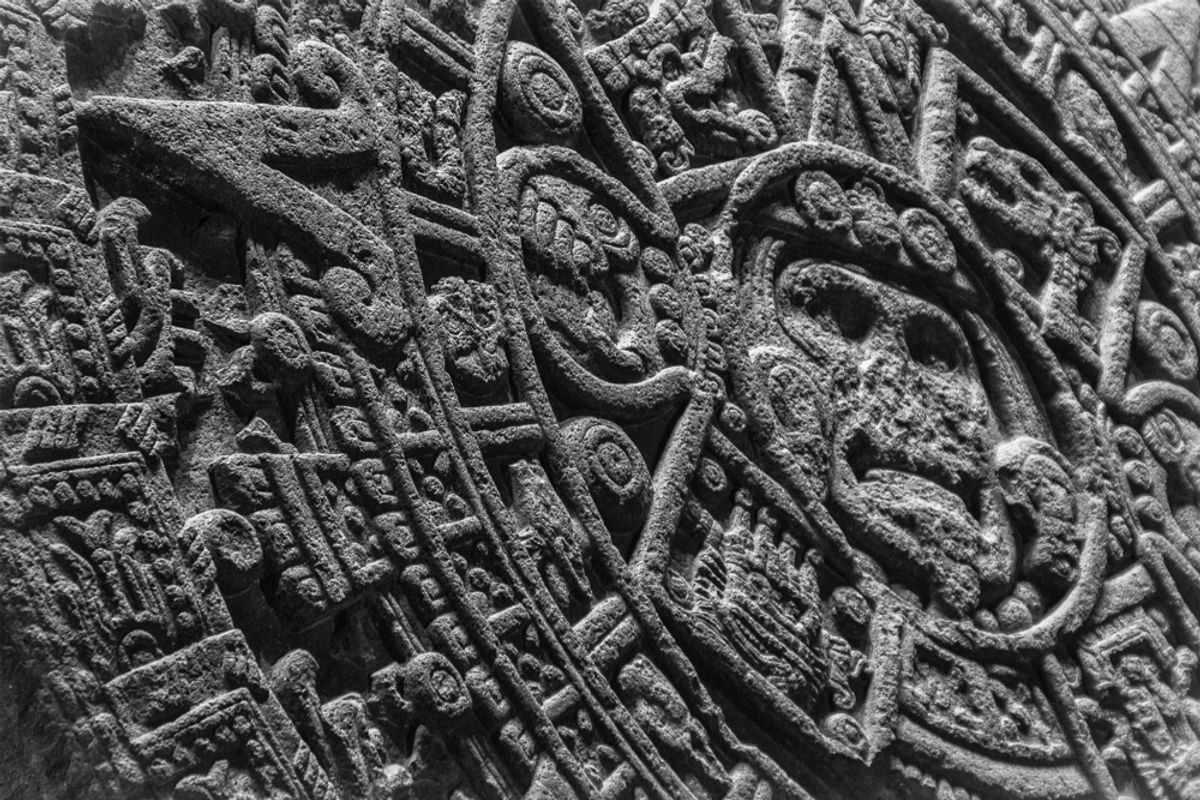
Nuttall also brought her deciphering skills to the Aztec Calendar Stone. The stone was likely buried sometime in the 1500s to protect it from the Spanish. It was unearthed in 1790, but scholars were befuddled until Nuttall unlocked its meaning.
There were actually two calendars. The first was a 260-day ritual calendar. “The other was a 360-day solar calendar that laid out solstices and equinoxes and seasons — with five additional days tacked on at the end of each calendar year — to make it astronomically accurate,” Grindle said.
Nuttall determined how the calendars functioned together. In doing so, she revealed the Aztecs were a highly sophisticated society with an advanced understanding of astronomy.
Scholars benefited from Nuttall’s discoveries, including the Aztec iconography she decoded in the many codebooks and articles she published, according to the book The Codex Nuttall.
Nuttall was well-known during her lifetime, and many scholars visited her home near Mexico City. But after she died in 1933, many forgot about her contributions.
Grindle says there were many reasons Nuttall was not better remembered, and part of this had to do with changes within the discipline. Anthropology and archeology both became fields requiring an advanced degree, and few women were allowed to study.
“Those who controlled access to graduate degrees in universities essentially became a ‘club’ that tended to discriminate against the admission of women,” Grindle said.
The same club also suppressed the memory of past scholars who didn’t fit the disciplines’ new directions, including Nuttall.
Read More: The Fall of the Aztec Empire: What Really Happened in the Battle of Tenochtitlan?
Article Sources
Our writers at Discovermagazine.com use peer-reviewed studies and high-quality sources for our articles, and our editors review for scientific accuracy and editorial standards. Review the sources used below for this article: