
Your Backyard Hammock Has a 4,000-Year-Old History and Helped Shape the Americas
You may have memories of lounging in a hammock while at summer camp, or you might even have one in your own yard. But have you ever wondered where they came from?
A new study in Postmedieval tells the story of the hammock, an Indigenous technology that has often been overlooked by scholars. What may seem like a basic sleeping net is actually a complex material object that can teach us a lot about Indigenous and European colonizer history.
Read More: How Indigenous Oral Tradition Is Guiding Archaeology and Uncovering Climate History in Alaska
How Were Hammocks Made?

Artist’s interpretation of a hospitality ritual in a hammock. Created by André Thevet, Les singularitez de la France Antarctique (Paris, 1588), 85–87.
(Image Credit: Huntington Library, San Marino, CA)
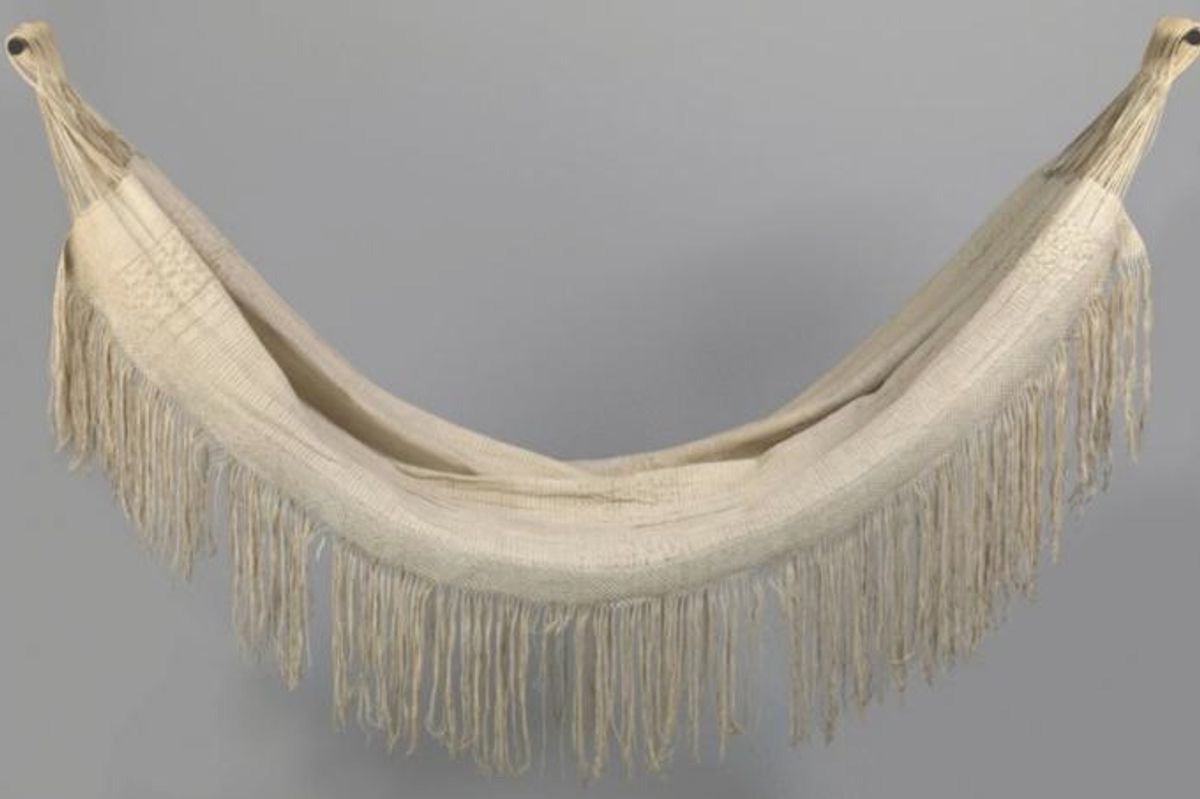
Hammocks originated in the Caribbean and South America, and were typically woven by women who mastered the skills of fiber-working. Fiber-workers would use threads made from palm and cotton plants, and either hand-weave or use a loom to create the hammocks.
As explained by co-author John Kuhn in a press release, these materials are partially to blame for the hammock being an often-forgotten part of material culture:
“The oldest preserved specimen is 4,000 years old, but they may actually be much older. We just don’t know; textiles don’t preserve well in the tropics.”
Fiber-working was not the only skill on display through the making of hammocks. The ability to make a hammock requires a wide range of skills, including agroforestry, dyeing, weaving, cleaning, and architecture.
What Did Indigenous Cultures Use Hammocks For?
Although Indigenous cultures often used hammocks for sleeping, they also used them for a wide array of cultural practices, as well. Hammocks were intimately tied to a person’s personal expression and interests, as they were used as private spaces where people could engage in conversation or their favorite hobbies.
The word “hammock,” according to a Kalinago-French dictionary, is thought to come from Indigenous words for “placenta” and “womb.” Babies were often placed in a hammock after birth, and they remained a place of comfort and safety throughout people’s lives.
Hammocks also held an important role in religious ceremonies and practices. They were sometimes used as burial shrouds, as well as a place where shamans would lie in order to pass into a trance state and communicate with spirits.
Hammocks and Colonization
From the beginning of the colonial project in the Western Hemisphere during the fifteenth century, European colonizers recognized the hammock as an invaluable technology for Indigenous peoples. Europeans were likely introduced to the hammock as part of hospitality practices, and they immediately took to the technology.
Hammocks are comfortable to sleep in because they are breathable in the stifling heat of the tropics and are more effective at helping people avoid insects than the ground mattresses Europeans used. These factors are what made hammocks a common technology used by Europeans during their military expeditions in the Americas. The technology was so beneficial to soldiers during these expeditions that English explorer Sir Walter Raleigh wrote home and suggested that hammocks be adopted for European missions as well.
Unfortunately, much like chocolate and tobacco, the hammock became another part of Indigenous culture that was co-opted by European colonizers without regard. The research team hopes that their history of the hammock will inspire people to think more about where these technologies came from and how they challenge the belief that Indigenous technologies are inferior to those of the colonizers.
“Sometimes people have this idea that Indigenous cultures were just destroyed, and they aren’t necessarily seen as huge technological contributors to the Atlantic world that emerges out of colonization. The next time you see a hammock, just take a minute to marvel at the ingenuity of the cultures it sprang from,” concluded Kuhn.
Read More: The Florentine Codex Describes Early Aztec Life and Is Now Accessible Online
Article Sources
Our writers at Discovermagazine.com use peer-reviewed studies and high-quality sources for our articles, and our editors review for scientific accuracy and editorial standards. Review the sources used below for this article: