
Young Martian Volcano Reveals 9 Million Years of Hidden Activity

Mars may look frozen and silent today, but near Pavonis Mons — a volcano that rises nearly nine miles above the Martian surface — researchers have uncovered evidence that a nearby volcanic system remained active for millions of years longer than once assumed.
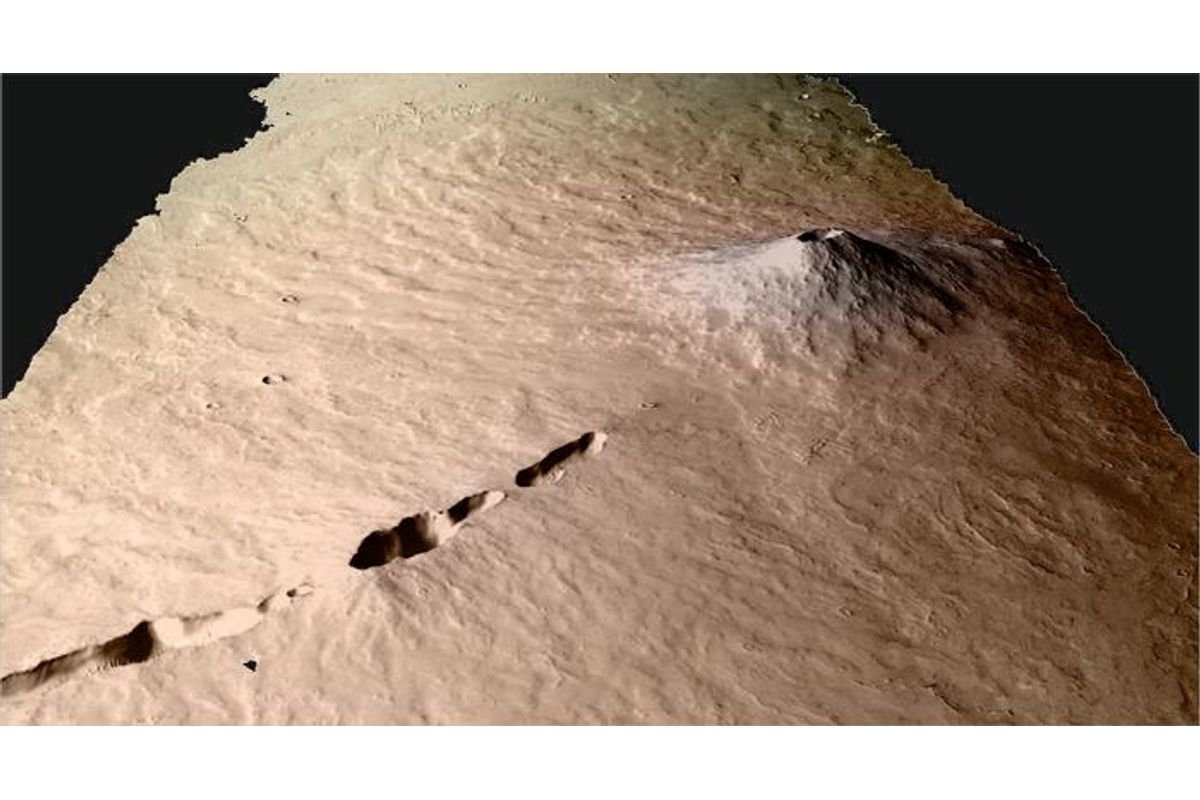
Researchers studying a smaller cluster of lava flows just south of the massive volcano found that what appears to be a simple lava field actually records at least nine million years of underground activity. Rather than erupting once and fading away, the system continued sending molten rock to the surface as conditions below slowly changed. The findings, published in Geology, challenge the idea that Mars’s later volcanic history consisted mainly of brief, isolated outbursts.
“Our results show that even during Mars’ most recent volcanic period, magma systems beneath the surface remained active and complex,” said study author Bartosz Pieterek, in a press release. “The volcano did not erupt just once—it evolved over time as conditions in the subsurface changed.”
Read More: Thin Ice May Have Helped Ancient Lakes Survive on Mars
Mapping Volcanism on Mars
Volcanism has shaped Mars for billions of years. The planet’s largest volcanoes formed early in its history, when internal heat was far more abundant.
Because scientists cannot yet drill into Mars’ crust or collect samples from this region, understanding what happens beneath the surface requires indirect evidence. To piece together the system’s history, the research team combined topographic mapping with mineral measurements collected by instruments aboard NASA’s Mars Reconnaissance Orbiter. By examining the shape, age, and chemistry of different lava flows, they reconstructed how eruptions unfolded over time.
The oldest flows spread widely across the landscape, traveling nearly 19 miles (about 30 kilometers). These early eruptions released lava along a long crack in the crust. Millions of years later, activity became more focused, building a central cone and producing shorter, finger-shaped flows between 3 and 6 miles (5 to 10 kilometers) long.
The shift from crack-fed eruptions to cone-building activity indicates that the same underground plumbing system continued operating, but in different ways, over an extended period.
Mineral Clues Inside a Young Volcano
Using visible and near-infrared measurements from orbit, the team identified differences in the composition of the older and younger flows. The earlier, widespread lavas show strong signals of olivine, a mineral commonly associated with hotter magma rising from deeper inside a planet. The later cone-building flows are dominated by high-calcium pyroxene, which typically forms when molten rock cools and changes while stored underground.
“These mineral differences tell us that the magma itself was evolving,” Pieterek explained. “This likely reflects changes in how deep the magma originated and how long it was stored beneath the surface before erupting.”
Laboratory studies of Martian meteorites suggest such mineral shifts can reflect changes in temperature and storage conditions as magma cools. In this case, the transition from olivine-rich to pyroxene-rich lava shows that the magma feeding later eruptions likely cooled within the crust before reaching the surface.
A More Nuanced View of Late Martian Volcanism
Late Martian volcanism has often been described as fairly uniform. This study instead points to a more chemically varied history within a single young system.
The transition from olivine-rich to pyroxene-rich lava offers rare evidence that magma changed composition over time — a pattern not widely documented in similarly young Martian volcanic fields.
By connecting surface features with mineral clues, the researchers pieced together how magma rose from deep inside Mars, cooled beneath the crust, and erupted again, indicating that even relatively recent volcanic activity on the Red Planet was more complex than it first appears.
Read More: Bacteria Haven’t Been Found On Mars — Could They Be Beneath the Surface?
Article Sources
Our writers at Discovermagazine.com use peer-reviewed studies and high-quality sources for our articles, and our editors review for scientific accuracy and editorial standards. Review the sources used below for this article: