
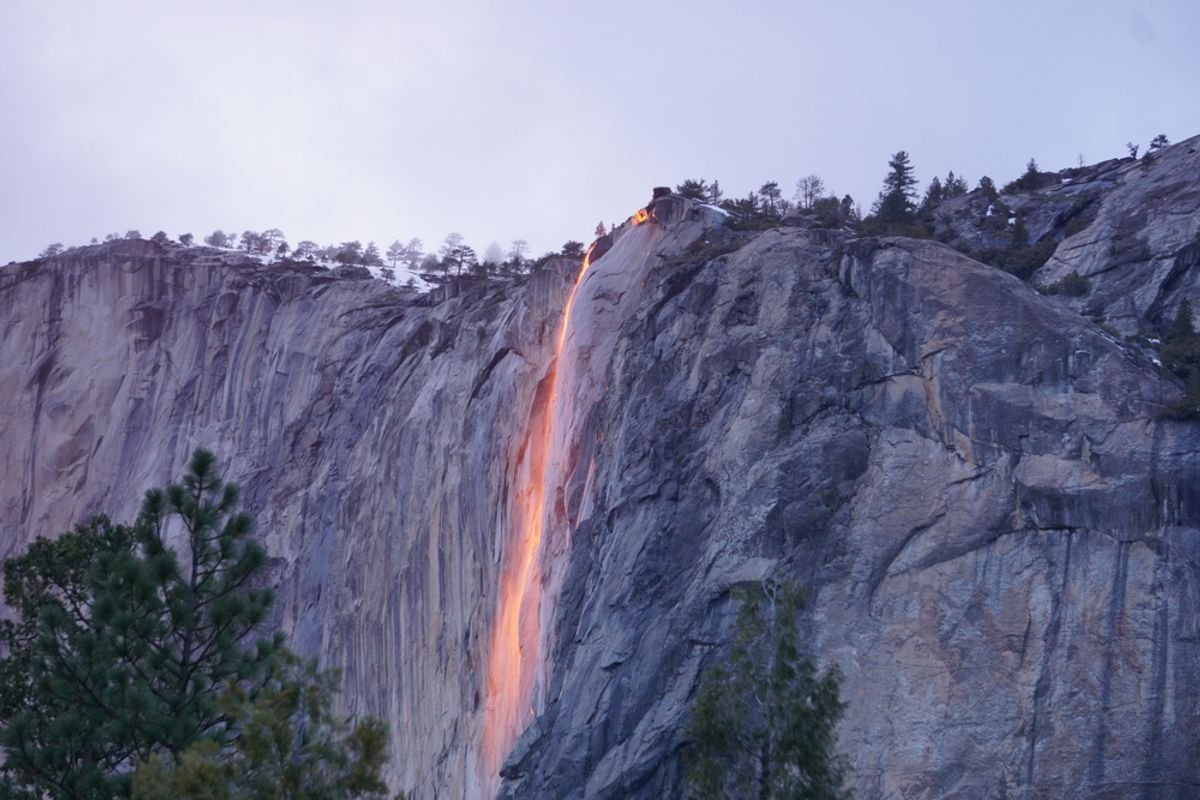
Yosemite’s Rare Firefall Returns This February — but the Fiery Glow Will Last Only Minutes

Once a year, a waterfall at Yosemite National Park ignites into a can’t-miss natural phenomenon — the Firefall. For a few minutes on select evenings in mid to late February, Horsetail Fall, usually overlooked by many Yosemite visitors, suddenly glows orange and red as the sun drops toward the horizon. The effect lasts just 5 to 15 minutes, but it draws thousands of people from across the country to the park each year.
Most of the year, Horsetail Fall is far from Yosemite’s headline act. Although it drops an impressive 2,130 feet, the stream at the top of El Capitan is narrow and fed entirely by snowmelt and runoff. By summer, it often dries up completely and disappears.
But for a few weeks in February, the right combination of sun angle, flowing water, and clear skies transforms the waterfall into something that looks almost unreal. In 2026, visitors can view the Firefall between Feb. 10 and Feb. 26, according to the National Parks Traveler.
Read More: Your Guide to Staying Safe While Visiting National Parks
What Causes Yosemite’s Firefall?
According to the Yosemite Mariposa County Tourism Bureau, the Firefall effect depends on two precise conditions. First, the sun must align with Horsetail Fall at just the right angle. This only happens in mid to late February, when the setting sun shines directly on the waterfall rather than slipping behind surrounding cliffs. As sunset approaches, the light shifts and bathes the falling water in warm tones that resemble molten lava.
The second requirement is water — something that isn’t as guaranteed as you may think. Horsetail Fall needs enough snow above El Capitan to feed the stream, and daytime temperatures must be warm enough to melt that snow and send water flowing over the cliff. Too little snow, overly cold days, or heavy cloud cover can cancel the effect entirely.
The History Behind the Firefall
The name “Firefall” predates the glowing waterfall by nearly a century. As explained by Yosemite Mariposa County Tourism Bureau, beginning in 1872, the owners of the Mountain House Hotel created a nightly spectacle by pushing a bonfire off Glacier Point. The cascade of embers tumbling down the cliff looked like a fiery waterfall to spectators below. The event drew huge crowds and continued for decades.
By the mid 1900s, thousands of visitors came to Yosemite specifically to watch the original Firefall. In January 1968, the National Park Service ended the practice, citing its incompatibility with the park’s mission to protect natural landscapes.
Five years after the man-made Firefall ended, an adventure photographer driving along Southside Drive noticed a small, glowing waterfall. With his famous photograph of Horsetail Fall at sunset, Yosemite’s Firefall was reborn.
How to Prepare for Firefall and Protect the Park
There is one designated viewing area on the eastern edge of El Capitan, with the El Capitan Picnic Area serving as a popular gathering point. Visitors should expect long walks from parking areas and plan to spend several hours outdoors. The National Park Service recommends having a flashlight or headlamp, warm boots, extra layers, food, water, and a foldable chair or standing support.
Knowing how to protect the park during your visit is also important. The National Park Service says to stay on trails and out of meadows, which at Yosemite are fragile ecosystems that support much of Yosemite Valley’s plant and animal life. Visitors should also respect fencing around sensitive habitats and use designated dumpsters for their trash.
The Firefall may only last minutes, but preserving Yosemite ensures the phenomenon can continue dazzling audiences for generations to come.
Read More: 5 Endangered Species the National Park Service Helps Protect
Article Sources
Our writers at Discovermagazine.com use peer-reviewed studies and high-quality sources for our articles, and our editors review for scientific accuracy and editorial standards. Review the sources used below for this article: