
Yellowstone Is One of the World’s Largest Magmatic Systems – And It May be Missing a Key Volcanic Gas

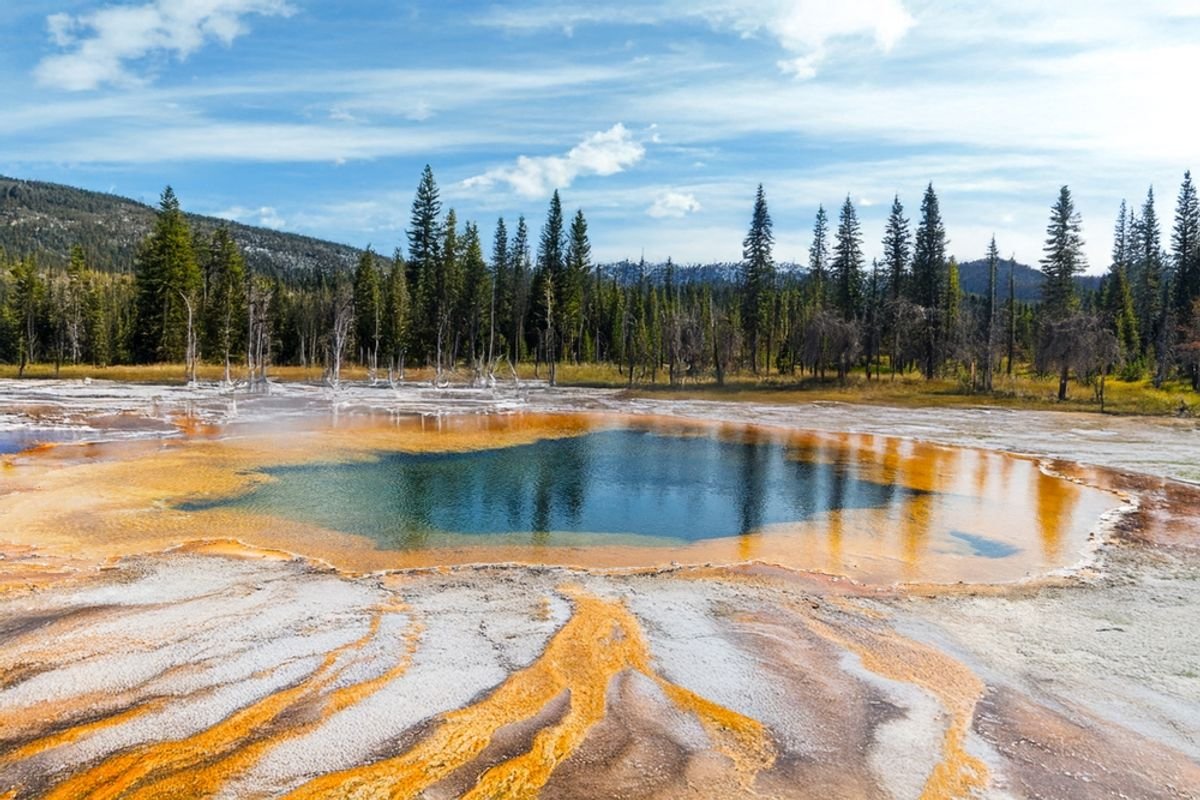
Venture too close to the hydrothermal vents dotted around Yellowstone National Park and you will be met by a powerful stench reminiscent of rotten eggs. These calderas are a (literal) hotbed of noxious gasses like hydrogen sulfide and carbon dioxide – but one gas is surprisingly lacking.
The absence of sulfur dioxide at Yellowstone appears to be something of a mystery. Other volcanoes, like Mount Etna in Italy and Santorini in Greece, pump out tons of the stuff each year.
According to Jennifer Lyn Lewicki, a research geologist at the United States Geological Survey (USGS) California Volcano Observatory, Yellowstone’s sulfur dioxide is not really missing. Instead, it undergoes an underground conversion, transforming into hydrogen sulfide and dissolved sulfate ions before reaching the surface.
Writing in the Yellowstone Volcano Observatory’s Caldera Chronicles, Lewicki explains that this is good news for residents in nearby states as the presence of sulfur dioxide could signal volcanic unrest.
Important Volcanic Gasses
Magma is not just molten rock. It contains several dissolved gasses, including water vapor, carbon dioxide, and sulfur dioxide.
As the magma flows towards the surface, the decrease in pressure causes the gasses to exsolve from the liquid magma and continue to rise to the surface, eventually escaping into the atmosphere – a process known as outgassing.
Crucially, different gasses have different levels of solubility. Sulfur dioxide has relatively high levels of solubility and does not often escape the magma until it reaches shallower depths.
Read More: One of the Oldest Organisms on Earth Thrives in Yellowstone’s Scalding Hydrothermal Features
Where Has the Sulfur Dioxide Gone?
Essentially, the absence of sulfur dioxide at Yellowstone boils down to two factors: the depth of Yellowstone’s magma chambers and the interference of hydrothermal systems.
In contrast to Hawaii’s Kīlauea, which stores magma in shallow reservoirs just a mile or two (1 to 5 kilometers) below the surface, Yellowstone’s magmatic system lies deep below ground.
There are two chambers, with the shallower of the two located 3 to 10 miles (5 to 17 kilometers) below the surface. The deeper (and much larger) of the two lies 12 to 30 miles (20 to 50 kilometers) underground and is 4.5 times the size of the first. This depth means very little of Yellowstone’s sulfur dioxide escapes the magma in the first place.
The fact that Yellowstone also contains a large hydrothermal system comprising thousands of hydrothermal features, from hot springs to geysers, means that any sulfur dioxide that does escape interacts with water before it reaches the surface.
Through a process called “scrubbing,” the water transforms the sulfur dioxide into several other substances, including hydrogen sulfide, dissolved sulfate ions, and elemental sulfur.
Predicting Volcanic Unrest
While sulfur dioxide is often used as a monitoring tool, helping scientists track the activity levels of volcanoes, its absence at Yellowstone may well be a good sign.
According to Lewicki, a sudden change in sulfur dioxide levels could indicate a change below the surface of Yellowstone and may indicate magma has risen closer to the surface, causing water to evaporate. This could signal volcanic unrest.
But even if an eruption were to occur, USGS predicts this would most likely be a hydrothermal explosion – a relatively small affair that occurs every few years or so. As for a so-called “super-eruption,” volcanologists are dubious there will ever be another catastrophic eruption of the kind that occurred 2.08 million years, 1.3 million years and 0.631 million years ago. At least for the time being, the magma that is present at Yellowstone appears to be too widely distributed to threaten eruption, according to Nature.
“Most volcanic systems that have a supereruption do not have them multiple times. When supereruptions do occur more than once in a volcanic system, they are not evenly spaced in time,” according to the USGS. “The rhyolite magma chamber beneath Yellowstone is only 5-15% molten […] so it is unclear if there is even enough magma beneath the caldera to feed an eruption.”
Read More: Yellowstone Bison Meets Tragic End at Hot Spring, Showing the Danger of Hydrothermal Features
Article Sources
Our writers at Discovermagazine.com use peer-reviewed studies and high-quality sources for our articles, and our editors review for scientific accuracy and editorial standards. Review the sources used below for this article: