
Wild Parrots May Follow Language-Like Rules — Including Syntax

When rival Yellow-naped Amazon parrots confront one another in the treetops of Costa Rica, their exchange can erupt into a rapid, layered volley of sound. The calls overlap, accelerate, and sharpen as territorial tensions rise. To human ears, it may seem like noisy chaos. But are these bursts of sound improvised, or carefully structured?
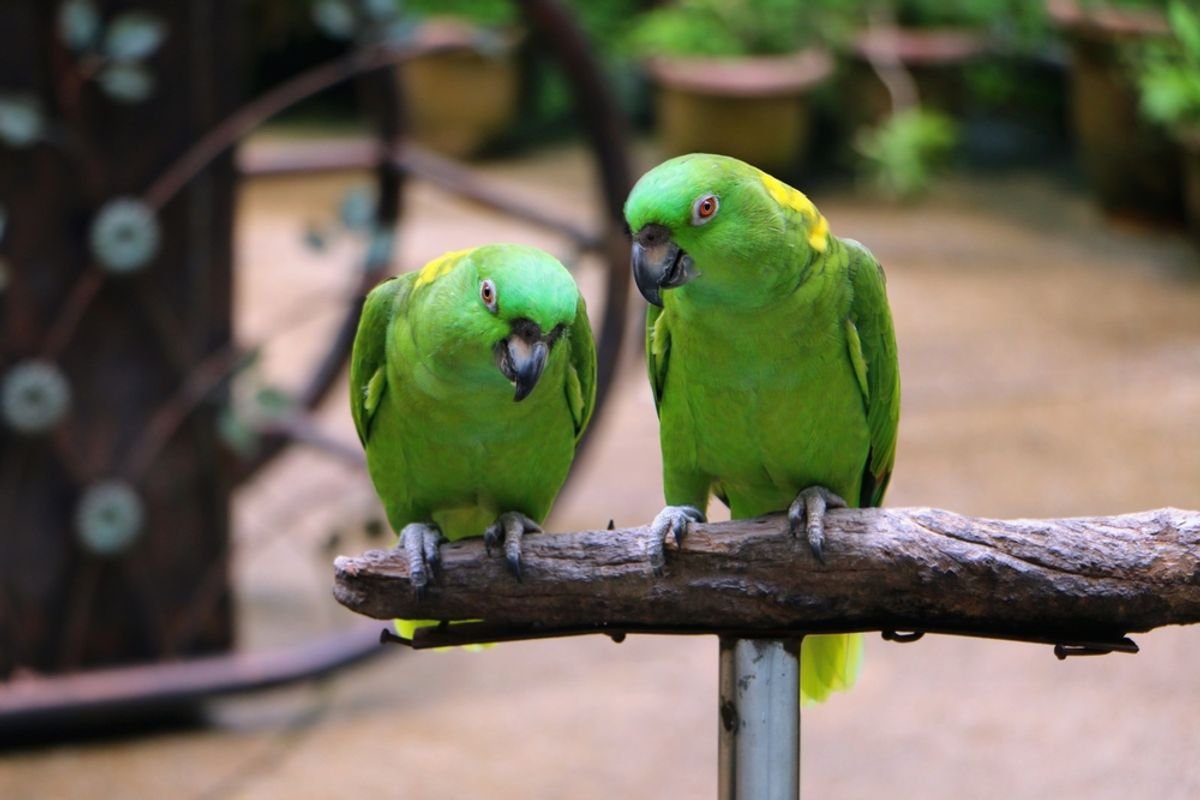
In a study published in the Journal of Avian Biology, biologist Christine Dahlin found that the parrots’ fast-paced “warble duets” follow syntactic rules — consistent patterns that govern how sounds are arranged — along with recurring sound pairings similar to words that often appear together in human speech.
“Ultimately, I really want to understand how these birds are communicating in the wild,” Dahlin said in a press release. “I want to know what they are saying, and how they are saying it.”
Read More: Whales are Capable of Complex Communication — Could Humans Ever Talk With Them?
Recording Parrot Duets in the Wild
Yellow-naped Amazon parrots perform coordinated duets, with mated pairs alternating calls in tightly timed bursts. Dahlin had previously studied a simpler version built from just a few call types. Even those exchanges followed clear ordering patterns.
Warble duets, however, are much more elaborate. They pull from a larger range of sounds and are most often heard during territorial disputes. When rival pairs approach, the calls grow louder and faster, sometimes escalating just before a fight.
To capture them, Dahlin and her students made repeated trips to Costa Rica over three years, recording parrots at breeding trees with directional microphones. Out of hundreds of recordings, about 50 were warble duets from 13 mated pairs. Though each lasted only five to ten seconds, together they contained more than 450 individual calls.
Language-Like Patterns in Parrots
In the simpler duets, parrots relied on four main call types. In the warble exchanges, the team identified at least 36 distinct types — and likely more that appeared too rarely to categorize.
To search for structure, the researchers turned to an unlikely tool: software normally used to analyze literature. Treating the calls like words, they examined how the sounds were arranged.
What they found was evidence of syntax, consistent ordering rules that shaped how the calls were combined. The team detected more than 20 syntactic rules governing which sounds could follow others and which sequences tended to occur together.
Additionally, they noted the presence of what linguists call “collocates” — words that frequently travel together. In human language, pairs like “eat” and “food” or “green” and “grass” tend to cluster.
The parrots showed similar pairings, with particular sounds repeatedly appearing alongside specific others far more often than chance would predict.
And yet, despite these rules, individual duets contained very little repetition. The birds were not looping memorized strings of notes. Each exchange was varied but still constrained, implying the parrots were making rapid, coordinated decisions in real time.
What Warble Duets Reveal About Animal Communication
The findings do not mean parrots are speaking in sentences. But they do show that their communication follows rules and adapts to context rather than unfolding randomly.
Warble duets appear to play a key role in territorial disputes. In Dahlin’s recordings, the few physical fights she observed were all preceded by intense vocal exchanges. The duets may help rivals size one another up before a confrontation turns physical.
Understanding these patterns could reshape how researchers interpret animal communication more broadly.
Dahlin still has years of recordings to analyze, including how different pairs respond to one another and whether certain vocal patterns escalate or calm a dispute. For now, what sounds like noisy squabbling in the canopy may instead be a tightly structured exchange.
Read More: Here’s Why Words Blur Together When You Listen to a Foreign Language
Article Sources
Our writers at Discovermagazine.com use peer-reviewed studies and high-quality sources for our articles, and our editors review for scientific accuracy and editorial standards. Review the sources used below for this article: