
Why the Ancients Ate These Bizarre Foods — and Why We Don’t Anymore

By modern standards, the diets of some ancient civilizations may seem downright bizarre. Think fermented fish left in open-air vats for months, insects roasted whole, or pork-stuffed rodents presented in an earthen casserole. To ancient eaters, these foods were nourishing, medicinal, and in some cases, sacred — no matter how much they might make epicurians cringe today.
For ancient societies, these bizarre foods provided sustenance during times of famine, were efficient in resource-limited environments, and conferred spiritual, cultural, or medicinal benefits that have been lost over the millennia. Nawal Nasrallah is an author and historian with expertise in Arab food culture. She argues that what makes one food bizarre to one culture and normal to another depends on several factors.
“I think that in most cases, how bizarre a food is largely depends on the availability of a given food in a given region, which determines its familiarity or weirdness. Also, our sensory reactions to what we are used to eating in our daily lives may play a role,” Nasrallah told Discover. “I come from Iraq, for instance, where the culture of eating crustaceous sea foods is almost non-existent, and I cannot stand even looking at diners slurping raw oysters.”
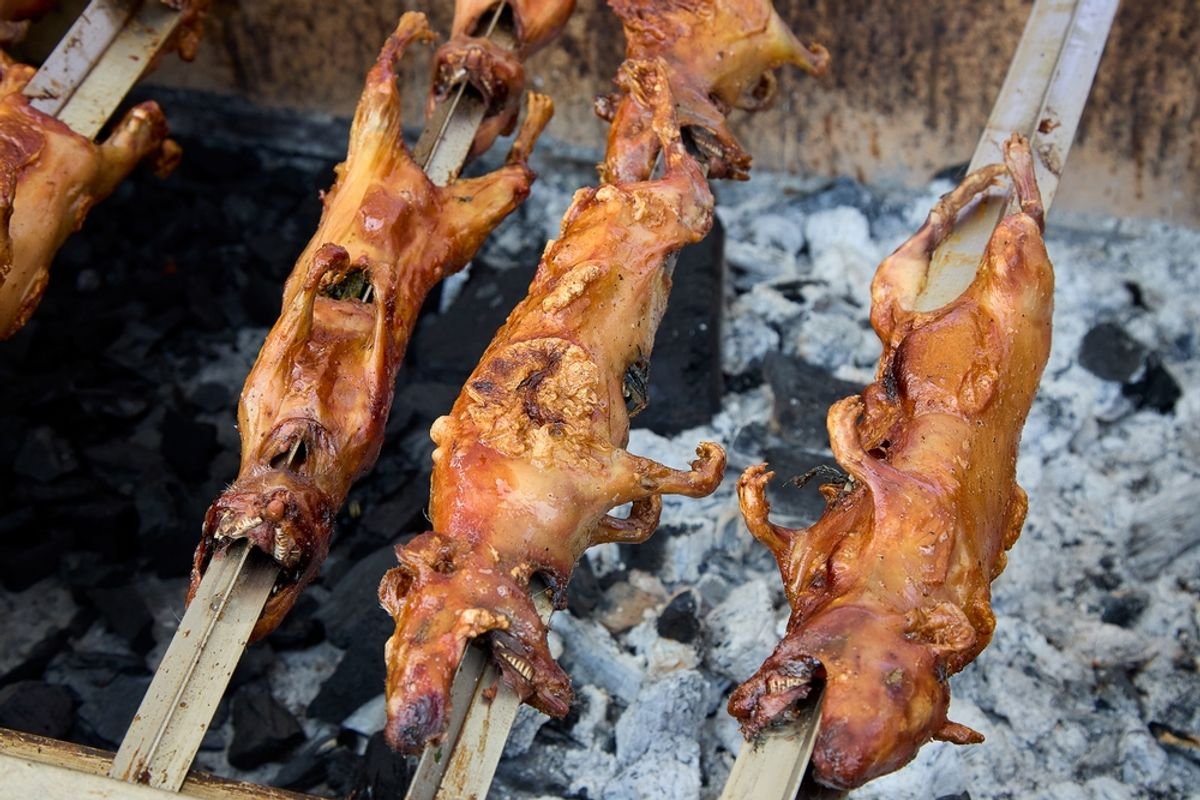
In the Peruvian Andes, for example, guinea pig, or cuy (pronounced “kwee”), is still a popular dish. It’s also an ancient high-protein course dating back 5,000 years. Just as one person’s trash may be another’s treasure, one group’s bizarre food may just be your new favorite snack.
Read More: 2,500-Year-Old Iron Age Teeth Reveal How Ancient Childhoods and Diets Unfolded
Dormice: An Ancient Delicacy
Take the dormice, for example. It’s a fat rodent about the size of a rat that lives in the trees of Southern Europe and was once a favorite of the ancient Romans. Stuffed in an earthenware casserole, roasted in the oven, or boiled in a stockpot, it is thought the meal was prepared with pork, small pieces of dormouse meat trimmings, and pounded with pepper and nuts.
Apparently, it’s also similar in taste and texture to squirrel, opossum, and muskrat. Dormice were considered a delicacy to some ancient societies, including the Romans.
“To the ancient Mesopotamians, it was an acquired taste, and those who dared have a taste say they liked it for its delicate flavor,” said Nasrallah to Discover. “However, we do not know how it was prepared exactly, but most likely it was roasted or grilled, like they used to do with locusts.”
Dormice were originally considered a delicacy for the elite, but documents suggest the rodents appeared in large numbers every year after the Nile flooded. This population boom allowed medieval Egypt’s lower class to enjoy free, nourishing protein. Today, however, there is little contemporary taste for dormice.
“Although they are still eaten in some parts of eastern Europe, I think the general public in non-dormice-eating regions does not relish the idea of eating a rodent, like what had happened to the squirrels. Our awareness of the dangers of dealing with and consuming rodents has been a strong deterrent,” Nasrallah told Discover.
Garum: A Fishy Sauce
Among their many historical reputations, the ancient Romans also had a knack for bizarre foods. One such cuisine was garum, fermented fish guts left for months in salt-filled open-air vats until they liquefied into a sauce.
Cambridge researchers wrote in a July 2025 Antiquity study that the Romans were among the first societies to industrialize fishing from their oceans, and established plants to ferment garum along their coastlines.
Small pelagic fish, such as sardines, anchovies, and mackerel, were often used to make the savory, meaty paste.
Lamprey Pie: Fit for a King
Lamprey eels are one of the oldest fish on Earth and, to be completely honest, probably the most terrifying. These jawless fish have a suction-disk mouth filled with jarring fang-like teeth, the remnants of which researchers used in 2018 to reveal an ancient European delicacy: lamprey pie.
In 2018, archaeologists at the Museum of London Archaeology wrote that the snake-like marine parasites were baked into pies for medieval British nobility — and are still eaten in some parts of Spain and Finland today.
In fact, high-class Brits so highly favored lamprey pies that it’s rumored Henry I suffered an untimely death after enjoying a “surfeit of lampreys,” according to a story from the Cambridge University Press.
Flamingo Tongues and Other Specilities
In his encyclopedic work, Natural History, 1st-century author and historian Pliny the Elder described eating flamingo tongue, which makes sense given that eating exotic bird parts was considered a high-status subculture in ancient Rome.
“Apicius, the most gluttonous gorger of all spendthrifts, established the view that the flamingo’s tongue has a specially fine flavor,” he wrote, crediting the discovery of the culinary oddity to Marcus Gavius Apicius, a Roman foodie.
Other elite favorites included peacock tongues, flamingo brains, partridge eggs, parrot heads, and mullet bears, according to scholar Bill Thayer and the University of Chicago.
Insects: A Sustainable Food
In recent years, edible insects — deep-fried, candied, or oven-roasted — have been presented in modern society as a sustainable solution to food supply. But their origin goes way back. Aztecs and other ancient Mesoamerican societies regularly ate insects, including grasshoppers, ant larvae, and stink bugs. Locusts, too, were consumed by cultures in the Middle East.
“Locusts were a popular source of meat to the Mesopotamians, and it was even considered fit to be served at the tables of kings. There is a slab where the palace servers were carrying grilled skewered locusts, like shish kabab,” said Nasrallah to Discover.
What Causes Foods to Go Out of Favor?
While some of these bizarre foods have been left in the past, some are still regularly eaten, like fermented shark, or hákarl, in Iceland. But what makes a diet go out of style, and why do some cuisines stay in favor?
According to Nasrallah, it’s a combination of shifting cultural values, understanding of health and safety, and changing environmental conditions.
“It could be the increasing awareness of the unsafe nature of that food, or it could be their scarcity (as in Egypt, when the floods were no longer happening,” Nasrallah told Discover. “Or it could be cultural prohibitions or restrictions. Food fads can easily fall in and out of favor, simply because they are not staples.”
Read More: From Cucumber Salad to Dubai Chocolate — How TikTok Shapes Food Choices
Article Sources
Our writers at Discovermagazine.com use peer-reviewed studies and high-quality sources for our articles, and our editors review for scientific accuracy and editorial standards. Review the sources used below for this article: