
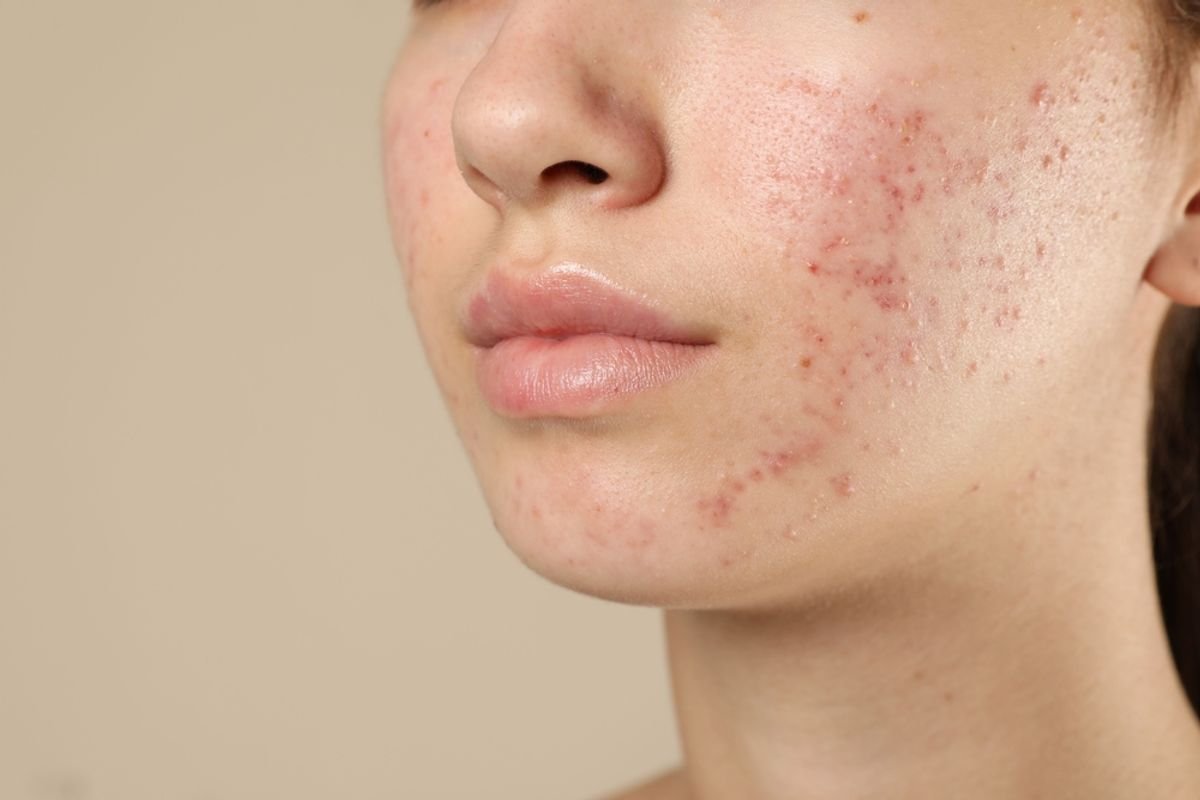
Why Do Humans Get Acne, and Is it Unique to Us? Here’s What to Know

It can happen when you’re an adolescent and when you’re an adult, but no matter when acne rears its ugly head, it can be stressful and make you feel self-conscious.
While acne is largely a human-specific disease, dogs and cats can develop forms of acne, too. Dogs get acne on their muzzles when bacteria build up in hair follicles, cats can get acne on their chins, and there’s some evidence of acne-like conditions in other primates, according to the University of Illinois College of Veterinary Medicine and Plewig and Kligman’s Acne and Rosacea.
When an animal’s hair follicle clogs, it can cause acne, which can become irritated and cause the animal to scratch. And just like popping a pimple is bad for your skin, the same is true for an animal’s fur coat.
Read More: Treatments for Acne and Rosacea Pose Potential Cancer Risk When Improperly Stored
Why do Humans Get Acne?
Your epidermis is made up of millions and millions of skin cells, according to the Cleveland Clinic. It’s the body’s largest organ, and it plays an important role in protecting your body from the outside world. As a result, your skin can sometimes take a beating.
Hair follicles, in particular, are an organ found on the skin’s dermal layer that allows hair to grow in response to a combination of hormonal activity. When hair follicles become clogged with old skin cells and oil, acne results, per the Mayo Clinic. Acne, which is especially common during adolescence, can come in the form of whiteheads, blackheads, pimples, or, more painfully, larger bumps that appear underneath the skin.
“Teenage years are shaped by fluctuations in hormones,” says Tanya Kormeili, a dermatologist in Santa Monica. “This means increased androgen hormones result in more sebum that feed the acne bacteria and can cause clogging of the pores.”
Kormeili adds that whiteheads are what you see underneath the skin, and red pimples are what you see above the skin when clogged pores become inflamed. Sebum is a natural oil produced by the sebaceous glands.
Adult acne is also the result of hormonal changes that can occur at various periods of life, such as during pregnancy.
“Adult acne tends to appear along the lower face, jawline, and neck, and is often deeper and more inflammatory than teenage acne,” says Anna Andrienko, a dermatologist with Dr. Ducu Clinics in London, England. She adds that adult acne is prone to scarring if it’s not properly treated.
How To Treat Acne As a Teen or Adult
It’s the age-old question that can be so hard to answer. What to do about acne before it gets out of hand. Should you see a dermatologist, or can acne be treated at home?
For teens, consistently caring for your skin is a must. Wash your face twice daily with a gentle cleanser and avoid harsh products that may cause inflammation. Use products that contain salicylic acid, benzoyl peroxide, or retinoids, which have all been shown to be helpful at treating acne, says Andrienko.
And most importantly, “squeezing spots should be avoided as this increases the risk of scarring,” Andrienko adds.
The bottom line for the teen group is to avoid the urge to pop your pimples, as difficult as it might be.
Treating adult acne can be trickier than it is for teens. “Adult acne is usually seen in women as the androgen to estrogen/progesterone levels change and create a similar imbalance,” says Andrienko.
Kormeili stresses that acne is a medical condition, and seeing a dermatologist can make a big difference in results. “Over-the-counter [salicylic] acid and benzoyl peroxide might be a good choice for oily teenage skin with mild acne only, but can really create havoc on adult acne or dry skin individuals,” she says.
For adults, dermatological treatments like deep extractions, chemical peels, and cortisone injections, given to reduce inflammation, can all be really helpful in treating adult acne, according to the National Library of Medicine. It might also be worth addressing the hormone imbalances in adults that are causing acne in the first place.
This article is not offering medical advice and should be used for informational purposes only.
Read More: Vitamin C Promotes Skin Cell Growth to Keep Skin Healthy and Prevent Aging
Article Sources
Our writers at Discovermagazine.com use peer-reviewed studies and high-quality sources for our articles, and our editors review for scientific accuracy and editorial standards. Review the sources used below for this article: