
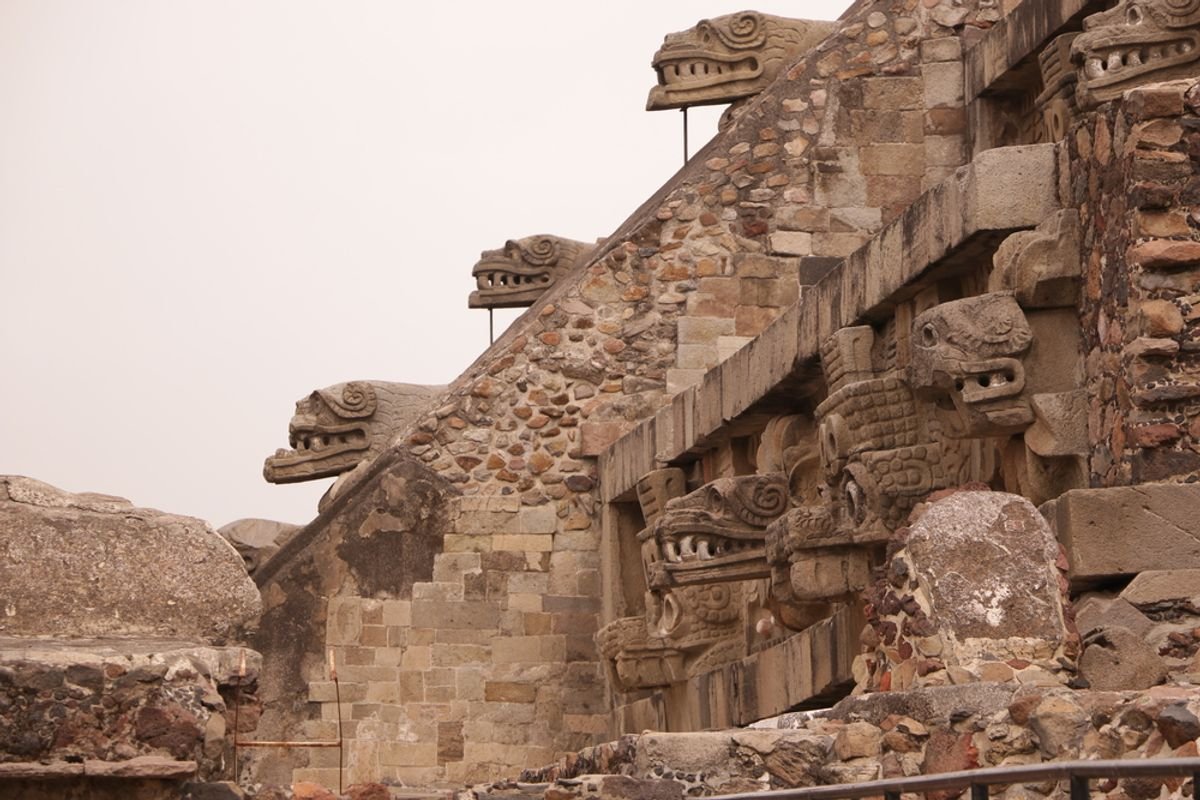
What Happened to the Aztec Empire? Lost Artifacts Help Rejuvenate Its Past

Key Takeaways on the Aztec Empire
- The Aztec Empire was one of the largest cities in the world toward the end of 1519 and was located where Mexico City is today. The Aztec capital and major city was named Tenochtitlan, and was just one of 400 cities and towns that were part of the Aztec empire.
- The city’s infrastructure had gardens where crops were cultivated, bridges arcing over maritime highways, marketplaces, homes, pyramids, and palaces.
- Spanish explorers took over the Aztec Empire in 1521 and destroyed many artifacts, but some artifacts remain to give a glimpse of the ancient empire.
Toward the end of 1519, Spanish explorers arrived at the Aztec capital in what is now Mexico City. They were awed by the Aztecs’ sophistication and soon demanded the land and resources for themselves.
Within a few short years, the Aztec empire was decimated by European diseases and brutality. Many of their important artifacts were buried, destroyed, or sent to Europe as novelty gifts. Knowledge of the empire was reduced to misconceptions and bias.
But in the last few decades, archeologists have been able to unearth thousands of Aztec artifacts in Mexico City. Long-held stereotypes about the Aztec empire are finally being replaced with a better understanding of an advanced society.
What Was the Aztec Empire?
When Spanish explorers arrived at the Aztec capital, Tenochtitlan, they entered one of the largest cities in the world that was far greater than anything they had seen in Spain. Whereas Sevilla had 60,000 people, Tenochtitlan was home to 200,000 people.
The capital city was one of 400 cities and towns that were part of the Aztec empire. The empire had around five million people and stretched across what is now Mexico.
Upon entering Tenochtitlan, the Spanish explorers were impressed with the city’s infrastructure. They reported seeing gardens where crops were cultivated, bridges arcing over maritime highways, marketplaces, homes, pyramids, and palaces.
The Spanish became determined to take the land and its riches for themselves, and the capital city fell into Spanish possession in 1521.
Read More: Why Did the Aztec Empire’s Headdress of Montezuma End Up in Vienna?
Erasing the Aztec Empire
The Spanish conquistadors destroyed many Aztec artifacts. They also looted many items, and some were sent back to Europe. Many artifacts were buried for protection, and the garden city of Tenochtitlan soon disappeared.
As the artifacts disappeared, so did the people who could promote the memory of the Aztec culture, language, and history. The Spanish brought diseases like smallpox, for which the Aztecs had no past exposure or immunity. In the following decades, diseases like measles and influenza ravaged the ailing empire and killed up to 80 percent of the population.
Without the people or even their possessions, the conquistadors were able to introduce many misconceptions that were used to rationalize their own brutality.
“As a way of justifying their own violence, they exaggerated tremendously the role of sacrifice in the Aztec world,” says Davíd Carrasco, a professor at Harvard University in the Divinity School and the department of anthropology, and the author of The Aztecs: A Very Short Introduction.
Although sacrifice was an occasional part of Aztec ceremonies, Carrasco says that the Conquistadors overemphasized the ritual while the gentler aspects of Aztec culture were diminished.
Franciscans, for example, who traveled with the Conquistadors, made note of how the Aztecs valued and cared for their children. The Aztecs were also accomplished artists, sophisticated farmers, and advanced architects. Yet, the Aztecs were stereotyped as savages who routinely made blood sacrifices, Carrasco says.
Unearthing the Aztec Empire
In 1790, workers in Mexico City were making repairs to the central plaza when they uncovered a massive, engraved stone. A century later, archeologist Zelia Nuttall was able to decipher the meaning of the Aztec Stone Calendar. She found it was based on the solar calendar, which meant the ancient Aztecs had a sophisticated understanding of astronomy.
In 1978, power company workers were digging next to a cathedral in Mexico City when they discovered an ancient carving seven feet underground. The carving was a disc in honor of the moon goddess, Coyolxāuhqui. Archeologists soon unearthed a temple and thousands of artifacts.
These artifacts have allowed scientists to study the lost empire and learn about life in Mesoamerica before colonization.
“The excavation continues,” Carrasco says. “It yields something new every week. It just rejuvenated Aztec studies.”
Read More: The Fall of the Aztec Empire: What Really Happened in the Battle of Tenochtitlan?
Article Sources
Our writers at Discovermagazine.com use peer-reviewed studies and high-quality sources for our articles, and our editors review for scientific accuracy and editorial standards. Review the sources used below for this article: