
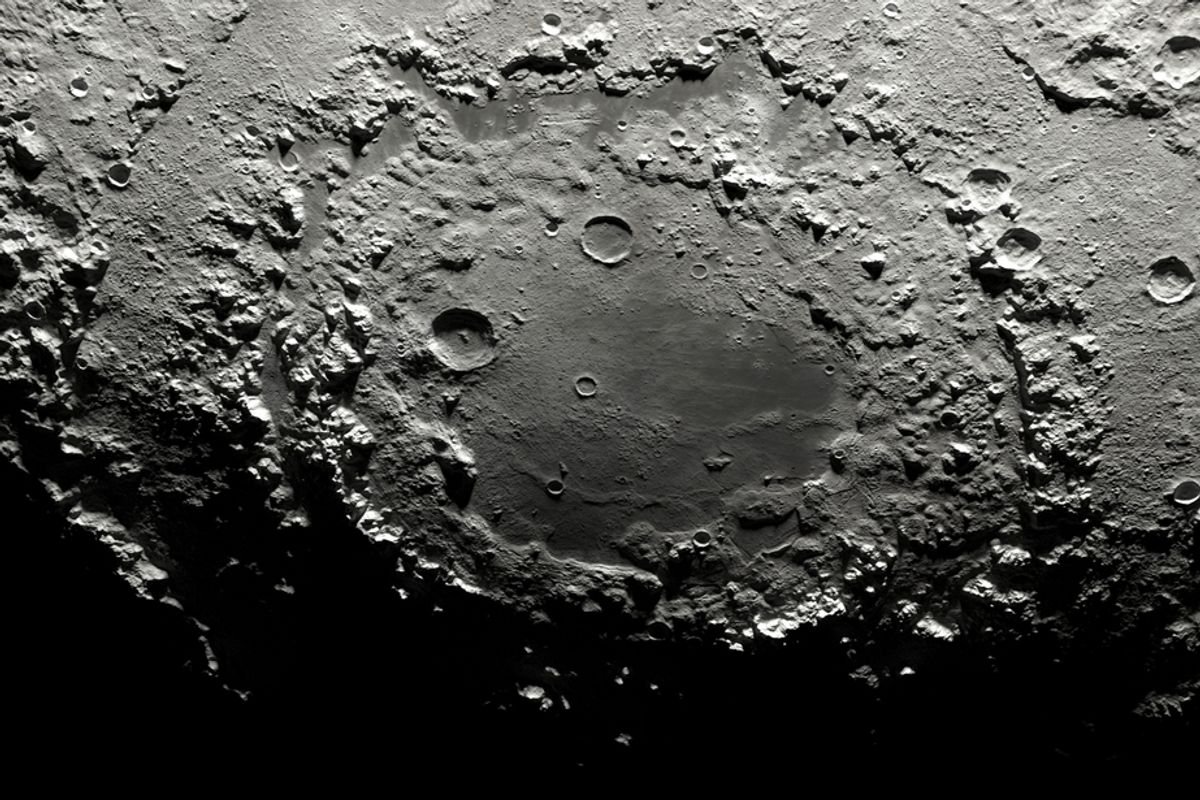
Water May Have Been Collecting in the Moon’s South Pole for Over a Billion Years

While water molecules and ice have been detected on the moon, researchers are still unsure of how that water arrived on our natural satellite. A new study, however, may just offer some clues as to where the moon’s water came from.
Publishing their findings in Nature Astronomy, a research team, including Paul Hayne, a planetary scientist at the Laboratory for Atmospheric and Space Physics (LASP) at the University of Colorado Boulder, suggests that water slowly accumulated on the moon over a billion years, instead of all at once, during some larger event.
“It looks like the moon’s oldest craters also have the most ice,” said Hayne, an associate professor in the Department of Astrophysics and Planetary Sciences, in a press release. “That implies the moon has been accumulating water more or less continuously for as much as 3 or 3.5 billion years.”
Water Arriving on the Moon
Previous research, including NASA studies, has indicated that there may be significant amounts of water on the moon, especially in the deep craters at the South Pole. But, while there is evidence of water, there hasn’t been conclusive evidence as to how the water got there, or why the water appears in some craters and not in others.
While the researchers can’t yet point to how the water got there, their findings can rule out a few theories, especially one that suggested water arrived all at once when a comet crashed into the moon’s surface.
Read More: Artemis II Catches Glimpse of the Moon’s Grand Canyon, a Basin That Looks Like a Giant Bullseye
Lunar Water Theories
There are other theories about how the moon acquired its water. One theory, according to Hayne, suggests that lunar volcanoes may have brought water to the moon’s surface from deep within. Another theory suggests that comets and asteroids brought water with them as they crashed into the lunar surface. Or that solar wind may have brought hydrogen to the moon.
“Through the solar wind, a constant stream of hydrogen bombards the moon, and some of that hydrogen can be converted to water on the lunar surface,” Hayne said.
Regardless of where the water came from, researchers, including Hayne, suggest that the ice has accumulated within ‘cold traps’ — moon craters that lie in permanent shadow and may not have seen the sun for billions of years. Evidence gathered from the Lyman Alpha Mapping Project (LAMP) on NASA’s Lunar Reconnaissance Orbiter (LRO) suggests that ice may be in those craters.
“What’s clear is that the ice has a patchy distribution,” Hayne said in the release. “It’s not concentrated in the same quantities in every crater. And there was no great explanation for that.”
Where Is the Lunar Water?
In search of an explanation, Hayne and study co-authors Oded Aharonson and Norbert Schörghofer looked over some of the moon’s history. For this part of their research, the team looked over lunar surface temperature data collected from the LRO Diviner instrument and also ran a series of simulations to come up with estimations about the evolution of craters on the moon’s surface.
Hayne also added in the press release that the moon is now at a different orientation than it once was. Its tilt relative to the Earth has shifted, meaning that some of the craters that now reside in shadow may not always have been.
From the data the researchers collected, they compiled a list of the moon’s cold traps and identified which have been in the dark the longest. The results showed that the oldest and darkest craters on the moon also showed the strongest evidence of ice. The team hopes that this study can help give astronauts more clues on where to search for water on the moon in the future.
“Ultimately, the question of the source of the moon’s water will only be solved by sample analysis,” Hayne said. “We will need to go to the moon to analyze those samples there or find ways to bring them from the moon back to Earth.”
More research is still needed to understand the water on the moon. Hayne and team are already working on instruments to help them do so, which could help as early as the end of 2027.
Read More: Apollo Rocks Reveal The Moon’s Magnetic Field Was Both Strong and Weak
Article Sources
Our writers at Discovermagazine.com use peer-reviewed studies and high-quality sources for our articles, and our editors review for scientific accuracy and editorial standards. Review the sources used below for this article: