
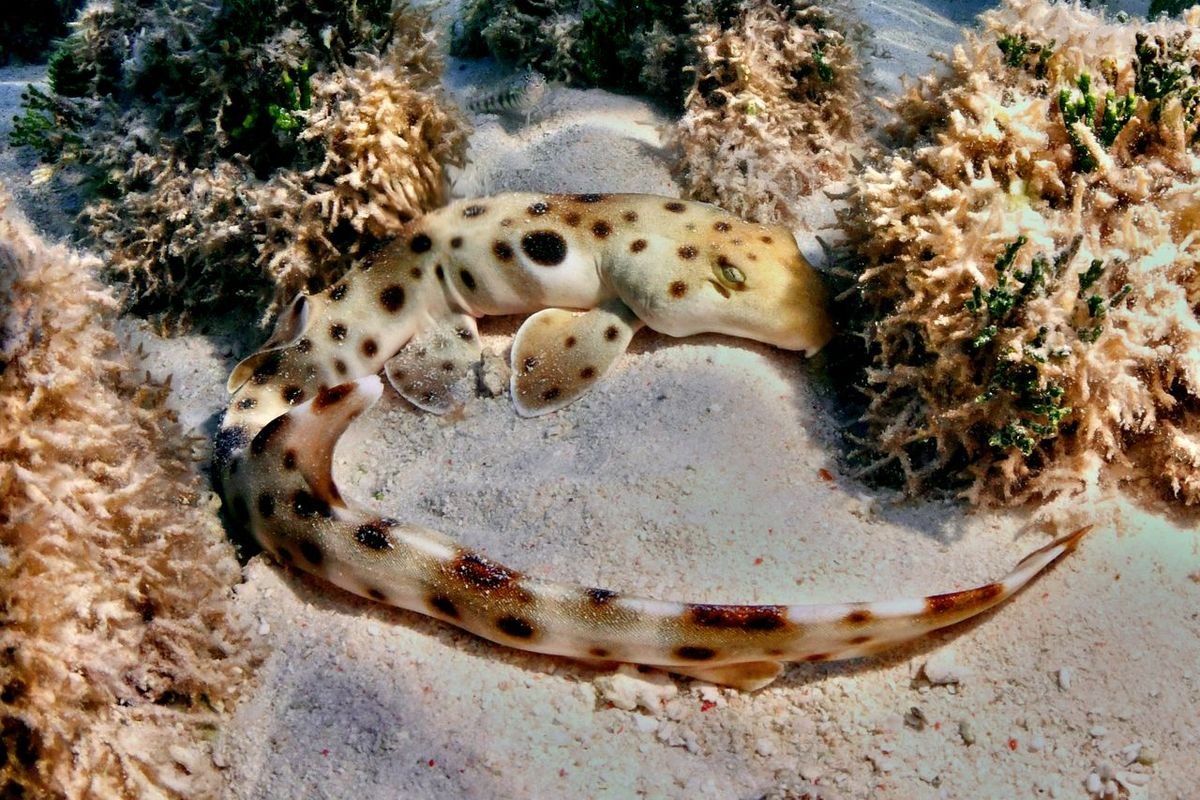
Walking Sharks Are Breaking the Rules of Evolution and Reproduction
There is a shark that can walk on land. That fact alone sounds like biology showing off. But even more impressively, the epaulette shark — a small, spotted reef dweller also known as a “walking shark” — has added another surprise to its resume: it can reproduce without paying the usual metabolic price.
New research suggests these sharks are quietly rewriting some of the rules scientists thought governed energy, evolution, and reproduction in the ocean. Published in Biology Open, the study reveals that female epaulette sharks can produce and lay eggs without any measurable increase in energy use. For animals living in some of the most challenging environments on Earth, that efficiency may be exactly what makes them such successful survivors.
What Are Walking Sharks?
Epaulette sharks are famous for their unusual way of getting around. As explained by the Oceanic Society, instead of relying solely on swimming, they “walk” along the seafloor using a crawling, undulating motion powered by highly flexible pectoral and pelvic fins. This adaptation allows them to navigate shallow, obstacle-filled coral reef systems, slipping through cracks and crevices where other predators can’t follow.

Walking shark (Hemiscyllium ocellatum) swimming.
(Image courtesy of Johnny Gaskell)
When tides drop, these sharks can even move between coral heads and briefly exposed reef or land. That ability is aided by another remarkable adaptation — extreme tolerance for low oxygen. According to a study in Marine & Freshwater Research, epaulette sharks can slow their heart rate and breathing and selectively reduce blood flow to parts of the brain, allowing them to survive conditions that would quickly overwhelm most fish.
There are nine known species of walking sharks, all found exclusively in Australia, Indonesia, and Papua New Guinea. Genetic analyses show they are also evolutionary newcomers. By comparing small fin clippings — similar to human nail clippings — researchers discovered that walking sharks evolved just 9 million years ago, making them the youngest sharks on the planet.
Their diversification likely occurred as populations slowly expanded, then became isolated by rising sea levels and changing landscapes.
Read More: Some Orcas Are Flipping Juvenile White Sharks and Devouring Their Livers
How Walking Sharks Evolved to Defy Expectations
Living in warm, shallow reef environments is energetically demanding. Food availability can fluctuate, oxygen levels drop, and predators are always nearby. Over time, epaulette sharks appear to have evolved a physiology that prioritized efficiency above all else.
That efficiency may extend far beyond movement and respiration. According to the new study, reproduction — typically one of the most energy-intensive processes in an animal’s life — barely registers metabolically for these sharks.
“Reproduction is the ultimate investment. […] You are literally building new life from scratch,” said Jodie Rummer in a press release from the James Cook University. “We expected that when sharks make this complex egg, their energy use would shoot up. But there was no uptick in energy use, it was completely flat.”
A Shark Reproductive Strategy Unlike Any Other
The research team tracked five female epaulette sharks before, during, and after egg case capsulation. Housed in large, temperature-controlled tanks at James Cook University, the sharks were monitored for oxygen consumption, blood chemistry, and hormone changes throughout their three-week reproductive cycle.

Embryo of walking shark (Hemiscyllium ocellatum).
(Image courtesy of Martijn Johnson)
Epaulette sharks typically produce two eggs per cycle, with peak egg-laying occurring between September and December. Yet despite this investment, researchers found that metabolic rate, blood markers, and hormones remained undisturbed.
“Everything was remarkably stable, so this research challenges our fundamental assumptions about chondrichthyan fishes (sharks, rays, skates, and chimaeras). Under environmental stress many species will choose between survival and reproduction, but the epaulette shark might be able to continue to produce eggs, even under such stressors. That’s encouraging, because healthy sharks equal healthy reefs,” explained lead author Carolyn Wheeler.
In a warming, increasingly unpredictable ocean, a shark that can walk, endure low oxygen, and reproduce on an energy budget may be exactly the kind of evolutionary success story the ocean needs.
Read More: Giant 115-Million-Year-Old Shark Fossil Found in Australia Rewrites Evolution Timeline
Article Sources
Our writers at Discovermagazine.com use peer-reviewed studies and high-quality sources for our articles, and our editors review for scientific accuracy and editorial standards. Review the sources used below for this article: