
Uranus’s 29 Moons Explained | Discover Magazine

Key Takeaways About Uranus’s Moons:
- Uranus has 29 moons orbiting it. The first two moons Herschel spotted in 1787 were Oberon and Titania, and they are Uranus’s largest moons.
- There is another Uranus moon that the James Webb Space Telescope discovered in February 2025. That faint moon, approximately 6 miles in diameter, brings the planet’s total number to 29, and it’s the fourteenth inner moon discovered.
- Uranus’s Moons are named after Shakespeare and Alexander Pope characters, unlike many other moons in the Solar System that are named after Roman characters.
Many of us will know Uranus as the seventh planet from the sun or as the butt of a cosmic joke. This incredibly cold, ice giant of a planet is not only around four times the size of Earth but also boasts a large number of spectacular moons, with the possibility that more will be discovered in the near future.
In 1781, astronomer William Herschel discovered Uranus, but it was not designated as a planet until two years later. Shortly after the planet’s discovery, astronomers spotted moons.
The first two moons Herschel spotted in 1787 were Oberon and Titania, and they are Uranus’s largest moons. Two more soon followed with the sighting of Ariel and Umbriel, until Gerard Kuiper found Miranda in 1948.
When NASA’s Voyager 2 spacecraft passed by Uranus in the 1980s, it spotted 10 more moons ranging vastly in size from only 16 miles to 96 miles in diameter. That vessel remains the only spacecraft to have explored Uranus and its moons. Advances in astronomy, and the billion-dollar Hubble Space Telescope, enabled scientists to spot a further 15 moons much smaller than the big five.
Read More: Astronomers Have A New Theory Why Uranus Spins On Its Side
Another Moon of Uranus
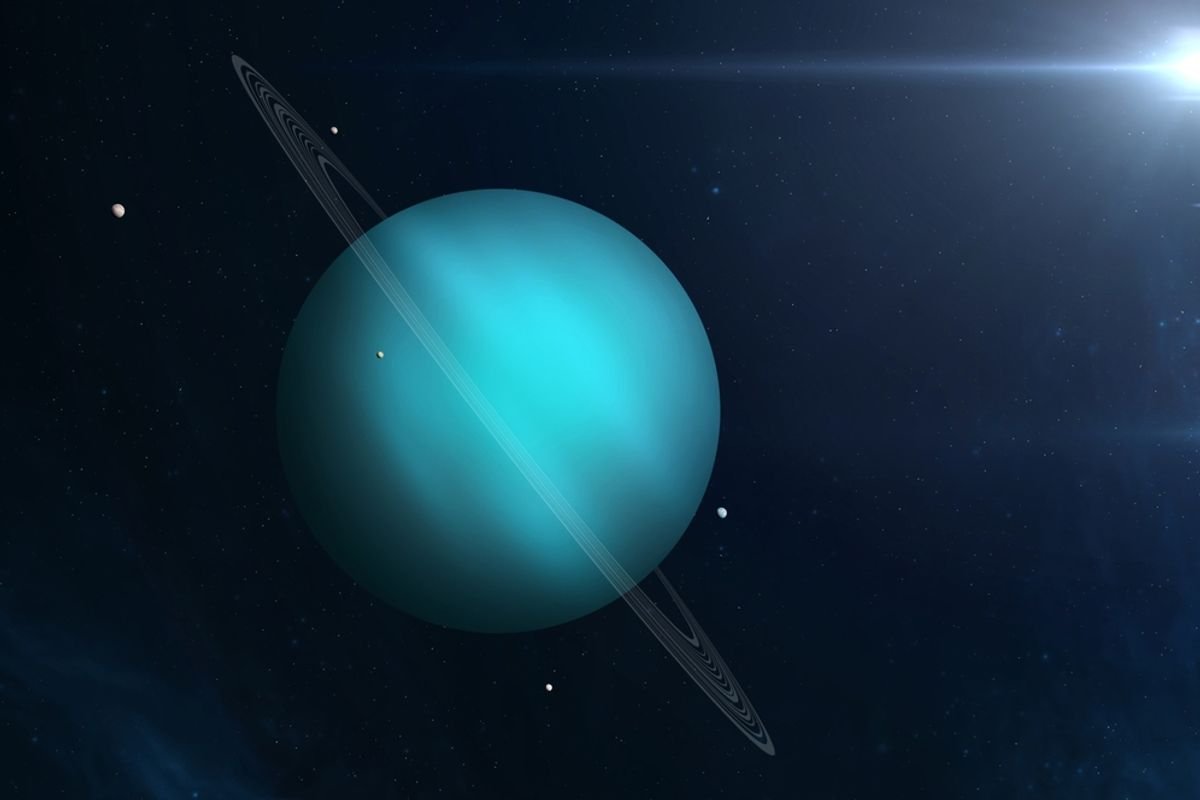
In an amazing feat, scientists recently discovered another new moon orbiting Uranus. That faint moon, approximately 6 miles in diameter, brings the planet’s total number to 29, and it’s the fourteenth inner moon discovered. Uranus’s moons are distributed across the planet’s faint rings, which are made up of ice and dust particles, each of which is named after a Greek letter.
“There is no moon in the middle of the new ring as far as we can tell,” Tiscareno says. “Maybe we’ll discover one, but at this point, that might indicate that there used to be a moon there, and it broke apart into this ring.”
It’s believed that these inner moons are made up of ice and rock, but what the outer moons consist of is still unknown.
What Is Unique about Uranus’s Moons?
Uranus and its moons are unique for many reasons. Firstly, Uranus orbits the sun on its side at a 98-degree tilt, and its moons follow suit. This hints to scientists that the planet suffered a huge collision in space, possibly with another Earth-sized planet that knocked it on its side. Other theories exist, and it’s not fully understood how Uranus came to orbit the sun sideways, but no other planet in our solar system orbits the sun in this way.
Some of its moons have unique features. Dubbed the “Frankenstein moon,” Miranda is the smallest of the major moons at 293 miles across. Its nickname is due to its misshapen surface, giving the appearance that it was cobbled together. Its surface is carved by huge fault lines that are up to 12 times as deep as the Grand Canyon. Scientists believe that Miranda was shattered by a collision once, or several times, before reforming in a haphazard and fractured structure we can see today.
Ariel, the youngest and brightest of Uranus’s major moons, may also possess a buried ocean of liquid water. Two of its smaller moons — Cressida and Desdemonda — are expected to crash into one another in roughly one million years’ time, according to researchers.
What are the Names of Uranus’s Moons?
Uranus’s moons are also unique for their names. Other planets’ moons tend to derive their names from either Greek or Roman mythology. Uranus’s moons, however, have their namesake in characters from the works of Shakespeare and Alexander Pope. Its largest moons are named Miranda, Ariel, Umbriel, Titania, and Oberon. The new moon, thus far assigned the rather dry scientific name of S/2025 U1, will in time be known in this fashion as well.
As Tiscareno explains, no other planet has such a quantity of small inner moons as Uranus. It’s possible that more remain to be discovered and that number of 29 may well increase in the coming years.
The latest moon is an exciting discovery, says Matthew Tiscareno, a planetary scientist at the SETI Institute in Mountain View, California, who was part of the team that found it. “This moon that we’ve just discovered is the smallest by a good deal,” he says. “It’s probably the first of a number of more.”
Read More: The Outer Moons of Uranus Have Been Gathering Dust, Darkening Their Front Sides
Article Sources
Our writers at Discovermagazine.com use peer-reviewed studies and high-quality sources for our articles, and our editors review for scientific accuracy and editorial standards. Review the sources used below for this article: