
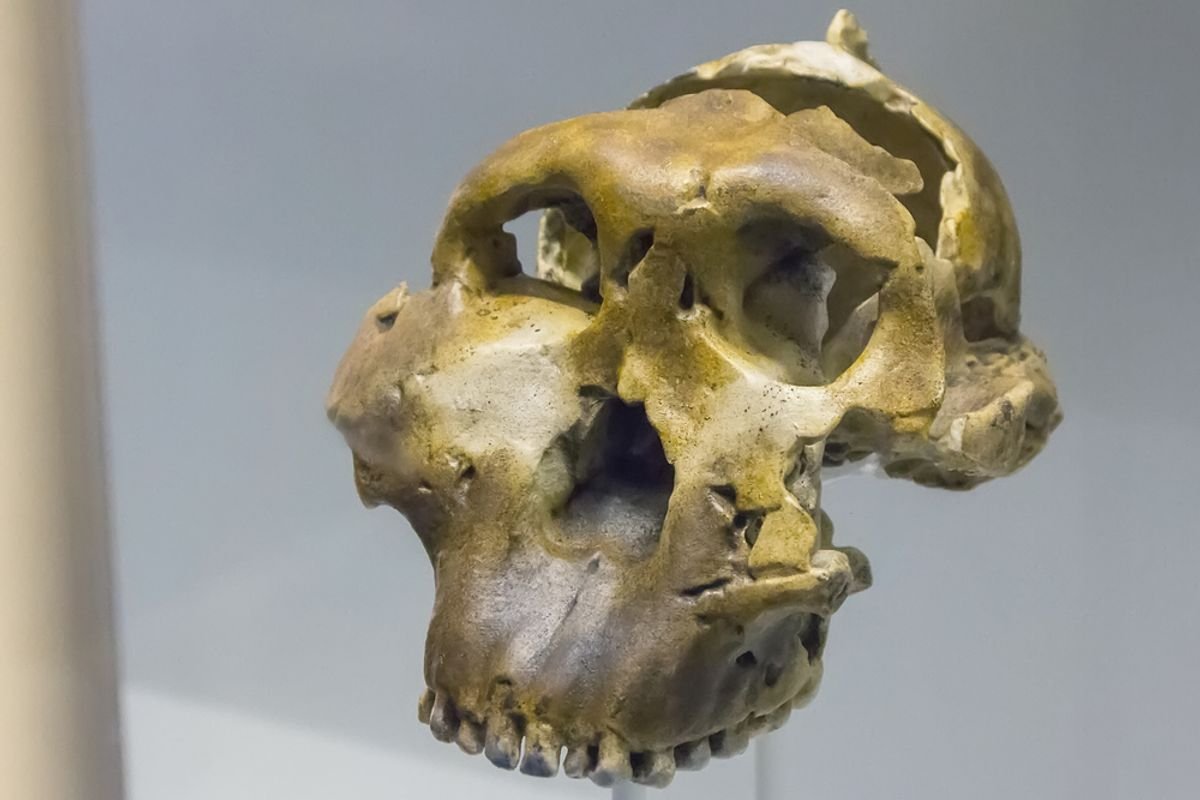
Upside-Down Skull Reveals That Neanderthal Noses Lacked Special Traits to Deal With Cold Air

It’s often said that Neanderthal noses were perfectly suited for life in cold weather, but this common view may need some fine-tuning thanks to new fossil evidence. Neanderthals — who lived in colder climates across Europe and Asia — had noses that were taller and broader than those of modern humans. But scientists have claimed that the real key lies in the inner nose, which they believe contains special adaptations for handling chilly air.
According to a new study published in the Proceedings of the National Academy of Sciences, Neanderthal noses may not have been all that special after all. Upon examining the inner nasal structures of the Altamura Man, a Neanderthal skeleton located in southern Italy, researchers didn’t locate any unique traits related to cold adaptation. This suggests that the Neanderthal nose may not have been as conditioned by the cold as once thought.
Read More: Reconstructing a Neanderthal Skull That Was Flattened Like a Pancake
Perplexed by Neanderthal Noses
Scientists have long been intrigued by the faces of Neanderthals, ever since Neanderthals were recognized as a new species of human after the 1856 discovery of a skull in Germany. The specimen displayed several eccentricities that provided a first look at the species’ appearance. For example, the skull indicated that Neanderthals had a pronounced brow ridge and larger brains than humans.
Reconstructions of Neanderthal faces grew more accurate over time, although something still bothered scientists; it had become clear that the Neanderthal nose was noticeably large, yet it wasn’t clear how its shape had helped the species live in cold climates. The larger nose size, it seemed, would only lose heat.
It was then speculated that the inside of the nose is what really mattered; larger sinuses in Neanderthals, some surmised, may have helped to warm air whenever it was breathed in, according to a study in the Proceedings of the Royal Society B.
With this idea in mind, many scientists were sure that Neanderthals had unique traits for cold adaptation within the inner nose. However, there was never any fossil evidence to back up these claims, since inner nose bones are fragile and rarely preserved.
Getting Inside an Ancient Skull
An answer to the Neanderthal nose mystery appears to be within reach after the researchers behind the new study revisited the Altamura Man skeleton, which is dated to between 130,000 and 172,000 years old and was first discovered in a sinkhole near the Italian city of Altamura in 1993.
Multiple bones have been found in this cave setting, including a skull that is stuck in an upside-down position. What makes the bones so distinct is that they’re encased in a thick layer of calcite (appearing as small bulbs called “cave popcorn”), which has helped to preserve them, according to a study in Quaternary Science Reviews.
The nasal cavity of the Altamura Man is thought to be the only one entirely preserved in the pre-modern human fossil record. They examined this nasal cavity using endoscopic technology directly in the cave system, since taking the fossils out could risk damaging them.
Looking at the nasal cavity, the researchers were able to rule out the existence of adaptations of the inner nose unique to Neanderthals.
“As pointed out by several authors in the past,” said co-author Antonio Profico, a paleoanthropologist at the University of Pisa, in a statement. “These traits were defined as diagnostic without clear fossil evidence. Altamura finally provided the evidence of their absence: even without these adaptations, the Neanderthal nose had an efficient model to fulfill the high energetic demands of the species.”
A Better Idea of Neanderthal Breathing
The researchers also gained insight into another notable facial feature known as the “midfacial prognathism,” a forward protrusion in the middle of the face. This feature, they say, was likely not shaped by upper respiratory function and could instead be linked to other evolutionary factors.
Now that this nasal knowledge has come to light, the researchers have created a 3D model of the Neanderthal nose, which they hope will guide future research on Neanderthal respiratory systems.
Read More: Neanderthals Continued to Grow into Adulthood — Even Their Faces
Article Sources
Our writers at Discovermagazine.com use peer-reviewed studies and high-quality sources for our articles, and our editors review for scientific accuracy and editorial standards. Review the sources used below for this article: