
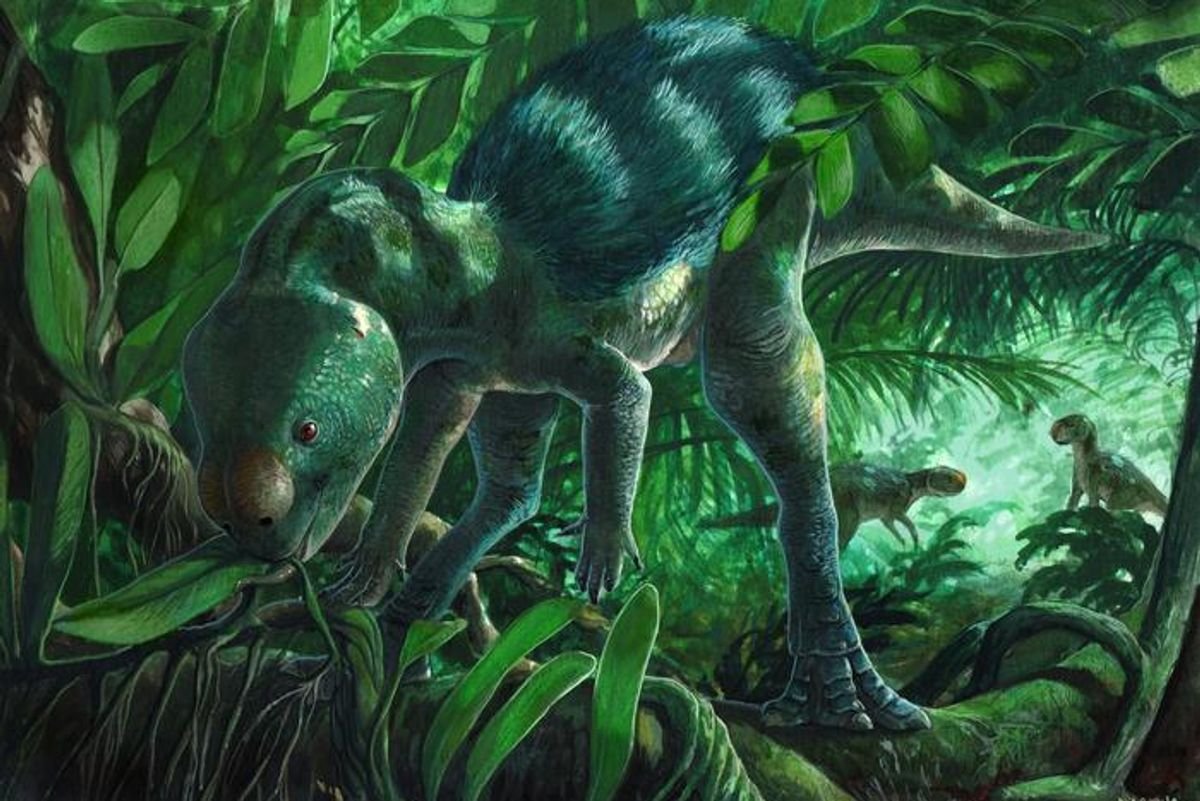
Unusually Small Dinosaur Fossil Helps Fill a 70-Million-Year Gap in Ornithopod Evolution
Dinosaur evolution is often told through giants, towering herbivores and predators that define museum halls. But a new discovery suggests that some of the most consequential evolutionary shifts may be preserved in much smaller bones.
When paleontologists uncovered a collection of unusually small fossils in northern Spain, the remains did not fit into any known ornithopod lineage. Their size implied they were juveniles, yet their anatomy indicated otherwise.
The fossils, representing at least five individuals, belong to a newly identified species named Foskeia pelendonum. In a study published in Papers in Palaeontology, researchers report that the dinosaur represents a distinct branch of ornithopods, reshaping how researchers understand the evolution of these plant-eaters.
“Foskeia helps fill a 70-million-year gap, a small key that unlocks a vast missing chapter,” said coauthor Thierry Tortosa, in a press release.
Not Just a Miniature Ornithopod
Earlier material from the site consisted mostly of fragmentary limb bones and other postcranial remains. Those fossils had been grouped under what researchers called the Vegagete ornithopod, thought to represent an early Rhabdodontomorpha. Without skull material, however, the animal could not be named.

Skull of Foskeia pelendonum.
(Image Credit: Dieudonné et al. 2026/ Dieudonné, Becerra, Zanesco, Tortosa, Cruzado-Caballero, Stein, Fernández-Baldor)
That changed when additional cranial elements were recovered and scanned using micro-computed tomography. Three-dimensional reconstruction revealed features that did not match known ornithopods.
The bones at the very front of the skull were fused, and the front teeth angled forward rather than sitting upright. One of the lower teeth was unusually slender, and the jaw joint sat higher than expected. Researchers also identified an extended attachment point for a jaw muscle, suggesting a different chewing motion from its relatives.
“Its anatomy is weird in precisely the kind of way that rewrites evolutionary trees,” added coauthor Penélope Cruzado-Caballero.
Read More: Jurassic Predators Feasted on Baby Long-Necked Dinosaurs 150 Million Years Ago
Confirming It Was Not a Juvenile
The small size of the fossils initially raised the possibility that they belonged to juveniles of a larger dinosaur. To test that idea, researchers examined thin sections of bone under a microscope. The internal tissue revealed structures associated with sexual maturity in at least one specimen, rather than the active growth typical of juveniles.
The tissue also suggests relatively rapid development, with growth rates that may have approached those of birds or small mammals. Together, the microscopic evidence shows that Foskeia was not simply a young individual of another species, but a small-bodied dinosaur in its own right.
A Revised Evolutionary Framework
When researchers added Foskeia to an expanded evolutionary dataset, its placement proved more precise than earlier material had allowed. The species falls within Rhabdodontomorpha and appears closely related to the Australian dinosaur Muttaburrasaurus, strengthening links between European and Gondwanan ornithopods.

Foot skeleton of Foskeia pelendonum and comparison in size to a human being.
(Image Credit: Dieudonné et al. 2026/ Dieudonné, Becerra, Zanesco, Tortosa, Cruzado-Caballero, Stein, Fernández-Baldor)
The revised analysis also reshapes parts of the broader ornithischian family tree. Several plant-eating lineages shift position, and the results revive support for Phytodinosauria, the proposal that plant-eating dinosaurs form a natural evolutionary group.
Specialized teeth, a modified jaw joint, and possible shifts in posture during growth suggest that Foskeia occupied a distinct ecological niche, likely navigating dense vegetation in short bursts.
Its anatomy and evolutionary placement indicate that diversification was unfolding even among the smallest members of the dinosaur world. Small-bodied species like Foskeia were not peripheral experiments but active participants in shaping ornithopod diversity.
“These fossils prove that evolution experimented just as radically at small body sizes as at large ones. The future of dinosaur research will depend on paying attention to the humble, the fragmentary, the small,” said first-author Paul-Emile Dieudonné.
Read More: How AI Is Solving Some of Paleontology’s Biggest Dinosaur Footprint Mysteries
Article Sources
Our writers at Discovermagazine.com use peer-reviewed studies and high-quality sources for our articles, and our editors review for scientific accuracy and editorial standards. Review the sources used below for this article: