
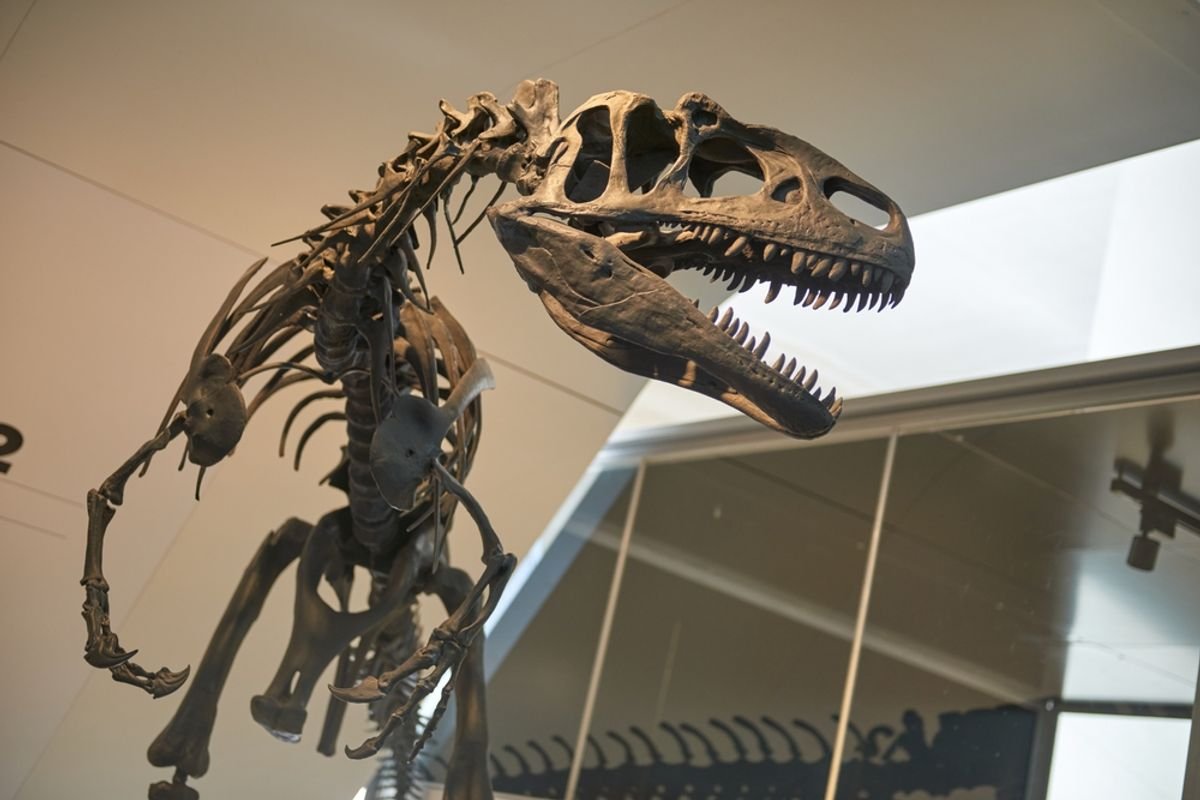
Tyrannosaurus Rex Took 40 Years to Grow Up, Fossil Bones Reveal
Growth rings preserved in fossilized leg bones have been used to estimate how fast Tyrannosaurus rex grew and how old the specimen was when it died. Based on those rings, earlier studies suggested the giant carnivore reached adult size by about age 25.
A new study published in PeerJ reexamines those records across a much broader range of fossils. By analyzing growth rings from 17 tyrannosaur specimens, researchers now conclude that T. rex likely took around 40 years to reach its full size.
“This is the largest data set ever assembled for Tyrannosaurus rex,” said research lead, Holly Woodward, in a press release. “Examining the growth rings preserved in the fossilized bones allowed us to reconstruct the animals’ year-by-year growth histories.”
Read More: How Big Was the Tyrannosaurus rex? They May Have Been Larger Than Fossil Evidence Suggests
Reconstructing the Growth of T. Rex

(Image Credit: Dr. Holly Woodward Ballard)
The new analysis draws on growth rings preserved inside fossilized leg bones, which form as dinosaurs add bone year by year. By slicing thin cross-sections of these bones, researchers can count the rings and estimate how quickly an animal grew at different stages of its life.
One challenge is that a single bone typically preserves only the final 10 to 20 years of growth. To build a fuller picture, the team combined growth records from multiple individuals, ranging from small juveniles to large adults, and assembled them into a single composite growth curve.
The expanded dataset and closer examination of the bones revealed growth rings that earlier studies had missed, helping explain why previous estimates underestimated how long T. rex continued to grow.
Why T.Rex Took 40 Years to Grow Up
Rather than reaching adult size quickly, the revised growth curve suggests that T. rex matured gradually over roughly four decades. That extended growth would have shaped how the animals moved through their ecosystems as they aged.
Younger tyrannosaurs likely differed dramatically from fully grown adults in size, speed, and hunting ability, allowing them to occupy different ecological roles instead of competing directly with mature individuals.
“A four-decade growth phase may have allowed younger tyrannosaurs to fill a variety of ecological roles within their environments,” said coauthor Jack Horner of Chapman University, in a press release. “That could be one factor that allowed them to dominate the end of the Cretaceous Period as apex carnivores.”
What Growth Patterns Reveal About Tyrannosaurus Diversity
The findings also feed into an ongoing debate over tyrannosaur diversity. Some paleontologists have suggested that smaller specimens traditionally labeled as juvenile T. rex may actually represent a separate species, often called Nanotyrannus. Others have proposed that even large specimens could belong to more than one species.
To account for that uncertainty, the study grouped all 17 fossils into a T. rex “species complex.” When researchers compared growth curves across the dataset, two well-known specimens — nicknamed “Jane” and “Petey” — showed growth patterns that did not align with the rest of the sample. Growth data alone cannot resolve species identity, but the results raise the possibility that tyrannosaurs were more diverse than once assumed.
The work also has implications beyond T. rex. By revealing growth rings that standard approaches can miss, the study suggests that dinosaur growth histories may need to be revisited more broadly.
“Interpreting multiple closely spaced growth marks is tricky,” said Nathan Myhrvold, a mathematician and paleobiologist at Intellectual Ventures who led the statistical analysis, in a press release. “We found strong evidence that the protocols typically used in growth studies may need to be revised.”
Read More: Tiny Throat Bone Confirms Nanotyrannus as Own Species — Adding Another Predator to the Late Cretaceous
Article Sources
Our writers at Discovermagazine.com use peer-reviewed studies and high-quality sources for our articles, and our editors review for scientific accuracy and editorial standards. Review the sources used below for this article: