
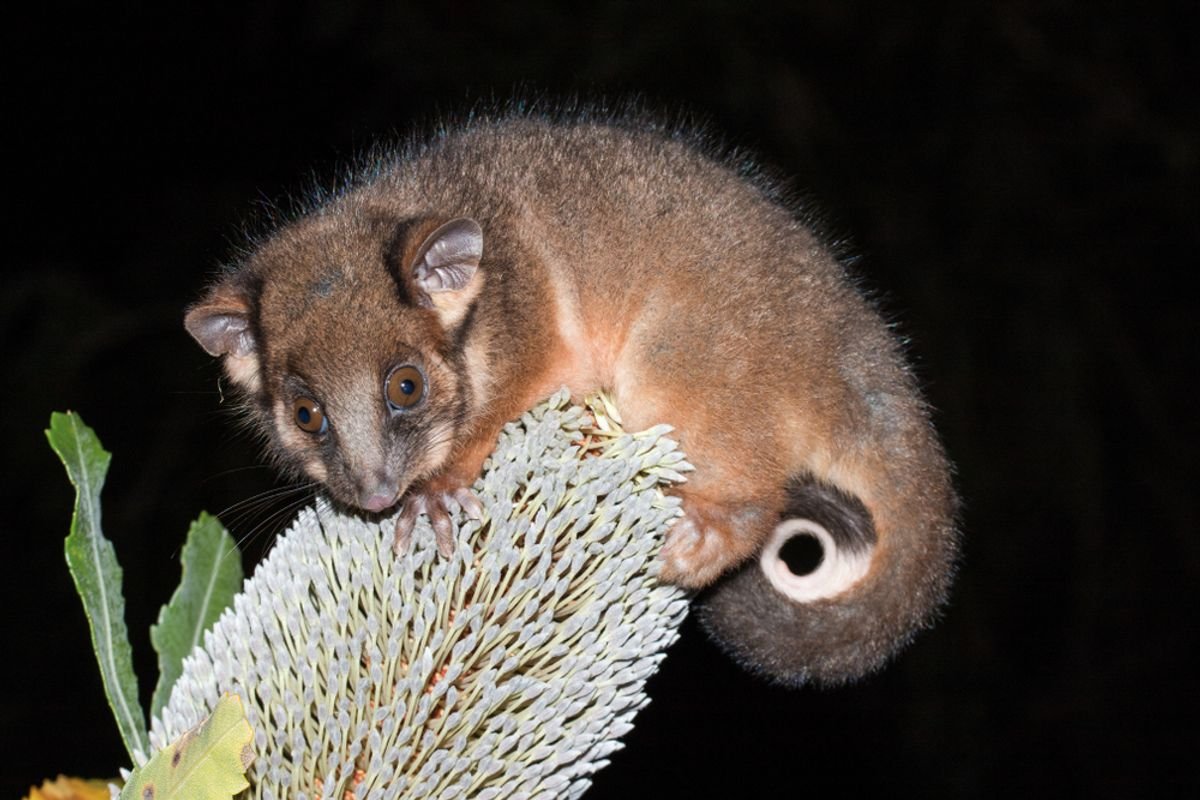
Two Marsupials Re-emerge in New Guinea Rainforests After Being Considered Extinct for 6,000 Years

Two marsupial species that were thought to be long gone from this planet have miraculously been found alive and well. Both species dwell in the rainforests of the Vogelkop Peninsula in Papuan Indonesia, but in years past, their existence was known only from fossils.
A new study published in Records of the Australian Museum has announced the momentous discovery of the pygmy long-fingered possum and the ring-tailed glider, both previously believed to have been extinct for 6,000 years; the latter also represents a brand new genus dubbed “Tous” by researchers, a classification set in motion by meticulous fossil analysis and close conversations with local Papuan clans.
Read More: Scientists Might Bring Back These 7 Extinct Animals
Back From the Dead
Sometimes, species that have vanished from the fossil record reappear, either in later fossil records or as a living organism. This describes “Lazarus taxa,” which “come back from the dead” after being presumed to have gone extinct.
The newest Lazarus taxa, the pygmy long-fingered possum (Dactylonax kambuayai) and the ring-tailed glider (Tous ayamaruensis), were known only from Pleistocene fossils in Australia and from Pleistocene/early-Holocene fossils on the island of New Guinea. But as it turns out, they’re both still alive on New Guinea.
“The discovery of one Lazarus taxon, even if thought to have become extinct recently, is an exceptional discovery. But the discovery of two species, thought to have been extinct for thousands of years, is remarkable,” said study author Tim Flannery, a Distinguished Visiting Fellow at the Australian Museum, in a statement.
Finding a Long-Lost Species
The pygmy long-fingered possum, assumed to have gone extinct in Australia during the Ice Age, sports a noteworthy adaptation: one digit on each hand is twice as long as its next longest finger.
The researchers behind the new study, however, were drawn more to the ring-tailed glider, which was discovered by a stroke of luck. In 2015, a plantation worker in Indonesian Papua (the western half of New Guinea) came across a ring-tailed glider (not known to be this species at the time). He took several pictures of the animal, which were later sent to researchers.
The researchers weren’t quite sure what to make of this marsupial, with its large eyes and unfurred ears. It shared similarities with two existing genera of arboreal marsupials: Hemibelideus (which includes the lemuroid ringtail possum) and Petauroides (which includes three species of greater gliders).
The unknown marsupial had a prehensile, furry tail like Hemibelideus, but it also had a well-developed patagium (or gliding membrane) like Petauroides. The marsupials’ odd combination of traits told researchers that it didn’t belong to Hemibelideus or Petauroides — it was something else entirely.
The marsupial didn’t match any living species in New Guinea, but based on its resemblance to fossil bones that were discovered on the island decades earlier, they began to suspect that it was actually a Lazarus taxon.
Saving a Sacred Marsupial
To find the identity of the ring-tailed glider, researchers compared photographs with fossils found on New Guinea, and also spoke with local Indigenous landowners on the Vogelkop Peninsula. The knowledge they gained not only confirmed that the ring-tailed glider still lived, but also allowed them to introduce a new genus that they’ve named “Tous.”
Tous is considered sacred by local clans such as the Tambrauw and the Maybrat, and its forest habitat is home to kauri trees, which the clans believe are the birthplace of all animals and humans.
The researchers know that Tous nest in tall trees in forests, but they don’t yet know the animal’s full range. It may have avoided being found all these years because it only raises one young annually. However, this low reproduction rate is also a problem, as it puts the animal at greater risk of population decline due to local logging and agricultural expansion; the researchers ultimately stress the urgent need to survey areas where the animal still lives so it can be protected.
Read More: Dire Wolf De-Extinction Breeds Both Hope and Uncertainty
Article Sources
Our writers at Discovermagazine.com use peer-reviewed studies and high-quality sources for our articles, and our editors review for scientific accuracy and editorial standards. Review the sources used below for this article:
This article references information from a recent study published in the Records of the Australian Museum: A new genus of hemibelideine possum (Marsupialia: Pseudocheiridae) from New Guinea and Australia, including a Lazarus taxon from the Vogelkop Peninsula