
Turtles Can Sense Earth’s Magnetic Field — And Some Even Dance When They Feel It

Loggerhead turtles are always on the move. Migrating thousands of miles over the course of their lifetimes, these sea turtles navigate according to Earth’s magnetic field, which they sense through two separate approaches. In fact, loggerheads see the field, and they feel the field, too, effectively having both a compass and a map for their travels. But for years, scientists struggled to explain how, exactly, the latter sense functioned.
Researchers have finally found an answer, exploring how these turtles follow the magnetic field in a study in the Journal of Experimental Biology. Testing these turtles’ ability to feel the field after teaching them to signal the sensation through an adorable dance, the researchers revealed that the “magnetic map sense” of loggerhead turtles may work thanks to the existence of embedded bits of magnetite throughout their bodies.
The research is as endearing as it is scientifically significant. According to the researchers, the results represent a major step in understanding these turtles and in disentangling how they find their way using Earth’s magnetic field.
Read More: Animals Can Find Their Way Home, But We Aren’t Sure Exactly How
Turtle Migration and Earth’s Magnetic Field
The migrations of loggerhead turtles are epic, spanning thousands of miles of open ocean. Though the travel is difficult, the turtles are well-equipped, being born with a built-in navigation system that’s based on Earth’s magnetic field.
Surprisingly, there are two separate sensations that allow these turtles to orient themselves with magnetism: In one, the turtles see the magnetic field, thanks to the light-sensitive molecules that activate around it. In another, the turtles feel the field, though the exact explanation of how has long evaded scientists.
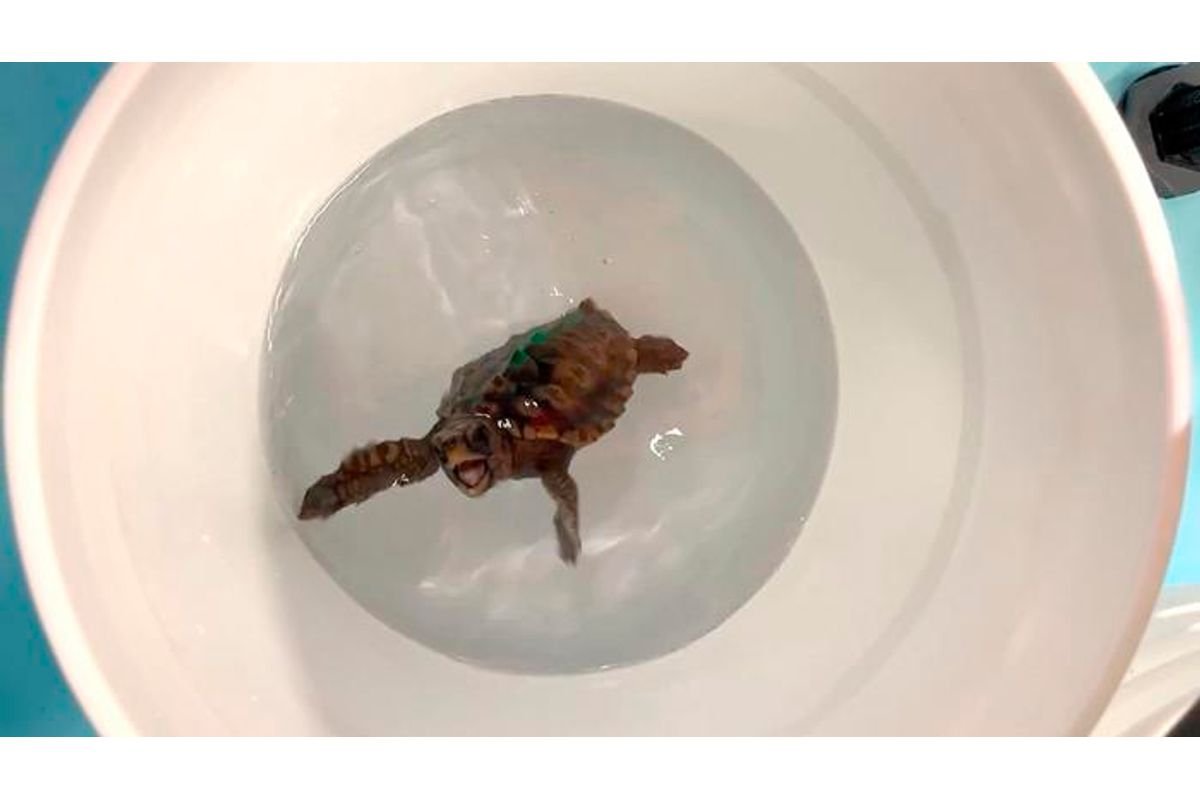
Setting out to learn more, the team trained eight loggerhead hatchlings to signal, through a delightful, twirling dance, when they felt the magnetic field at a particular location around the Turks and Caicos islands. (They also trained an additional eight hatchlings to do the same when they felt the magnetic field around Haiti.) Then, after exposing the turtles to strong magnetic pulses, the researchers observed their behavior, waiting to see whether they signaled the field’s presence through their spins.
If the turtles didn’t dance, the researchers said, it may suggest that they felt the magnetic field through bits of embedded magnetite, which would be disrupted by the strong magnetic pulses. Alternatively, if the turtles did dance, it might suggest that they felt the magnetic field through some other mechanism. Putting the turtles to the test, the team found that the hatchlings did less dancing after their exposure to the pulses, indicating that their magnetic map may depend on the presence of these bits.
Read More: From Songbirds to Dung Beetles, These Animals Can Navigate by Starlight
Dancing Magnetism
Of course, the trick to the discovery was the turtles’ signaling, which was triggered by the hatchlings’ love of food. “They are very food motivated and eager to dance when they think there is a possibility of being fed,” said Alayna Mackiewicz, a study author and a graduate student at the University of North Carolina at Chapel Hill, according to a press release.
Indeed, hatchling loggerhead turtles twist and turn in anticipation of food, whirling around and around in an excited dance. So, by teaching the turtles, over the course of two months, to associate their sensation of the magnetic field with food, the researchers effectively encouraged them to communicate when they sensed its magnetism.
“It’s really fun, but takes up quite a bit of time,” Mackiewicz said.
According to the team, the turtles use both of their magnetic senses to make sense of their surroundings, seeing and feeling the magnetic field. While one works like a compass, informing them about the direction of their travel, the other works like a map, tracking their position. The results show that the latter is an especially essential component of the turtles’ navigation — one that is now better understood thanks to the turtles’ twirling dance.
Article Sources
Our writers at Discovermagazine.com use peer-reviewed studies and high-quality sources for our articles, and our editors review for scientific accuracy and editorial standards. Review the sources used below for this article: