
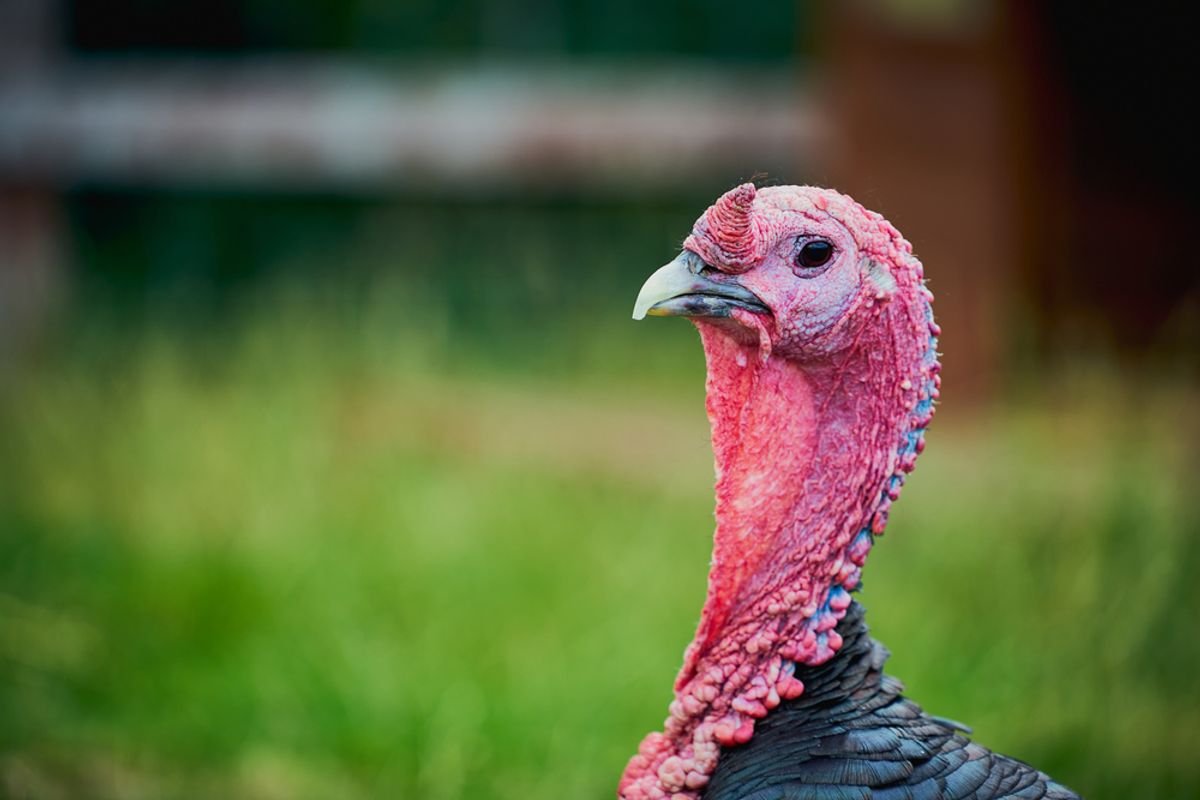
Turkeys Have a Strict Hierarchy, and Humans May Be at the Bottom of the Pecking Order

It’s that time of year when many of us have turkey on our minds. From hunting to Thanksgiving feasts to Turkey Trot 5Ks, turkey season is in full swing. And while you may be thinking of this large bird quite often, it’s possible they have you on their minds too — and they may be sizing you up.
Turkeys have dominance hierarchies within their flocks, meaning they can have a distinct and aggressive pecking order, especially when it comes to mates and resources. However, other turkeys aren’t the only animals this Thanksgiving bird can express these dominant traits to. According to the Massachusetts Division of Fisheries and Wildlife (MassWildlife), turkeys may also try to establish dominance over humans.
Read More: Inside the Speed-Walking, Head-Bobbing Physics of the Humble Turkey
Turkeys Above Humans in Pecking Order
Dominance hierarchies — also known as pecking orders — are seen all over the animal kingdom in species like wolves, baboons, and birds — like chickens and turkeys — according to Britannica. The hierarchy follows a linear (or nearly linear) structure in which each animal is submissive to the one above it, until they reach the top of the pecking order.
When a turkey hierarchy is established, it usually goes unchanged and can remain rather peaceful. However, during mating season, this can change. Male turkeys, known as toms, will fight to remain the alpha of a flock or over mates. Higher-ranking Toms may often turn a cold shoulder to younger male turkeys — jakes — trying to join a flock.
How Turkeys Show Dominance
Toms can show dominance in several ways, and one way is posturing. Here, a turkey may puff out its feathers or strut around with their wings lowered. This can be intimidating to other males. Toms will also fan out their tail feathers, something that not only makes the turkey seem larger and more imposing but also attracts mates.
Head pecking is another way turkeys show dominance — literally the pecking order. Toms will often peck at the heads of those beneath them in the hierarchy. Pecking can be painful and cause serious injury to other turkeys.
Toms can also show dominance in a rather odd way. Hunters with the Wild Turkey Lab observed that after a tom is killed during hunting, a different tom that may have been considered a ‘friend’ or an ‘equal’ will sometimes run up to the dead turkey and begin posturing, pecking its head, or even standing on the dead bird.
Can Turkeys Assert Dominance Over Humans?
Besides asserting dominance over other turkeys, it’s possible that some turkeys could attempt to assert dominance over humans as well. Now, wild turkeys that aren’t accustomed to humans aren’t likely to be the aggressors; however, if humans have fed or interacted with certain turkeys, they may begin to see these humans as a threat, according to the Audubon Society.
To prevent aggressive wild turkeys, it’s important not to feed them, according to the Massachusetts Division of Fisheries and Wildlife (MassWildlife). The more humans feed wild turkeys, say, in residential neighborhoods, the more likely wild turkeys will begin to flock to that area.
MassWildlife also advises covering shiny or reflective objects in your yard, such as mirrors, windows, and even vehicles. During mating season, a turkey may see its reflection and think it’s a rival, and thus begin attacking the reflection, causing damage to that reflective object.
If or when turkeys begin exhibiting more aggressive behavior towards humans, MassWildlife offers a few tips to stay safe.
- Keep the turkey in front of you; it thinks you’re more vulnerable from behind.
- Don’t run. Turkeys will likely see this as a form of submission and chase after you.
- Stand your ground and try to make yourself seem bigger by opening your jacket or lifting your arms above your head.
- Keep a more dominant body language.
- Move aggressively towards a turkey.
- Be loud and vocal. Beep a horn if one is available.
- Use objects at hand, like a rake or other garden tools, to distance the turkey from you.
- Keeping a dog around can help keep turkeys away, but be careful that neither animal gets hurt.
Read More: Turkeys Are Capable of “Virgin Birth”
Article Sources
Our writers at Discovermagazine.com use peer-reviewed studies and high-quality sources for our articles, and our editors review for scientific accuracy and editorial standards. Review the sources used below for this article: