
Titan’s Subterranean Liquid Oceans May Actually Be Slush

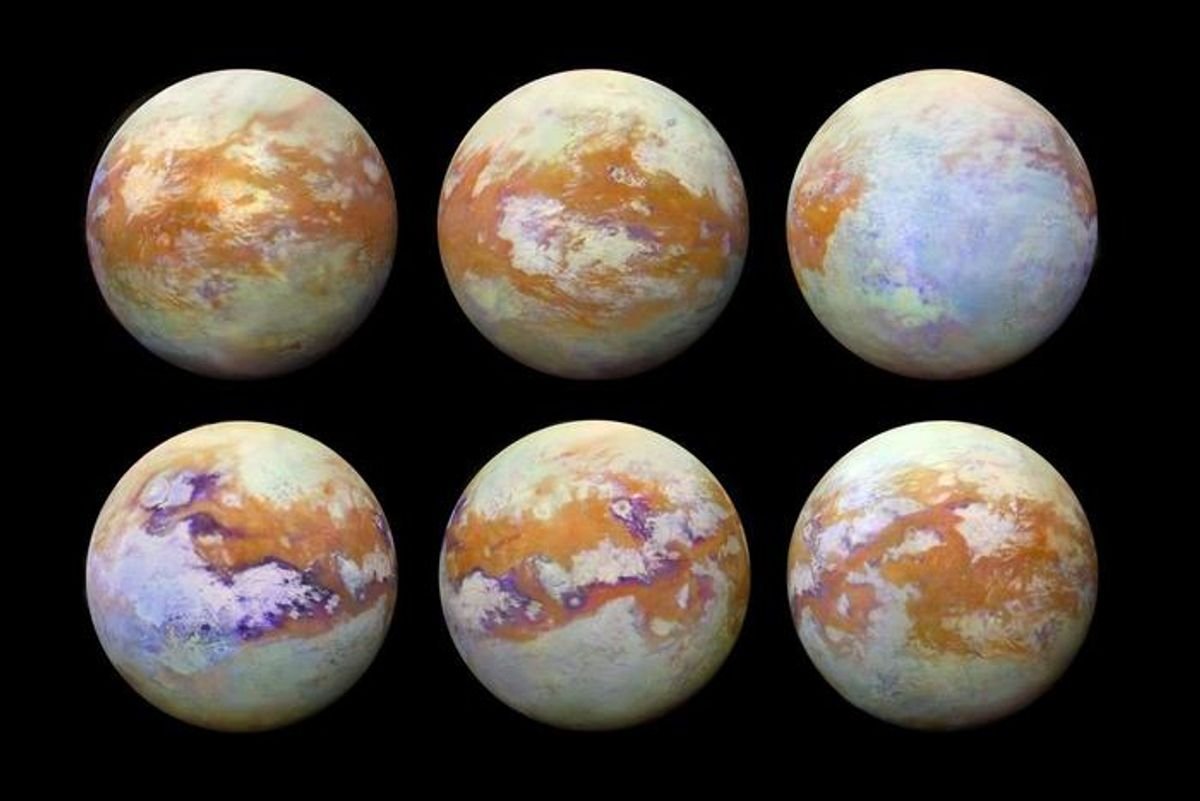
Titan, Saturn’s largest moon and the only known celestial body other than Earth to have liquids on its surface, has been extensively studied by planetologists. Their analysis suggested that below the moon’s icy surface, which is roughly negative 297 degrees Fahrenheit, lay a vast ocean.
A new, more in-depth analysis published in Nature however, has suggested that Titan’s deep “oceans” may in fact be dense layers of hydrocarbon slush.
Read More: Saturn’s 128 New Moons May Be Remnants of Past Cosmic Collisions
The Mystery of Saturn’s Moon
Researchers first proposed that Titan may have oceans based on analysis from NASA’s Cassini mission to Saturn, which first reached the gas giant in 2004. But the probe’s data didn’t match up with some of the other physical data Cassini recorded.
Titan’s lemon-shaped orbit around Saturn causes the moon to stretch and squish depending on where it is in its journey. Researchers believe that such drastic physical changes could only be enabled by a vast ocean.
“The degree of deformation depends on Titan’s interior structure. A deep ocean would permit the crust to flex more under Saturn’s gravitational pull, but if Titan were entirely frozen, it wouldn’t deform as much,” explained Baptiste Journaux, a University of Washington planetologist and study co-author, in a press release.
The new study added an extra metric — time — onto earlier studies of how Saturn alters its moon. The team noted that instead of deforming when the gas giant’s gravity was strongest, Titan shifted roughly 15 hours later. This, they realized, might be down to viscosity.
While a paddling pool full of water can be displaced with relative ease — by a cannonball from an overeager adult, for example — the same pool filled with jelly would require far more energy to move. In the same way, the researchers realized that the time delay was due to Titan’s thicker consistency, requiring more energy to shift.
By calculating that energy, the team could decipher what Titan’s interior was likely to be made of. The global ocean theory did not match up with the data.
“The Smoking Gun” Behind Titan’s Interior
“Instead of an open ocean like we have here on Earth, we’re probably looking at something more like Arctic sea ice or aquifers, which has implications for what type of life we might find, but also the availability of nutrients, energy, and so on,” said Journaux.
This consistency would still explain why Titan can squish under Saturn’s gravity, but also account for the delay. “Nobody was expecting very strong energy dissipation inside Titan. That was the smoking gun indicating that Titan’s interior is different from what was inferred from previous analyses,” said NASA planetologist Flavio Petricca, who also co-authored the study, in a press release.
In the study, Petricca analyzed the timing of the radio waves emitted by Cassini during flybys of Titan. Journaux confirmed his colleague’s suspicions by simulating how ice and water might react deep within Titan’s oceans.
“The watery layer on Titan is so thick, the pressure is so immense, that the physics of water changes. Water and ice behave in a different way than seawater here on Earth,” Journaux said.
If Titan’s seas aren’t as watery as first thought, could it harm the moon’s chances of containing life? The authors say the opposite might be true. If much of the water on the planet is actually slush, the remaining areas that are water are likely to be far warmer, as toasty as 68 degrees Fahrenheit. These more favorable conditions could be paired with richer, more nutrient-rich waters, which could also increase the likelihood of life forming.
“The discovery of a slushy layer on Titan also has exciting implications for the search for life beyond our solar system,” said study author and planetologist Ula Jones in a press release. “It expands the range of environments we might consider habitable.”
Read More: Icy Moons Orbiting Saturn and Uranus May Hide Boiling Liquid Oceans
Article Sources
Our writers at Discovermagazine.com use peer-reviewed studies and high-quality sources for our articles, and our editors review for scientific accuracy and editorial standards. Review the sources used below for this article: