
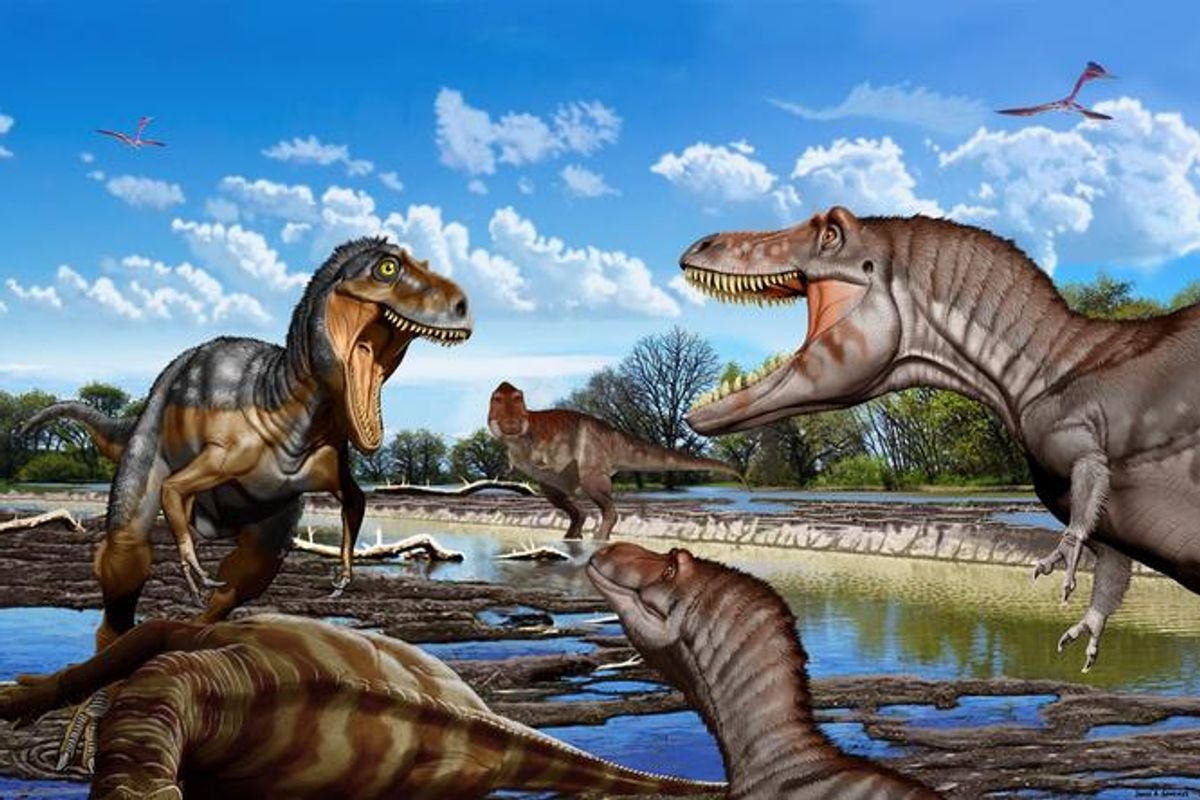
Tiny Throat Bone Confirms Nanotyrannus as Own Species — Adding Another Predator to the Late Cretaceous
The identity of Nanotyrannus has long hinged on one unresolved question: Was it its own small-bodied predator — or simply a juvenile Tyrannosaurus rex that hadn’t finished growing?
Now, researchers say a tiny bone in the throat has delivered an answer. By analyzing the hyoid — located beneath the tongue and used to anchor swallowing muscles — the team found that the Nanotyrannus had already reached, or nearly reached, skeletal maturity when it died.
Published in Science, the findings confirm that Nanotyrannus was a distinct species, not a young T. rex — while also revealing a powerful new way to determine a fossil’s age at death.
“This small-bodied — in relation to the T. rex — meat-eater’s hyoid bone showed growth patterns that suggest maturity or approaching maturity,” said Ashley Poust, Voorhies Endowed Curator of Vertebrate Paleontology, in a press release. “This lets us be confident in keeping the name Nanotyrannus, because this animal is clearly not on a growth path to becoming a Tyrannosaurus rex.”
The Nanotyrannus Identity Debate, Revisited
The hyoid was preserved intact with the skull when it was discovered in 1942. Since then, the fossil has moved through several identities. It was first classified as Gorgosaurus, then renamed Nanotyrannus lancensis in 1988, before later being reinterpreted by many researchers as a juvenile Tyrannosaurus rex.

Dr. Morris studies the throat bone (hyoid) of “Thomas” in the Dinosaur Institute collections.
(Image Credit: Stephanie Abramowicz)
Just last month, a dueling dinosaurs fossil added new weight to the case that Nanotyrannus was its own species. But that discovery did not resolve a key uncertainty: how old the original reference fossil — the holotype skull housed at the Cleveland Museum of Natural History — actually was when the animal died.
“At the time, the prevailing consensus was that the Nanotyrannus holotype skull represented an immature Tyrannosaurus rex, and was not a separate species,” said Christopher Griffin, assistant professor of geosciences at Princeton. “Our expectations were simply following along with that consensus, but once we sampled the hyoid and saw features that strongly indicated maturity, we knew that we had to examine that idea more skeptically.
A New Tool for Dating Dinosaur Fossils
Because the hyoid is small and fragile, it is rarely preserved — and has never before been used as a primary aging tool for dinosaurs. Using bone histology, which analyzes microscopic growth layers frozen inside fossilized bone, the team found patterns that appear only in late-stage skeletal maturity.
To test whether the method was reliable, the researchers examined hyoids from modern animals related to dinosaurs, including ostriches, alligators, and lizards, as well as additional dinosaur fossils. In every case, the hyoid tracked age just as consistently as traditional tools such as ribs and femurs.
“It’s expanding, in a small way, the ability to learn about animals’ past lives,” Poust said. “It was exciting to show that the growth signal is so conserved across the body. Maybe this is a tiny wedge to start investigating that in some different ways.”
A Grown Nanotyrannus and the Late Cretaceous Ecosystems
With the holotype now confirmed as mature, the ecological picture of the Late Cretaceous becomes more crowded. The adult Nanotyrannus likely measured about 18 feet long — dwarfed by the more than 40-foot-length of T. rex, yet still a formidable predator in its own right.
“You’re left with at least two different sized meat eaters in the same environment, which has some big implications for ecology and the extinction of dinosaurs,” Poust said. “Knowing more about what existed gives us a sense of how big the fossil record is and how species change through time. And understanding the complexities of an ecosystem is important.”
Article Sources
Our writers at Discovermagazine.com use peer-reviewed studies and high-quality sources for our articles, and our editors review for scientific accuracy and editorial standards. Review the sources used below for this article: