
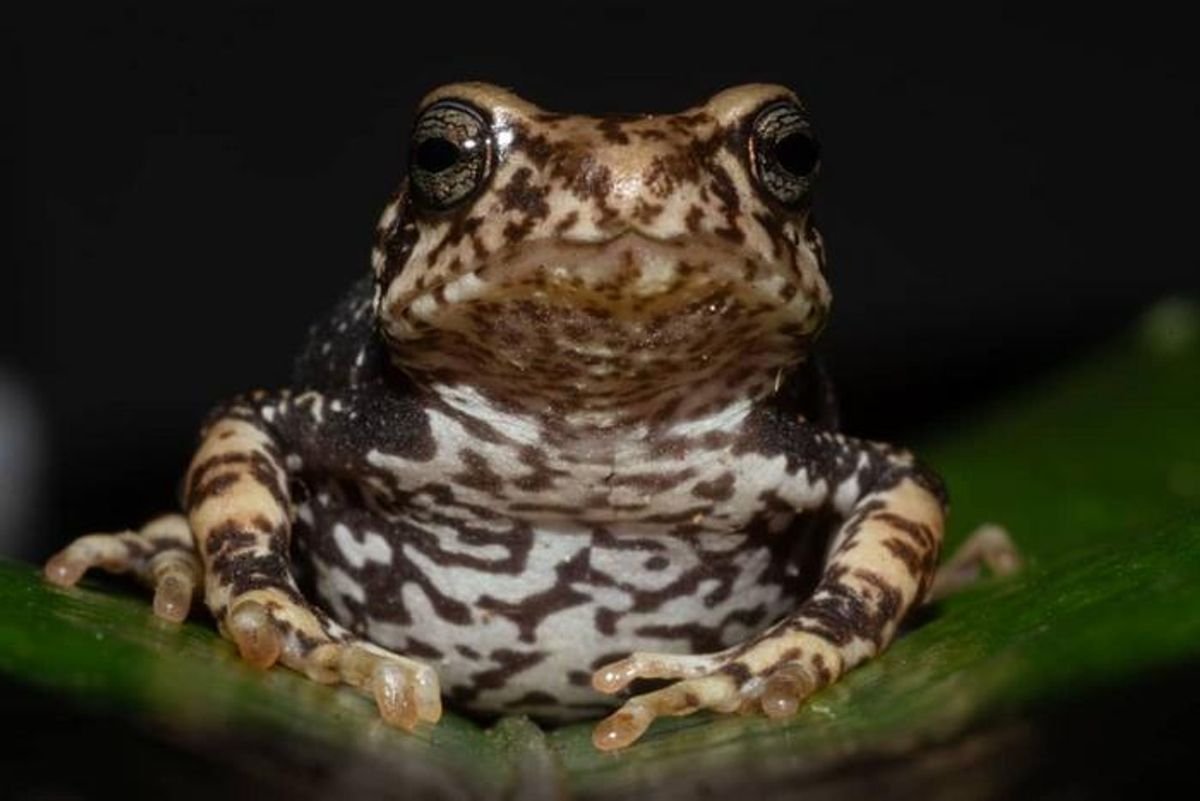
Three Newly Discovered Toads Give Birth to Live Young in a Bizarre Evolutionary Twist
Forget the tadpoles — in Tanzania’s mountain forests, three newly discovered toads enter the world ready to hop.
A new study, published in Vertebrate Zoology, introduces toad species that give birth to live young, skipping the aquatic larval stage entirely. This rare reproductive twist, seen in less than one percent of frogs and toads, offers fresh insight into how life evolves.
“It’s common knowledge that frogs grow from tadpoles — it’s one of the classic metamorphosis paradigms in biology. But the nearly 8,000 frog species actually have a wide variety of reproductive modes, many of which don’t closely resemble that famous story,” said Mark D. Scherz, a co-author on the study, in a press release.
Toads Evolved in Tanzania’s Eastern Arc Mountains
The newly found species belong to Nectophrynoides, a genus of small, tree-dwelling toads already known for breaking amphibian conventions. Rather than laying eggs in water, females carry fertilized embryos inside their bodies until they give birth to fully formed toadlets, one of the rarest reproductive strategies in the animal kingdom.

Nectophrynoides, like this N. viviparus, live in the low vegetation. Photo credit: Michele Menegon
(Image Credit: Michele Menegon)
“Live-bearing is exceptionally rare among frogs and toads, practiced by less than 1 [percent] of frogs species, making these new species exceptionally interesting,” said H. Christoph Liedtke a co-author, in the press release.
The new species, Nectophrynoides luhomeroensis, N. uhehe, and N. saliensis, come from Tanzania’s Eastern Arc Mountains, where isolated forests and ancient geology have produced exceptional amphibian diversity.
Read More: Fossils Show That These Ancient Frog Families Split Apart at Least 55 Million Years Ago
DNA Reveals Hidden Diversity
For more than a hundred years, scientists believed Nectophrynoides viviparus, first described in 1905, was a single species spread across Tanzania. But scattered populations looked slightly different, and genetic data hinted that they weren’t all the same.
To find out, researchers examined 257 toad specimens, many collected over a century ago and stored in European museums. Using museomics, a method that retrieves DNA from historical samples, the team compared genetic, morphological, and acoustic data to determine how these populations were related.
“Some of these specimens were collected over 120 years ago,” said Alice Petzold, who led the museomics work. “Our analyses revealed exactly which populations those old specimens belonged to, giving us much more confidence for future research on these toads.”
Their findings showed that N. viviparus wasn’t one species at all, but a complex of genetically distinct lineages, each isolated on separate mountain ranges. By combining museum genetics with new field data, the researchers discovered the three new species.
Habitat Loss Threatens These Rare Mountain Toads
The same mountain isolation that shaped these species now leaves them exposed to rapid change. Across the Eastern Arc Mountains, farming, logging, and mining are carving up forests.

One of the newly described toad species, Nectophrynoides uhehe. Photo credit: Michele Menegon
(Image Credit: Michele Menegon)
“The forests where these toads are known to occur are disappearing quickly,” said co-author John V. Lyakurwa.
Once mistaken for one widespread species, these toads are now known as isolated survivors in shrinking forests — a reminder that even the smallest lives can reveal both nature’s resilience and its fragility.
Read More: New Species of Frog Named After the Hobbit Author, J.R.R. Tolkien
Article Sources
Our writers at Discovermagazine.com use peer-reviewed studies and high-quality sources for our articles, and our editors review for scientific accuracy and editorial standards. Review the sources used below for this article: