
Three Generations Built the Pyramids of Giza Overtime, But How Is Debated

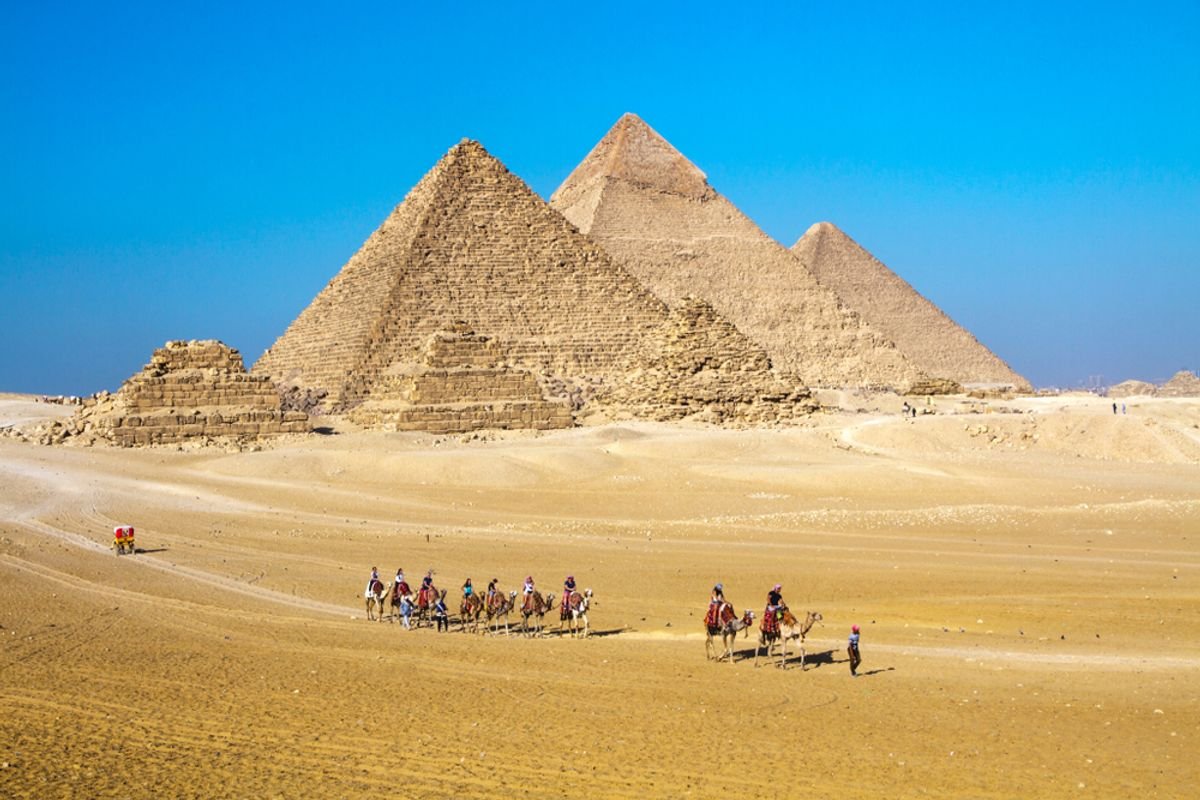
The pyramids of Giza are among the oldest monumental stone buildings ever created, and also contain the two tallest ancient pyramids in the world. The Great Pyramid — the tallest among the trio — is the only surviving of the original seven wonders of the ancient world. Many individuals overtime contributed to the construction of these incredible pyramids that still exist today.
“You can see over the generations how they are working out different kinds of engineering problems and getting more sophisticated in finding solutions for them,” says Roland Enmarch, an egyptologist at the University of Liverpool.
So just how old are these pyramids, who built them, and how were they built so long ago? Some of these questions are relatively straightforward, while the mechanical specifics are somewhat uncertain.
Read More: The Pyramid of Djoser: The World’s Oldest Pyramid Is Often Overshadowed
Tombs Inside the Pyramids
The oldest of the three iconic pyramids, which sit next to each other, is also the largest. It was built as the tomb of the Fourth Dynasty Egyptian pharaoh Khufu, whose Greek name is also often spelled “Cheops.”
The other two large pyramids that sit beside the Great Pyramid — the Khafre and Mentaure pyramids — were meant for the tombs of Khufu’s son and grandson, respectively.
The dynastic line wasn’t necessarily a smooth one between the three pharaohs. Khafre wasn’t the first son to ascend to the throne of Egypt — his brother Djedefre, or Ratoises in Greek, took power for a relatively short period after his father, but was buried at a since-ruined pyramid at the Abu Rawash, an archaeological site about five miles from Giza. Khafre took power after the second-largest pyramid was built as his tomb.
The third and smallest of the large trio of pyramids at Giza is the tomb of Menkaure, likely Khafre’s son and Khufu’s grandson.
Building the Pyramids of Giza
All three of the large pyramids of Giza were built over three generations in the Old Kingdom of Egypt. Dates are uncertain as the evidence is fragmentary and estimated through a combination of historical accounts and radiocarbon dating.
Khufu may have ruled for about three decades, starting early in the 26th century B.C.E. Khafre’s reign is less certain, but it was at least two decades, while Mentaure’s reign may have lasted about six decades, ending near the close of 2500 B.C.E.
It’s difficult to say whether the pyramids were completed during the lifetime of each respective pharaoh or whether their successors completed the projects. The Great Pyramid — the oldest of the three — was likely built about 100 years after the Pyramid of Djoser, a step pyramid built at Saqqara during the Third Dynasty of the Old Kingdom.
How Were The Pyramids Built?
Building such massive monuments was no small undertaking. Nothing on this scale had really been attempted before — even the earlier Pyramid of Djoser was built a little differently than those at Giza, and the Khufu and Khafre pyramids are more than twice as tall as that of Djoser.
To start with, the conditions during the Fourth Dynasty, and, in fact, most of Ancient Egyptian rule, were well-suited to producing bounteous resources. This was partly due to the annual flooding of the Nile River, which helped produce a surplus of grain.
“Those Old Kingdom rulers were able to consolidate the seasonal Nile flood agriculture,” says Harvey Weiss, a Near Eastern archaeologist at Yale University. “That cereal agriculture wealth was deployed to sustain the workers who built these mortuary structures for the perpetual life of the rulers.”
Enmarch says that some of this surplus was likely used to feed pyramid laborers. It’s not clear whether the workers were slaves, serfs, or paid laborers, but Enmarch believes it was likely a mix. As the Egyptians didn’t use coins at this point, people often paid their taxes in kind. This may have meant a few weeks of free labor each year, or that villages had to send a certain number of workers every so often.
“It wouldn’t surprise me if they threw whatever resources they had at this massive project,” Enmarch says.
While some aspects of pyramid construction remain a mystery, a French archaeologist discovered papyrus fragments in 2013 written by an official who recorded the daily work of building the Great Pyramid. The logbook recorded the activities of a work crew that ferried fine white casing limestone from a quarry across the Nile from Giza to the pyramids for use in the outer layers of the Great Pyramid.
“We actually have a day-by-day set of administrative records,” Enmarch says. Shallow boats could be used back then to ferry this kind of material closer to the worksite during the wet season.
Read More: Who Built the Egyptian Pyramids? Not Slaves
What Materials Were Used to Build The Pyramids?
Less is known about how workers stacked the material to make the pyramid. The size of many of the rocks hint that a few people using rollers could have managed them, Enmarch says.
To get the materials up to the top, Enmarch adds that ramps were likely used — while no traces of such features remain at Giza, other pyramids elsewhere still have ramps that were never cleared away. The trouble is, a single straight ramp would have to be so long and massive that it would have been more of an undertaking than the pyramids themselves.
Other suggestions include ramps that wrapped around the outside of the pyramids, while some researchers believe the ramps were built on the inside of the pyramids due to structural anomalies detected there.
Enmarch isn’t convinced about the latter idea due to a lack of clear evidence so far. Instead, he points to the recent discovery of a ramp steeper than previously thought feasible at a rock quarry in Hatnub, contemporary with Khufu’s reign.
The area, which Enmarch has worked on, contained post holes that could have been used to ferry up large alabaster blocks on wooden sleds. If such a system were used in the pyramids, any ramp may have been smaller than previously believed possible.
Why Didn’t Ancient Egyptians Build More Giant Pyramids?
Pyramid building didn’t stop with those at Giza. In fact, there are several smaller pyramids surrounding the larger trio there. Furthermore, pyramid building went on, in a smaller sense, for some time in Egypt and eventually in Kush, whose rulers adopted some of the styles of past Egyptian pharaohs.
Leaders began to favor entombments at the Valley of the Kings by around the 16th century B.C.E., though the less elite continued to use smaller-scale mud-based pyramids for some time.
But the conditions that favored the development of such large tombs at Giza didn’t last. A long-lasting megadrought affected everything from China and India to Mesopotamia, Egypt, and beyond, according to a study in Progress in Natural Science. This dry period disrupted the seasonal flooding of the Nile, curtailing the fertility of Egyptian agriculture.
Read More: The Oldest Ancient Wonder Still Exists Today, 4,500 Years Later
Article Sources
Our writers at Discovermagazine.com use peer-reviewed studies and high-quality sources for our articles, and our editors review for scientific accuracy and editorial standards. Review the sources used below for this article: