
Those Orcas Wearing Salmon Hats? It Might Not Be as Cute as You Think

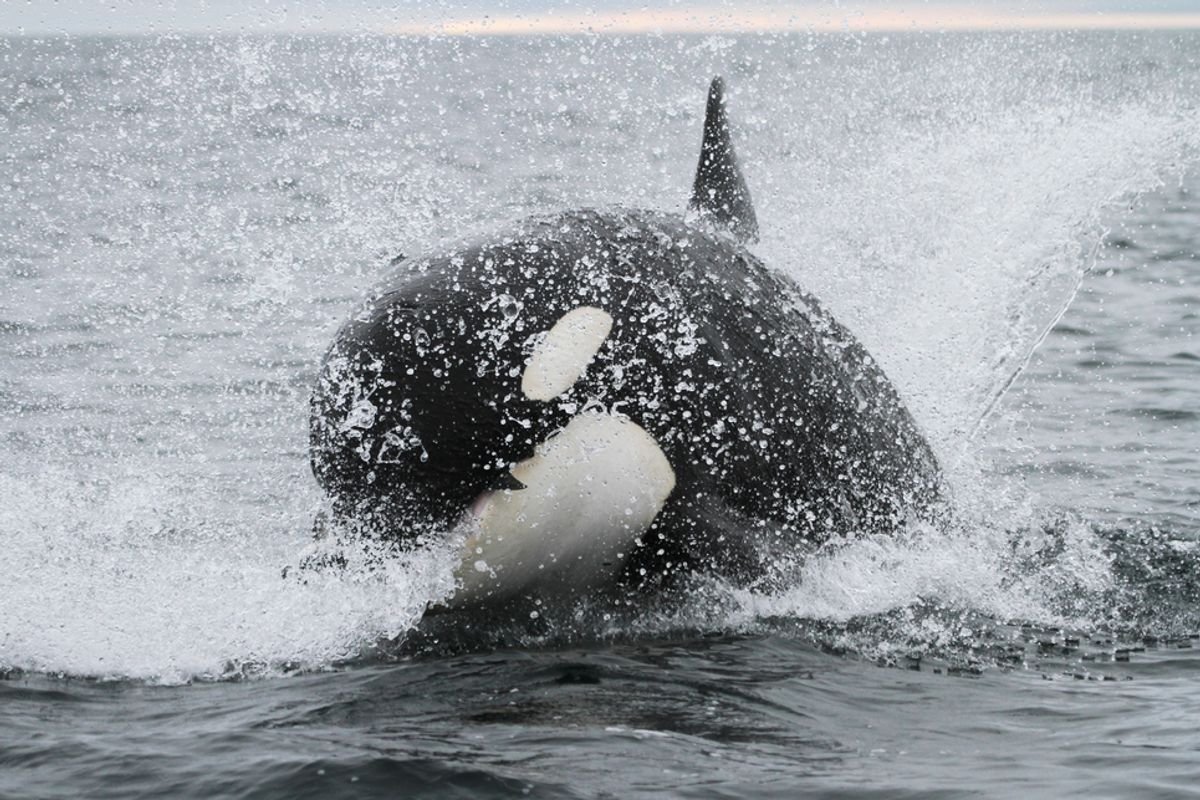
Killer whales have been spotted swimming around with dead salmon on their heads. The behavior was first spotted in 1987, among the Southern Resident population of killer whales, a critically endangered group of orcas that live off the Pacific Northwest coast. It was documented again in late 2024, according to the Wild Salmon Center.
From a human perspective, it’s cute, but a closer look at what it might mean reveals something more disturbing.
Read More: Some Orcas Are Flipping Juvenile White Sharks and Devouring Their Livers
Orcas Sharing Food, Even When It’s Scarce
Deborah Giles has been getting to know these killer whales for almost 40 years. Giles is the killer whale expert at The SeaDoc Society and a resident scientist at the University of Washington, Friday Harbor Laboratories. She witnessed the first documented incidence of orcas wearing salmon hats in 1987. But we still have no idea why they do it, she says. No one has studied it. There are several hypotheses, however.
One is that when these animals, who eat only salmon, are well fed, they don’t have to eat everything they catch, so they’re just playing with their food. Another is that they’re hanging on to the fish to share with a family member.
“These guys do hunt cooperatively,” says Giles. “But they also hunt on their own, and will catch a fish and then save it until their family is nearby, and then they’ll break it in half or in thirds and share with family members.”
This fits with what scientists know of their social structure. “Their social bonds are so strong that even in times when we know they’re hungry, they still share food,” Giles says.
A Recent Good Year for Salmon
So that’s a couple of potential explanations for this behavior. But something much more disturbing is swimming beneath the surface of this story. Though clearly documented in 1987 and again in November 2024, salmon wearing wasn’t seen much, if at all, in the intervening years.
“Perhaps the reason is because there wasn’t enough food,” says Giles. “Any food they caught, they had to eat right away.”
In the fall of 2024, there were exceptionally big runs of coho and chum salmon in Puget Sound, and that brought the orcas down in late October through November. That’s when someone documented one of the killer whales wearing a salmon hat.
Sadly, those big runs aren’t common, which could explain why we don’t see orcas in salmon hats too often. Whatever the reason for the behavior, it comes down to one thing: “They can’t wear salmon hats if there’s not enough fish to catch and put on their heads,” says Giles.
That 2024 run was an anomaly — or, let’s hope, a promising sign. However, the fact remains that these animals do not have enough to eat.
Orca Resting Times
Giles and colleagues are currently studying changes in the resting times of these orcas. That’s a good indication of how hard they’re having to work for food. In the 1980s, Giles says, these animals rested slightly more than a quarter of daylight hours. By the end of the 1990s, resting times had dropped to 13 percent.
In 2014, Giles conducted an analysis showing that daylight resting time was reduced to less than 7 percent. Last year, a quick calculation found that they were hardly resting at all — maybe three percent of daylight hours. What was resting time is now spent foraging and traveling in search of food. It’s like a human working three full-time jobs. There’s no time for family. And family is very important to these animals.
“In a lot of ways, our social connections with each other pale in comparison to the social bonds of these whales,“ says Giles. “They are incredibly connected and take care of each other. That’s what stands out to me. And they do share food even when they’re hungry.”
So if you see a news item about orcas wearing salmon hats, rejoice. We have no idea why they do it, but it’s a sign that, at least for that day, they have enough food. And tragically, getting enough food is rare for Southern Resident killer whales.
Read More: In a First, Watch as Orcas Team Up With Dolphins to Boost Their Salmon-Hunting Success
Article Sources
Our writers at Discovermagazine.com use peer-reviewed studies and high-quality sources for our articles, and our editors review for scientific accuracy and editorial standards. Review the sources used below for this article: