
This Newly Discovered Texas Bee Appears to Live on Just One Plant — and Nothing Else

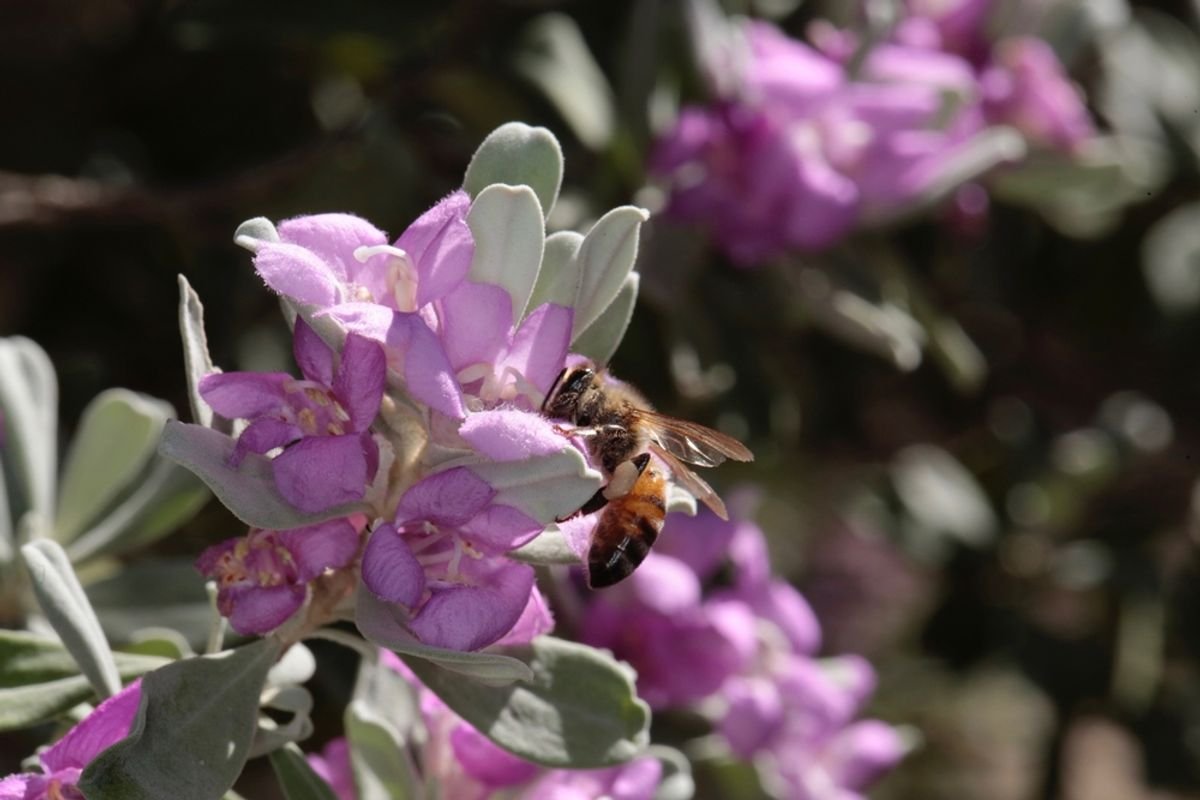
A newly identified bee species in Texas is so picky, it appears to rely on just one plant to survive — and it may be the only known mining bee in the world to do so. Meet Andrena cenizophila, a small, ground-dwelling bee discovered in southwestern Texas and northern Mexico. Its name means “lover of cenizo,” a nod to the purple-flowering shrub, also known as Texas Ranger, that seems to be its exclusive food source.
The findings, published in the Journal of Melittology, describe a highly specialized pollinator whose survival may be tightly linked to the unpredictable blooming cycles of a single plant species.
“To our knowledge, this bee is the only mining bee in the world that is specifically focused on this one particular kind of shrub,” said Silas Bossert, lead author of the study, in a press release. “The only pollen that we found on this bee is from flowers of purple sage.”
Read More: How Stingless Bees in the Amazon Became the First Insects With Legal Rights
A Mining Bee Species With Just One Food Source
Most bees are flexible foragers, visiting a variety of flowers to gather pollen. But A. cenizophila appears to break that rule.
Researchers confirmed its unusual diet by analyzing pollen stuck to preserved specimens. Every sample pointed to the same source: cenizo, a hardy shrub native to arid regions of Texas and Mexico that bursts into vibrant purple bloom after rainfall.
Texas Ranger flowers for only about a week at a time, often triggered by rain events, with its peak blooming season in late spring. That means the bee has a narrow window to gather enough food to sustain its offspring.
“Andrena cenizophila needs to get all the food for its brood during the main bloom,” Bossert said. “That tight window is very unusual for a bee. What does it do during the rest of the year?”
The question remains unanswered, and it’s one of the biggest mysteries surrounding the species.
A Bee That Didn’t Belong Anywhere
Although the bee is newly described, it isn’t newly collected. Specimens were first gathered decades ago by a researcher who immediately recognized that the insect didn’t match any known species. But without genetic data, its place in the bee family tree remained uncertain.
To finally classify it, researchers combined traditional anatomy with modern genetic analysis. Bossert extracted DNA from preserved specimens — including by removing three tiny legs from a female bee — and sequenced its genome.
They also examined physical traits such as antennae, body structure, and reproductive anatomy. Together, the data showed that the bee is most closely related to a group found in central Mexico.
Why Naming a Bee Still Matters
With roughly 1,800 species, mining bees are already one of the largest groups of animals on Earth, and scientists describe around 200 new bee species each year. But naming a species isn’t just about adding another entry to a list.
“The names we give to organisms should reflect their evolutionary history,” Bossert said.
Understanding how species are related helps researchers track biodiversity, identify ecological relationships, and better protect vulnerable pollinators, especially those, like A. cenizophila, that may depend on a single plant to survive.
And there’s still much to learn. Researchers have yet to locate a nest for this bee or fully understand its life cycle. How it survives outside the brief blooming periods of its host plant remains an open question.
For now, this tiny bee offers a reminder that even in well-studied ecosystems, some species live highly specialized, and largely hidden, lives.
Read More: Bumblebee Queens Can Survive and Breathe Underwater For Over a Week By Cutting Energy Demands
Article Sources
Our writers at Discovermagazine.com use peer-reviewed studies and high-quality sources for our articles, and our editors review for scientific accuracy and editorial standards. Review the sources used below for this article: