
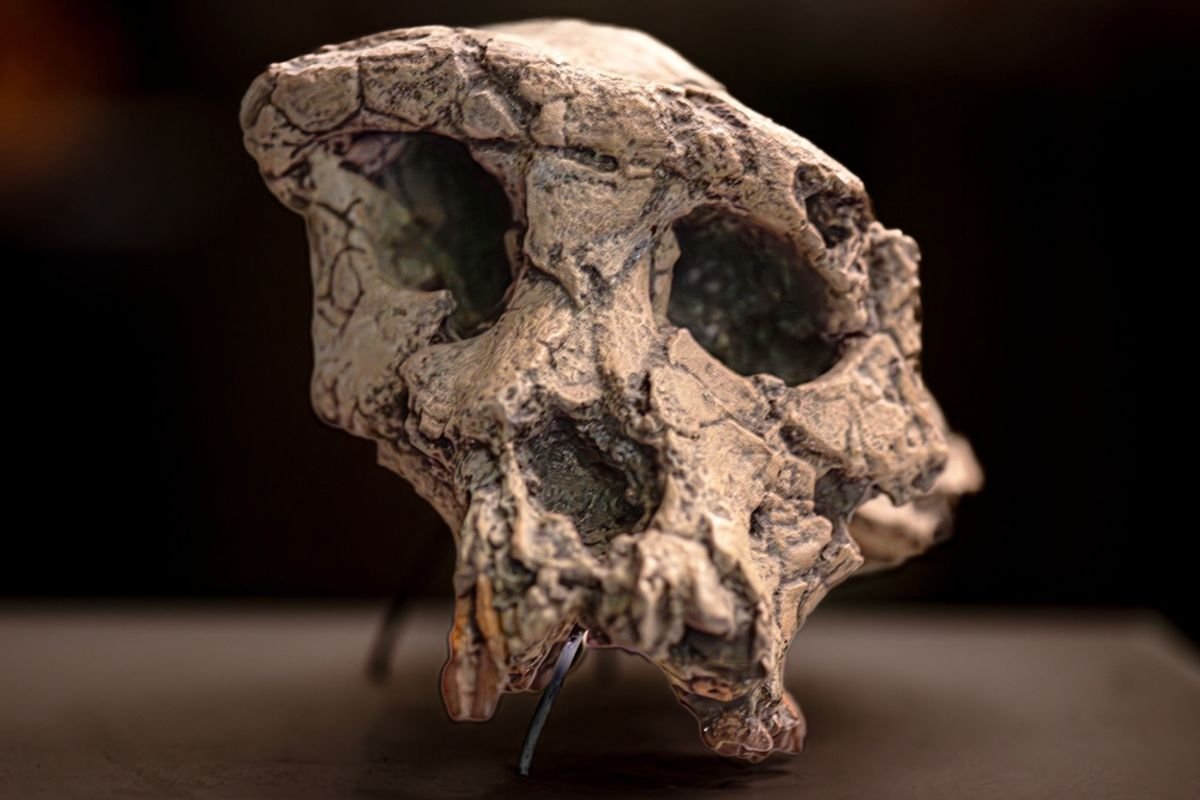
This 7-Million-Year-Old Fossil May Reveal When Ancient Humans Started Walking Upright
How one of the oldest candidates for a human ancestor moved through its environment has remained an open question. A seven-million-year-old fossil from central Africa has been interpreted either as an early upright walker — or as an ape that still relied on four limbs.
A new study now adds weight to that question. Published in Science Advances, the research presents the strongest anatomical evidence yet that Sahelanthropus tchadensis — a species discovered in Chad in the early 2000s — was capable of walking on two legs. Using high-resolution 3D analysis, the team identified a structure in the thigh bone previously found only in bipedal hominins, along with other traits that support upright posture and movement. Because walking on two legs is a defining feature of the human lineage, evidence of bipedalism at this age would place the species at or near the earliest known point of human ancestry.
“Our analysis of these fossils offers direct [evidence] that Sahelanthropus tchadensis could walk on two legs, demonstrating that bipedalism evolved early in our lineage and from an ancestor that looked most similar to today’s chimpanzees and bonobos,” said study author Scott Williams, in a press release.
Read More: A Crushed Cranium From One Million Years Ago Could Transform Our Timeline of Human Origins
Why This Ancient Human Fossil Has Been Hard to Classify

Skull and femoral comparisons of a chimpanzee, Sahelanthropus, and Australopithecus (left to right).
(Image Credit: Scott Williams/NYU and Jason Heaton/University of Alabama Birmingham)
Researchers discovered the fossil in Chad’s Djurab Desert in the early 2000s, but early studies focused mainly on its skull. Some features at the base of the skull suggested the head may have been positioned for an upright posture, but skull anatomy alone offered limited insight into how the animal actually moved.
Interpretations became more complex as other bones from the original discovery — including parts of the forearm and a thigh bone — were examined. Analyses of these limb bones varied, with some researchers emphasizing traits linked to climbing, and others identifying features consistent with bipedal movement.
If the species could walk on two legs, the implications extend beyond a single fossil. Upright walking would have emerged close to the time humans and chimpanzees diverged, long before later evolutionary changes such as larger brains or tool use.
The new findings also challenge the idea that bipedalism appeared only after major shifts in body size or brain anatomy, suggesting instead that upright movement evolved in a species that still retained many ape-like characteristics.
Revealing Early Signs of Upright Walking
In the new study, researchers reexamined the forearm and thigh bone using detailed comparisons with living apes and fossil hominins, alongside high-resolution 3D shape analysis. Together, these approaches allowed the team to distinguish traits linked to upright walking from those associated with climbing or more generalized movement.
The most distinctive feature they identified was a femoral tubercle — a small projection on the thigh bone that serves as the attachment point for the iliofemoral ligament. This ligament, the strongest in the human body, plays a key role in stabilizing the hip during upright standing and walking. Until now, the femoral tubercle had been documented only in bipedal hominins.
The analysis also confirmed two additional traits associated with bipedal locomotion: a natural twist in the femur that helps orient the legs forward, and a pattern of gluteal muscle attachment comparable to that seen in early human ancestors such as Australopithecus. Together, these features contribute to hip stability during standing and walking.
Although the species likely still spent time in trees and had much shorter legs than modern humans, its limb proportions differ from those of apes. The relatively long thigh bone compared with the forearm points to an early shift toward bipedal movement, suggesting that upright walking was already part of its behavioral repertoire.
“Sahelanthropus tchadensis was essentially a bipedal ape that possessed a chimpanzee-sized brain and likely spent a significant portion of its time in trees, foraging and seeking safety,” said Williams. “Despite its superficial appearance, Sahelanthropus was adapted to using bipedal posture and movement on the ground.”
Read More: Ancient Human Brains Adapted From Exposure to Lead Poisoning, Providing an Evolutionary Advantage
Article Sources
Our writers at Discovermagazine.com use peer-reviewed studies and high-quality sources for our articles, and our editors review for scientific accuracy and editorial standards. Review the sources used below for this article: