
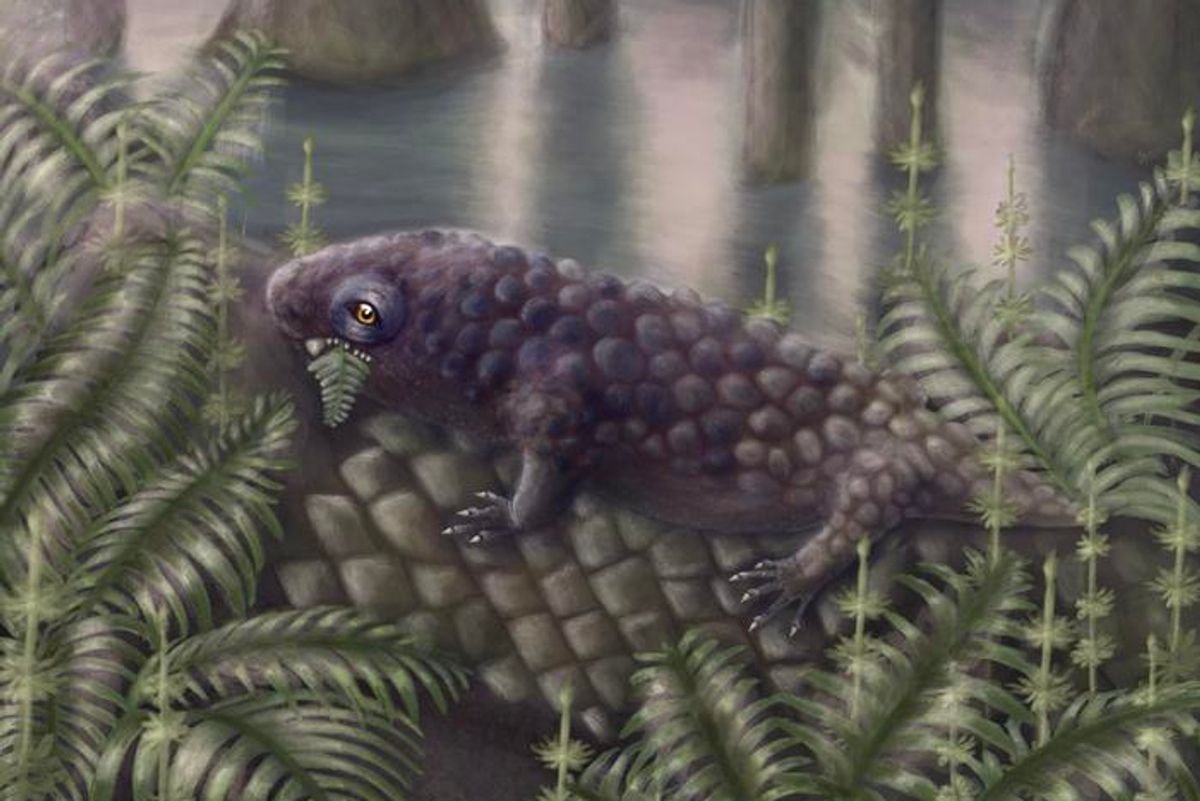
This 307-Million-Year-Old Animal May Have Been One of the First Plant Eaters
A 307-million-year-old football-sized creature may be one of the earliest land vertebrates to have eaten plants. While plant-eating animals are overly abundant today, that wasn’t the case millions of years ago. As land vertebrates began to evolve, they primarily consumed each other to survive until one creature began munching on plants.
Publishing their findings in Nature Ecology and Evolution, researchers believe they have identified one of the first-ever land vertebrates that consumed plants.
“This is one of the oldest known four-legged animals to eat its veggies,” said Arjan Mann, assistant curator of fossil fishes and early tetrapods at the Field Museum in Chicago and co-lead author of the study, in a press release. “It shows that experimentation with herbivory goes all the way back to the earliest terrestrial tetrapods — the ancient relatives of all land vertebrates, including us.”
Read More: 444-Million-Year-Old Microscopic Fossils Reveal Early Seafloor Recovery After Mass Extinction
Tyrannoroter heberti: One of the Oldest-Known Plant Eaters
About 475 million years ago, plants began moving from the ocean onto land, about 100 million years before vertebrates would also become land-dwelling, according to the press release. Even as these organisms lived together on land, it would still take tens of millions of years before a land vertebrate took a chomp out of a plant.
The first land vertebrate to possibly start eating plants is Tyrannoroter heberti, and its 307-million-year-old fossil has a lot to tell us.
What Did Tyrannoroter heberti Look Like?

Tyrannoroter skull fossil
(Image Credit: Arjan Mann)
The research team first discovered the fossil while doing field work in Nova Scotia, and the only part they uncovered was its skull. Brian Herbert, an avocational paleontologist, spotted the skull stuck in a tree, and once Mann saw it, he knew immediately what it was.
“The skull was wide and heart-shaped, really narrow at the snout but really wide at the back,” said Mann. “Within five seconds of looking at it, I was like, ‘Oh, that’s a pantylid microsaur.’”
Pantylids are a very ancient land vertebrate ancestor and are known as stem amniotes, meaning they were closely related to a group of tetrapods that would evolve into early reptiles and mammals.
“The pantylids are from the second phase of terrestriality, when animals became permanently adapted to life on dry land,” Mann said in the press release.
From this knowledge, the team was able to compare T. heberti to more complete skeletons of distant relatives and concluded that it likely had a stocky build, about the size and shape of a football, Mann explained in the press release.
T. heberti may have looked like a lizard, though this was before reptile and mammal ancestors split, so it was technically not a reptile. And while it might not seem very large by today’s standards, at that time T. heberti was likely one of the larger land-dwelling creatures.
Adjustable Diets Don’t Always Fare Well
Unfortunately, the skull had fossilized with its mouth closed, making it more difficult for researchers to analyze the contents of the skull, including its teeth. Using a CT scan, however, the team created a series of stackable X-ray images that formed a 3D picture of the inside of the skull.
“The specimen is the first of its group to receive a detailed 3D reconstruction, which allowed us to look inside its skull and reveal its specialized teeth, helping us to trace the origin of terrestrial herbivory,” said lead author Zifang Xiong, a Ph.D. student at the University of Toronto, in the press release.
From the images, the team determined that T. heberti had an additional set of teeth used for grinding plant-like foods. These teeth indicate that some of our stem amniote relatives may have been consuming plants much earlier than we thought.
From the evidence, the researchers also found that T. heberti didn’t eat only plants and likely ate smaller vertebrates and insects. Eating some of these insects may also have given T. heberti the gut microbiome it needed to digest plant materials.
Though T. heberti could eat a variety of food sources, that doesn’t mean it was adaptable to changes in its environment. It lived at the end of the Carboniferous period, a time when plant life was altered due to climate change.
“At the end of the Carboniferous, the rainforest ecosystems collapsed, and we had a period of global warming,” Mann said. “The lineage of animals that Tyrannoroter belongs to didn’t do very well. This could be a data point in the bigger picture of what happens to plant-eating animals when climate change rapidly alters their ecosystems and the plants that can grow there.”
Read More: Youngest Mammoth Fossils Identified as Whale Bones in Surprise Discovery
Article Sources
Our writers at Discovermagazine.com use peer-reviewed studies and high-quality sources for our articles, and our editors review for scientific accuracy and editorial standards. Review the sources used below for this article: