
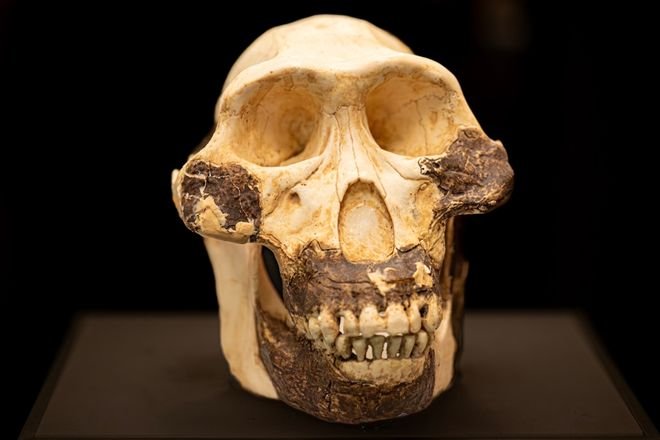
These Two Ancient Human Species Lived in Tandem Around 2.8 Million Years Ago
The period between 3 million and 2 million years ago was a transformative time in human history — it was back then that the genus Australopithecus led to the genus Homo, a new branch in the hominin family tree. But Australopithecus didn’t disappear the instant that Homo appeared in the fossil record. For a time, these two lineages lived together, sharing the landscape of northeastern Ethiopia.
Reporting their results in a study in Nature, researchers have found fossils at a northeastern Ethiopian site that show that a previously unknown species of Australopithecus and a previously known species of Homo — the oldest in the fossil record — lived alongside one another around 2.8 million and 2.6 million years ago. The fossils, which include 13 fossilized teeth, suggest that human evolution isn’t a single straight line from one genus to the next, but something much more complex.
“This new research shows that the image many of us have in our minds of an ape to a Neanderthal to a modern human is not correct — evolution doesn’t work like that,” said Kaye Reed, a study author and a paleoecologist at Arizona State University, according to a press release. “Here we have two hominin species that are together. […] Human evolution is not linear — it’s a bushy tree.”
Read More: Fossils Reveal How Ancient Human Relatives Used Their Hands For Climbing and Tools
New and Old Hominins
Nestled between the Ledi and Geraru rivers in the Afar Region of Ethiopia, the Ledi-Geraru site has hosted several significant finds, including fossils from the oldest member of the Homo genus — a mandible and teeth from about 2.8 million years ago — and tools from about the same time.

Ledi-Geraru paleontological team searching for fossils in the Lee Adoyta Basin where the genera Australopithecus and Homo have been recovered.
(Image credit: Kaye Reed/Arizona State University
These previous finds suggest that the site was occupied by a species from the Homo genus a long, long time ago. But the 13 teeth complicate the history of humans at this site, suggesting that Homo weren’t the only hominins to call this area home. Indeed, while some of the 13 teeth come from Australopithecus (probably a separate species from “Lucy,” the famous Australopithecus afarensis fossil from Ethiopia), others came from Homo, solidifying the fact that our own genus really did live at this site 2.8 million years ago.
“The new finds […] confirms the antiquity of our lineage,” said Brian Villmoare, another study author and an anthropologist at the University of Nevada, Las Vegas, according to the release. “We know what the teeth and mandible of the earliest Homo look like, but that’s it. This emphasizes the critical importance of finding additional fossils to understand the differences between Australopithecus and Homo, and potentially how they were able to overlap in the fossil record at the same location.”
Read More: Oldest Australopith Skull Raises Questions About Hominin Evolution
Retelling Human History With Teeth and Ash
While there are a number of ways to date teeth, the team took a volcanic approach, turning to the traces of volcanic ash scattered throughout the site’s sedimentary layers. Because the Afar Region has long been volcanically active, the teeth were buried between two strata filled with volcanic ash and tiny volcanic crystals called feldspars, which the researchers were able to date to around 2.8 million and 2.6 million years ago.

The 13 fossil teeth collected in the Ledi-Geraru Research Area from 2015-2018. The collections at LD 750 and LD 760 localities represent a newly-discovered species of Australopithecus. LD 302 and AS 100 represent early Homo already known from the LD 350 mandible discovered in 2013.
(Image Credit: Brian Villmoare/University of Nevada Las Vegas
“We can date the eruptions that were happening on the landscape when they’re deposited,” said Christopher Campisano, another study author and a geologist at Arizona State University, according to the release. “And we know that these fossils are interbed between those eruptions, so we can date units above and below the fossils. We are dating the volcanic ash of the eruptions that were happening while they were on the landscape.”
The team has already begun studying the enamel of the teeth to learn more about the environment and eating habits of these two types of hominins, which may reveal whether they competed for the same foods a few million years ago. Still, more fossils could provide important insights into these two species and their potential interactions.
“Whenever you have an exciting discovery, if you’re a paleontologist, you always know that you need more information,” Reed added in the release. “More fossils will help us tell the story of what happened to our ancestors a long time ago.”
Read More: New Method Could Unlock Diet, Disease, and Daily Life of Ancient Human Remains
Article Sources
Our writers at Discovermagazine.com use peer-reviewed studies and high-quality sources for our articles, and our editors review for scientific accuracy and editorial standards. Review the sources used below for this article: