
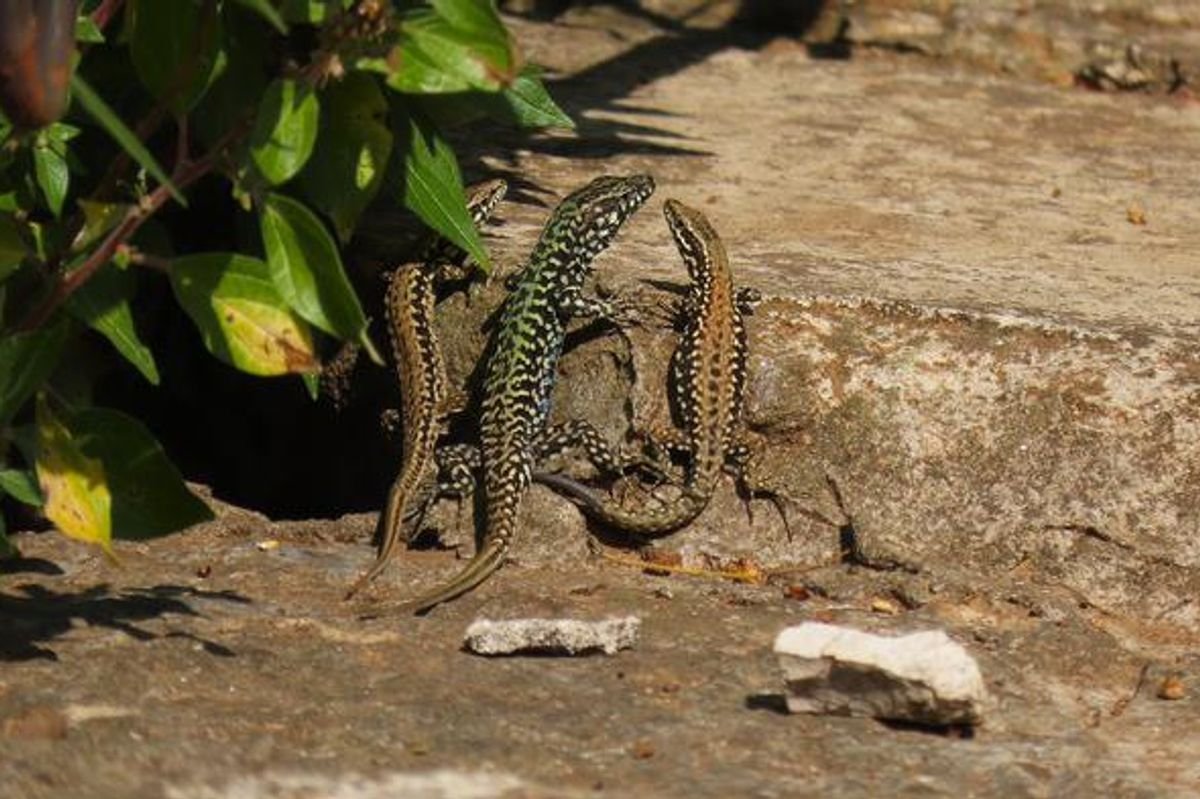
These City-Dwelling Lizards Have a Vibrant Social Life, Often Hanging Out with Friends

For some animals, living in the big city makes socializing a lot easier. Take the common wall lizard, for example; these reptiles don’t always see eye-to-eye with members of their own species in their natural habitat, but in urban areas, they seem to get along with their neighbors just fine.
A new study published in Biology Letters examined the contrasting social behaviors of urban lizards and non-urban lizards, showing how a species can adopt a trusting temperament in urban spaces. Thanks to the layout of urban infrastructure, city lizards have to get used to crossing paths with each other often. It turns out that this does wonders for their social skills, forcing them to be more tolerant than their countryside counterparts.
Urbanization’s Effects on Animals
Urbanization influences the animal kingdom in numerous ways, from disrupting migration patterns to altering reproduction rates. Infrastructure itself presents a major obstacle, but other factors like light pollution and noise pollution also force animals to adapt. Coyotes, bobcats, and deer will even adjust their circadian rhythms to avoid people.
The effects of urbanization on animal social behaviors have been a bit of a mixed bag. While some animals like song sparrows and Cuban rock iguanas exhibit increased aggression in urban areas, others like urban coyotes and coachwhip snakes may exhibit increased tolerance.
The new study aimed to see how the social lives of common wall lizards fared in cities. Researchers found that these city-dwellers were surprisingly social compared to the more standoffish non-urban wall lizards.
“Our findings show that wall lizards in cities maintain many more contacts and develop stronger bonds than their counterparts in natural habitats,” said first author Avery Maune, a doctoral researcher at Bielefeld University, in a statement. “That is remarkable because these lizards are usually highly territorial and tend to avoid one another.”
Read More: Cities Contain Pockets Of Nature – These Species Are Most Tolerant Of Urbanization
Networking for Lizards
In the study, the researchers observed populations of common wall lizards in the Croatian city of Rovinj and in a park 3 kilometers (about 2 miles) away. They marked the lizards with cloth tape that could come off after shedding and observed their interactions over 21 days, watching for social “associations,” which they define as times when lizards were observed within 2 meters (~ 6 feet) of each other.
The researchers then created social networks to map the relationships between lizards. With this method, they found that in urban habitats, common wall lizards built more connections, stayed in closer contact, and were observed in groups more frequently.
The researchers believe this social behavior has likely been shaped by the structure of city environments. Since cities usually have smaller, isolated habitat patches due to infrastructure, the lizards tend to inhabit the same spaces together. The researchers say that unevenly distributed resources like food and sunny spots for basking also push the lizards closer together, forcing them to be more tolerant than they would be in natural habitats.
Learning to Live with Others
Lizards aren’t the only animals that make more friends in the city. A 2020 study published in Mammalian Biology came to a similar conclusion with striped field mice living in urban areas. Monitoring social behavior of the species in urban and rural environments in Poland, researchers found that urban mice had more encounters with each other and were rarely aggressive in these encounters.
The urban mice engaged in a sort of compromise in the presence of food, a result of higher food abundance in cities and a strategy to save energy rather than waste it defending their meals. However, this was observed mostly at night, and not during the day, when the mice were less tolerant due to a greater perceived risk of predation.
These studies show that living in cities can bring some animals — whether it’s lizards or mice — closer together.
Read More: Spiders Will Hunt in Groups and Share Meals if They Have Enlarged Brain Structures
Article Sources
Our writers at Discovermagazine.com use peer-reviewed studies and high-quality sources for our articles, and our editors review for scientific accuracy and editorial standards. Review the sources used below for this article: