
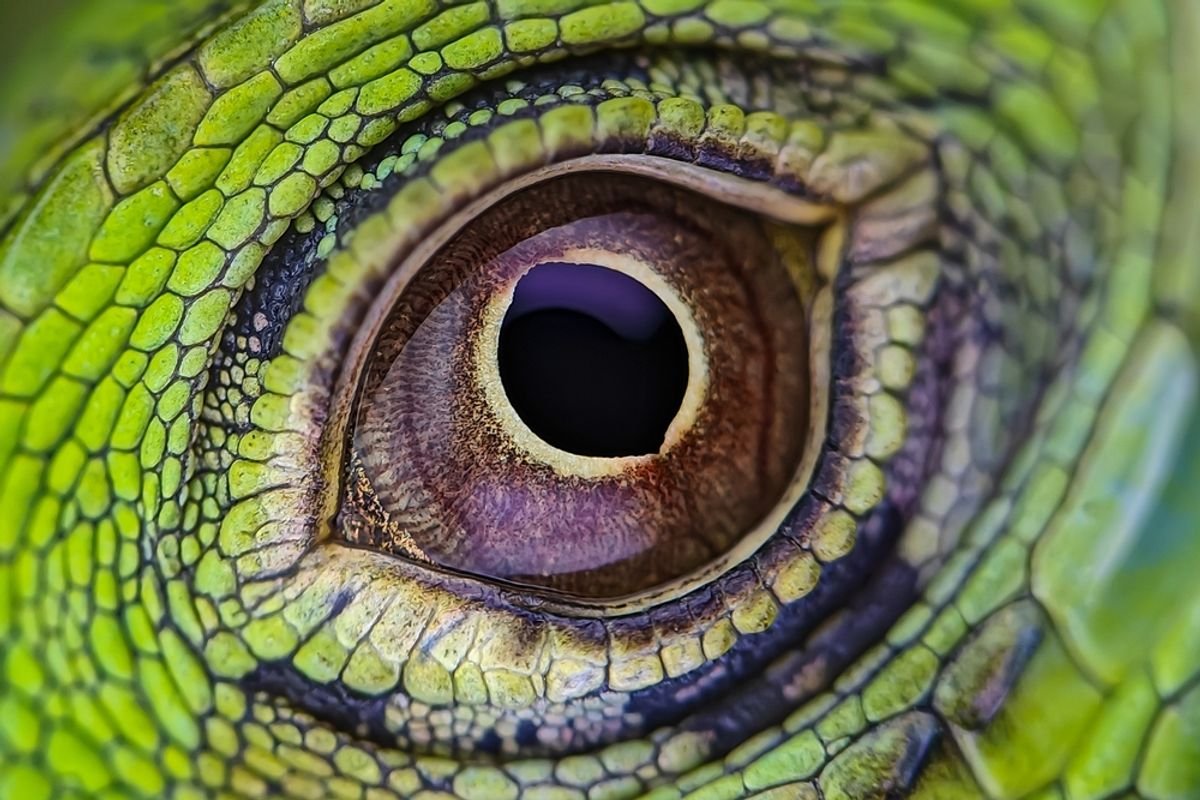
There Is a Rare Disorder Where People See Other Faces as Dragons

In 2011, a 52-year-old woman arrived at a psychiatric clinic in The Hague, the Netherlands, with a rare and peculiar disorder: within minutes of setting eyes on someone, their face would mysteriously morph into that of a dragon.
Researchers described the symptoms in a study published in The Lancet. While the woman was able to recognise faces, according to the study, in just minutes, “they turned black, grew long, pointy ears and a protruding snout, and displayed a reptiloid skin and huge eyes in bright yellow, green, blue, or red.” This wasn’t an occasional occurrence. It would happen multiple times a day.
And it wasn’t just faces that triggered her symptoms. The paper explained: “She saw similar dragon-like faces drifting towards her many times a day from the walls, electrical sockets, or the computer screen, in both the presence and absence of face-like patterns, and at night she saw many dragon-like faces in the dark.”
Testing for Seeing Dragons
These distressing distortions were a lifelong affliction, one the patient recalled experiencing in childhood. She remained unfazed by the dragons initially. Only in adolescence did it dawn on her that those around her did not see people as dragons as she did.
She was able to graduate from high school, secure a role as a school administrator, marry, and have a child.. Still, the condition did lead to experiences of isolation and depression as well as alcohol abuse, and communication issues that made it hard to hold down a job. It was in desperation that she contacted the neurologist Oliver Sacks and came to seek help at the psychiatric clinic.
The team performed a routine gamut of tests: a neurological examination, blood tests, and an electroencephalogram (EEG) — all of which came back normal. Then, the MRI scan returned and showed “only a few” white-matter abnormalities.
The abnormalities (or lesions) were located near the lentiform nucleus, which is associated with cognition and linked to cognitive impairments in schizophrenia, and the semioval centre, which has been linked to sensory abnormalities. The team concluded that the demonic distortions were caused by abnormal electrophysiological activity in regions of the brain related to face and color processing, which lie in the ventral occipitotemporal cortex.
Read More: A Rare Hearing Disorder Can Make Sounds Loud and Uncomfortable
What Is Prosopometamorphopsia?
The dragons are just one manifestation of an incredibly rare condition called prosopometamorphopsia (or demon face syndrome), first described in 1947. Unlike the woman described in the paper, the majority of patients suffer only temporarily. In most instances, it is linked to disorders such as epilepsy or physical changes to the brain. Indeed, it was only after the Second World War and its manifestation in soldiers who had experienced head wounds that it received greater recognition in the scientific community.
Prosopometamorphopsia is one example of Alice in Wonderland syndrome — a group of conditions that involve visual distortions. Others include seeing faces where there are none and perceiving half the visual field as smaller than it really is.
Further examples of prosopometamorphopsia include individuals who see faces transform into fish heads, faces melting, and faces featuring a third or fourth eye. It has even been put forward that the art of Pablo Picasso and Francis Bacon suggests they could have experienced the condition at some point in their lives.
Finding the Right Treatment
The trip to the clinic was life-changing for the woman described in the case study, who was taken off her medication, provided with psychoeducation, and prescribed 300 mg of valproic acid a day.
After an initial hiccup — the treatment was changed to 3 mg of rivastigmine a day after the valproic acid caused her to hear loud bangs in her sleep — the treatment, according to the study, “kept visual symptoms sufficiently under control for her to function normally.”
Read More: 5 Rare Mental Conditions You May Not Know About
Article Sources
Our writers at Discovermagazine.com use peer-reviewed studies and high-quality sources for our articles, and our editors review for scientific accuracy and editorial standards. Review the sources used below for this article: